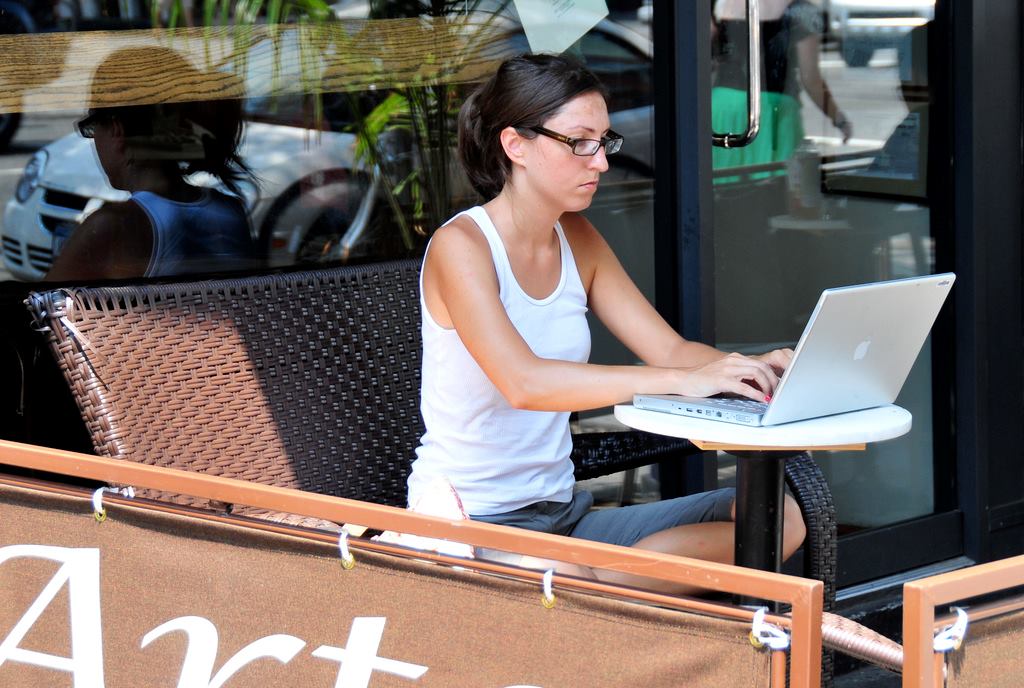
The time I save goes somewhere. Some of it I spend seeing and learning more, some of it meeting face-to-face, and some of it I spend looking at art and architecture. But more time than I am willing to admit turns into the kind of semiengaged social time we now call networking or surfing.
Just as mechanization created weekend and evening free time, so virtualization is creating open time within each day. That time is fragmented and not pure, as more and more socializing and work-related connecting intertwine. It is, however, a new, if invisible, kind of space.
The new interior is also the extension of a move inward that has been going on at least since the dawn of the industrial revolution. As the nuclear family replaced the clan or large social entity, and the work group became more atomized, we moved inward to hearth and cubicle. There, we found an environment fed by more and more mechanical systems that cocoon us, from air conditioning and heating to electrical lights and even sound controls. The world can come into us via all of the little cables and invisible waves, without us ever having to leave our homes.
So we live in a world that is moving toward a free-floating, information-rich place with few visible definitions in either time or space. It is a place where we are everywhere and nowhere at the same time. Filling that space and outfitting it are now the focal points of our technology and even our culture; even art, as I recently noted in my reports from Kassel and Basel, turns toward the ephemeral and the process-oriented. We fill that space with small things—snapshots and tweets, IMs in various forms, and YouTube videos.
We live, in other words, in an anti-Burnhamian world, in which big plans do not have the power to stir men’s (or women’s) minds, because … jeez … it would be hot out on the Chicago streets right now, and wouldn’t it be more fun to watch a clip of a truly visionary city on YouTube? But is that necessarily a bad thing? Don’t we have more information and more ideas, even if they are virtual? It is only if you hold onto the idea that bigger is better, monumental is more meaningful, and that the “almost” part of beinahe nichts that is the Modernist ideal should disappear. If you are interested in comfort and connection, the small and simple pleasures, and the contingent confusion of human life, then maybe exploring that elusive and half-real space that is opening up all around us might be worthwhile.