A wall of glass vitrines displays common natural artifacts as if they are already rare relics. An immersive tapestry is covered in data concerning climatic changes over time. A translucent, branching sculpture resembles a piece of seaweed at a vastly enlarged scale.
These are a few of the installations in “Broken Nature: Design Takes on Human Survival,” an international exhibition that opened March 1 at the Triennale di Milano. Assembled by Italian curator Paola Antonelli and featuring the works of 22 international participants, the exhibit is an expansive survey of works by artists, architects, scientists, and ecologists aiming to recalibrate our fraught relationship with natural systems. According to the exhibition statement, “Broken Nature” “highlights the concept of restorative design and studies the state of the threads that connect humans to their natural environments—some frayed, others altogether severed.”
The U.S. pavilion, entitled “RECKONstruct,” highlights efforts to improve the environmental performance of material flows. Curated by Russell Fortmeyer, an engineer and sustainability consultant in Arup’s Los Angeles office, the pavilion showcases recent designs by office furniture manufacturer Humanscale and lighting manufacturer Stickbulb in collaboration with Arup, and MIT’s SHINE Program. The exhibit highlights “the materials revolution underway in the United States and invites visitors to immerse themselves in a new circular economy, experiencing its activities in spatial, audial and temporal terms which expose the hidden opportunities of the material life cycle as a call to both collective and individual action,” according to the project description.
Arup
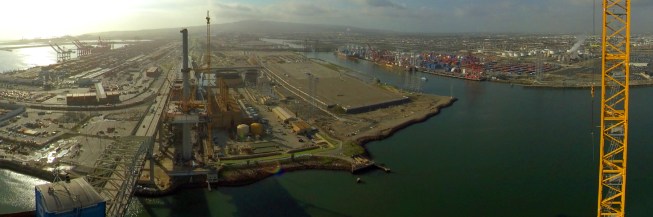
A film still captured from the exhibition RECKONstruct, an immersive film for the U.S. Pavilion at the 2019 Milan Triennale. Pictured is the Port of Long Beach, which,when coupled with the Port of Los Angeles, handles over 40 percent of all in-bound containers for the entire United States.
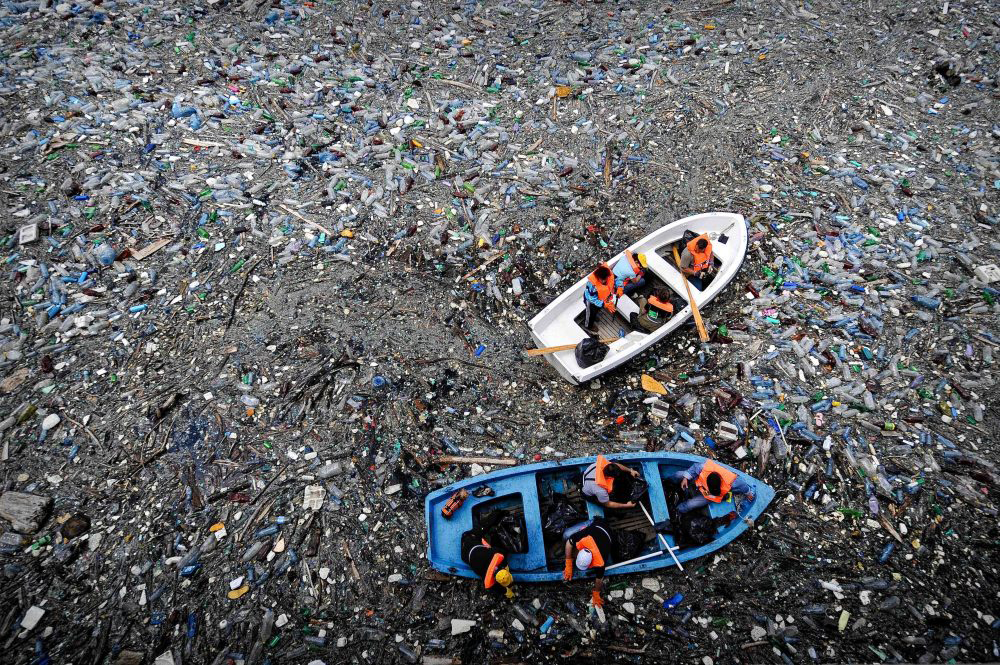
Half of the space is occupied by a 360-degree projection of an immersive video produced by Arup. The narration-free movie begins with what Jane Abernethy, Humanscale’s chief sustainability officer, calls “extraction landscapes” such as a concrete plant, followed by an all-encompassing scene set within a landfill. The visceral experience of being enveloped by anthropogenic debris is thematically connected to another work on display: the UBQ Stool. Designed by Humanscale’s Sergio Silva, this two-legged seat is composed primarily of re-engineered non-recyclable trash. According to material manufacturer Tel-Aviv, Israel–based UBQ Materials, the feedstock is “a bio-based thermoplastic composite made from substantially unsorted municipal solid waste.” Like the other pieces in the U.S. pavilion, the UBQ Stool is surrounded by sample raw ingredients used for its fabrication, including vials filled with landfill waste in various degrees of processing. Such materials provide an indelible link between a seemingly unserviceable substance and the design of new products.
Bureo
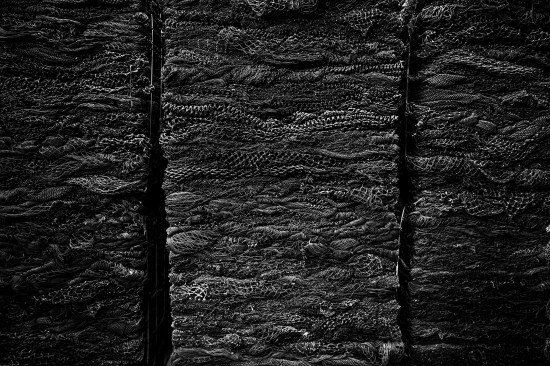
Discarded fishing nets harvested by Bureo for Humanscale's materials supply chain.
Humanscale
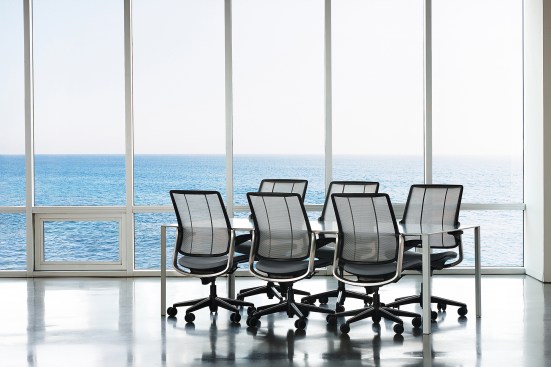
Smart Ocean chair
Humanscale also displayed its Smart Ocean chair, which is made of repurposed plastic from abandoned fishing nets. According to some estimates, fishing nets typically composed of synthetic polyamides like nylon amount to 46 percent of the 79,000 tons of Great Pacific Garbage Patch refuse. In an effort to repurpose this waste, each Smart Ocean chair incorporates nearly 2 pounds of marine nets sourced from Net Positiva, a fishing-net recycling program developed by environmental consultant Bureo in Chile. The “RECKONstruct” exhibit displays a model of Smart Ocean as well as a concept stool made entirely of re-engineered fishing-net plastic. Inspired by the structure of the sea sponge, the Venus Stool is a lightweight 3D-printed scaffold that makes optimal use of this repurposed waste material.
The U.S. pavilion also connects to broader themes introduced by “Broken Nature,” such as the untapped possibilities of using biomass for low-energy, decentralized manufacturing. For example, the installation “Algae Geographies by Algae Platform” by French think tank Atelier Luma showcases the untapped possibilities of using biomass for low-energy, decentralized manufacturing. A collection of works fabricated across Europe including algae-based biolaminates and textiles, the exhibit promotes the strategy to use wetlands as harvest sites for new materials.
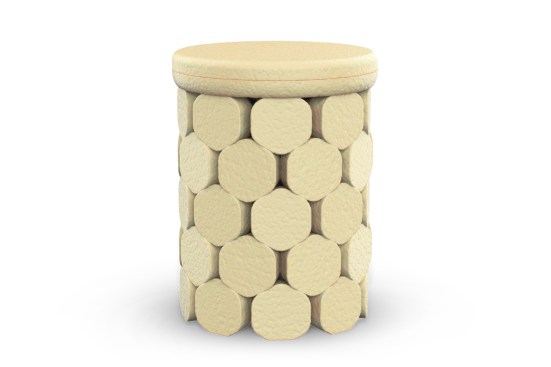
Humanscale
Rendering of a bio-fabricated stool conceived by Humanscale's Paul Sukphisit with Ecovative using mycelium mushroom and agricultural waste.
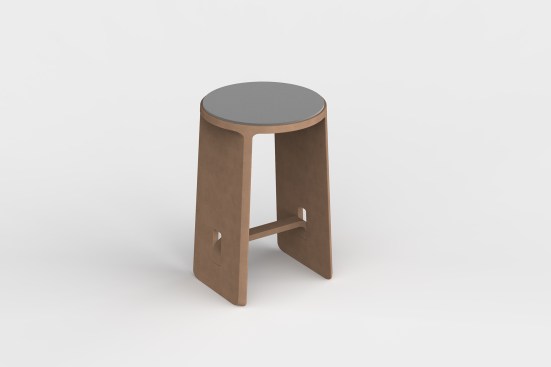
Humanscale
Rendering of a concept stool designed by Humanscale's Sergio Silva using primarily UBQ Materials from reformulated non-recyclable municipal waste.
“RECKONstruct” expounds on this research featuring a prominent recent example from the U.S.—the use of mycelium to grow designed objects. Humanscale partnered with Green Island, N.Y.–based biomanufacturer and “mycelium foundry” Ecovative Design to create the Mycelium Stool. The cylindrical piece is composed of lightweight, hexagonal modules that form a radial honeycomb structure topped by a solid disk—all pieces of which are made with Ecovative’s mycological biocomposite material. The low-impact concoction of agricultural byproducts and mycelium roots not only requires minimal energy but also absorbs carbon dioxide. According to Abernethy, the Mycelium Stool is so ecologically friendly that its most significant environmental impact is the transportation required for its shipping.
Other contributions to “Broken Nature” include an impressive 15-foot-tall sculpture made of disposed batteries by Czech artist Krištof Kintera in an exploration of land-bound waste; and screenings of the 2018 documentary film Albatross by American photographer and environmentalist Chris Jordan who chronicles the “stunning environmental tragedy” caused by the proliferation of waste plastic in the world’s oceans. Specifically, the movie reveals the extent of damage wreaked among the albatross population of Midway Island in the North Pacific. According to Jordan, “We and our team photographed and filmed thousands of young albatrosses that lay dead on the ground, their stomachs filled with plastic.”
Of the various approaches taken by Milan Triennale exhibitors, the U.S. pavilion team represents a positive demonstration of applied research in combating environmental degradation. Not all participants convey such an uplifting message. Indeed, the irrepressible advance of global warming and unceasing ecological devastation form a sobering backdrop for a celebration of human creative achievement. The exhibition will thus likely leave viewers with a sense of discomfort and distrust in design’s potential impact. Even the aspirational RECKONstruct exhibit paints an excessively glowing picture: as Abernethy admits to ARCHITECT, all pieces save the Smart Ocean are merely concepts and may never be commercialized. So, can design really save us or is it too late?
There is at least one glimmer of hope. When offered the opportunity to pilot a line of ecologically friendly Humanscale furnishings featured in RECKONstruct, “the designers and engineers were way more engaged and excited about it than I was expecting,” Abernethy says. She witnessed her team ask more questions, take initiative more quickly, and be significantly more proactive than in typical situations. Thus, the enthusiasm of today’s designers—and the opportunities that can fuel their drive—provide the optimism we need in an otherwise somber time.