






Lily Idov
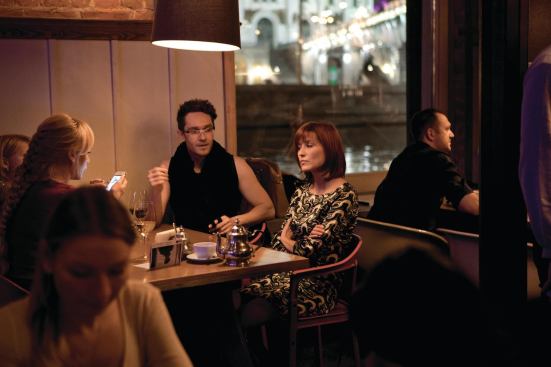
Amid the businessmen and other locals who flock to the restauran…
The pace at Strelka is accordingly brisk, with students launched into an immersive nine-month program. In the first semester, students largely work and study as a single unit, participating in workshops such as “Ideal Place,” and absorbing voluminous reading packets assembled by instructors. During the second semester, the class is divided into a series of focused sub-studios to tackle an aspect of that year’s overarching theme (the 2012 incarnation is “Agents of Change”), with the students reassembling occasionally in a class-wide “Studio Generale.”
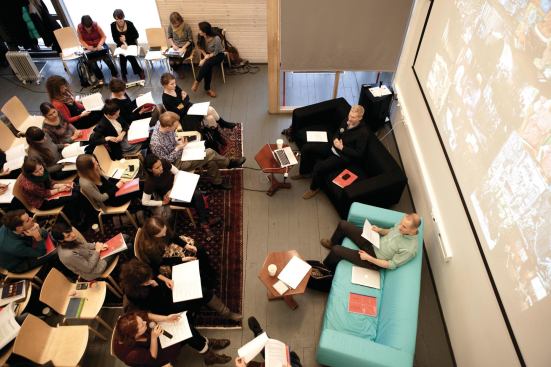
At the end of the term, the students come together one last time for a symposium, typically open to the public, in which each discusses his or her contribution to their respective studio projects. All in all, the educational regime at Strelka is nimble but by no means light, with students routinely showing up around 10 a.m. and not wrapping up till 8 p.m. or later.
The net effect, according to current student Alexey Mityaev, is “like LSD.” Twenty-seven years old and a native Muscovite, Mityaev says his initial weeks at Strelka have been rewardingly bewildering, scrambling his expectations of design and its potential. “It’s a ticket to a train, and you don’t the know destination until you jump on it,” he says.
The open-ended curriculum means there’s no knowing what students like Mityaev will take away, or how it will serve their professional lives. Many don’t even aspire to be architects at all—Ilya Oskolkov-Tsentsiper cites a 40 percent target rate for students without design backgrounds, with the program especially recruiting grads in fields such as economics and art. Diversity in the program is also bolstered by the array of student nationalities, from Polish to Indian to Swedish to American. Proficiency in English is required, and when Russophone lecturers turn up, the whole class is outfitted with headsets for simultaneous translations—something akin to a very eccentric meeting of the U.N.
One late October afternoon, a detachment of students with a translator in tow followed Kuba Snopek, a Polish-born urbanist and Strelka tutor, and local historian Denis Romodin on a tour of some of the imposing, Soviet-era residential blocks outside central Moscow. A sprinkling of snow covered the panel-built monoliths first erected in the Khrushchev years, mile upon mile of them set in vast parklike landscapes. These microrayons, or mini districts, have been fodder for copious urban analysis at Strelka both this year and last, as tutors and students have delved into the mixed legacy of social housing in Russia and considered new interventions to improve it.
“What I want people to see,” Snopek says, “is that these areas are not all the same. Each has individual qualities and its own history.” Snopek has even gone so far as to prepare an application for a number of Moscow’s microrayons to receive UNESCO World Heritage Site status.
The complex urban environment of the city, population 11 million, is not only an object of study for the institute, but a theater of operations. Earlier this year, OMA deployed Strelka researchers and resources in a competition to help plan a 600-square-mile region newly annexed by the city from the adjacent province. Since then, Koolhaas himself has departed from his de facto deanship, to pursue a new book project for which he’s conscripted a number of Strelka grads.
His departure, reportedly amicable (Koolhaas did not respond to an interview request in time for publication), signals a shift at the institute from his research-centric approach to one that favors more real-world problem-solving. Co-director Erixon argues that Strelka’s outside engagement has already yielded bona fide results, exerting a measurable influence on the urbanist discourse in Russia well beyond the design community. “When we started,” Erixon says, “the phrase ‘public space’ did not exist in Russia. Everywhere they talk about public space now. The mayor is running a conference on it.”