

You’ve seen ARCHITECT in print and online, but have you heard us? You can now, loud and clear, with our new podcast, ArchitectChats. Here, our editors talk with the people who are working at the cutting edge of design, technology, and practice in architecture. We’ll talk with them about what they’re doing, where they’re headed, and how you can learn from it.
In a study lost to the annals of architectural history, 40 of the 20th-century’s most prominent architects were invited over the course of a few weekends in the late 1950s to the University of California, Berkeley, where they were evaluated for their presumed creative genius. The researchers, from the school’s Institute of Personality Assessment and Research (IPAR), wanted to know how factors in a person’s life and environment shaped their creative aptitude. Particularly intrigued by architects for their mix of design and business savvy, the researchers attempted to get inside the minds of Eero Saarinen, Louis Kahn, Philip Johnson, I.M. Pei, FAIA, and others. The study received significant media attention at the time it was undertaken, but little on it was ever published, and what it determined about creativity in general and in architecture specifically was unearthed only recently.
In his book, The Creative Architect: Inside the Great Midcentury Personality Study (The Monacelli Press, 2016), Pierluigi Serraino, AIA, revisits the study and its implications. We talked with the Alameda, Calif.–based architect and author about what he learned during his research, and whether a similar attempt at understanding the minds of the world’s leading architects could be executed today.
Episode 9: Pierluigi Serraino on Creativity in Architecture. [SoundCloud] + [iTunes]
This episode was produced by Hallie Busta and Austin Heller.
We’re rolling out new episodes twice a month, so check back here, on SoundCloud, and in the iTunes Podcast Store for the latest. You can also find us on Stitcher and PocketCasts.
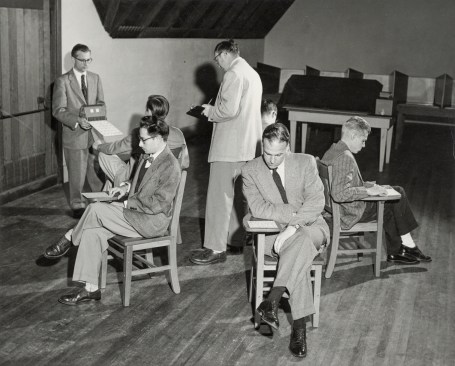
Courtesy Institute of Personality and Social Research, University of California, Berkeley / The Monacelli Press
The IPAR staff simulating a situational procedure involving group interaction, in this case, the Bingo Test.
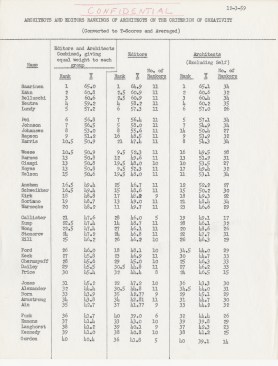
Courtesy Institute of Personality and Social Research, University of California, Berkeley / The Monacelli Press
The architects participating in the study, as well as a panel of architectural magazine editors, ranked their fellow architects "on the criterion of creativity."
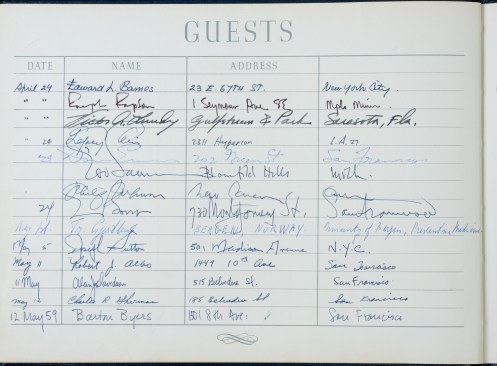
Courtesy Institute of Personality and Social Research, University of California, Berkeley / The Monacelli Press
Signatures in the guest book that participant architects signed at the Berkeley house in which the study was conducted.
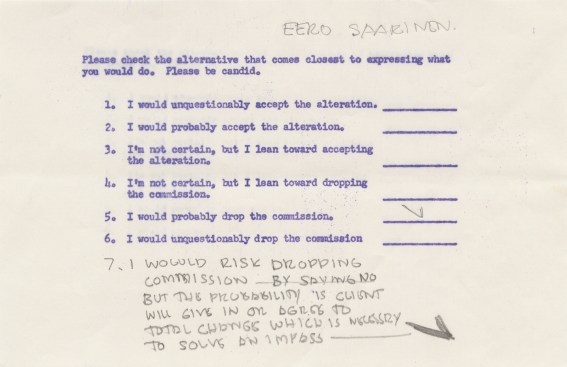
Courtesy Institute of Personality and Social Research, University of California, Berkeley / The Monacelli Press
Eero Saarinen's response to the Ethics Problem, in which participant architects were asked to discuss how they would handle the situation of a client demanding a significant, late-stage design change in a project.

Courtesy Institute of Personality and Social Research, University of California, Berkeley / The Monacelli Press
In another of the study's tests, the architects were each asked to arrange colorful tiles into a design; Philip Johnson's is shown above.