U.Va.'s Design Trust (left to right) W.G. Clark, Karen Van Lenge…
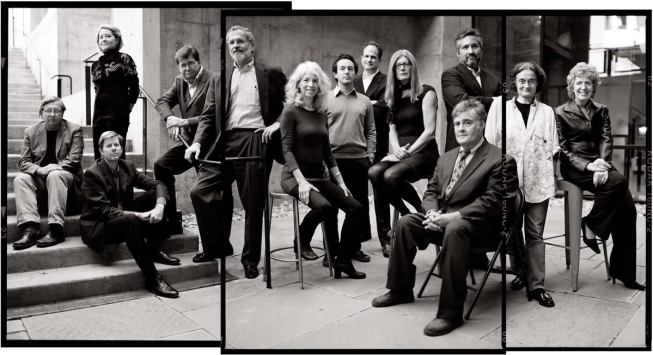
U.Va.'s Design Trust (left to right) W.G. Clark, Karen Van Lengen, William Sherman, Warren T. Byrd Jr., Willard Scribner, Lucia Phinney, Joshua Stastny, Jeff Bushman, Robin Dripps, Anselmo Canfora, Peter Waldman (seated), Sandra Illescu, Judith Kinnard
Maxwell MacKenzie
CAMPBELL HALL, THE UNIVERSITY OF VIRGINIA
Faculty Architect: W….
CAMPBELL HALL, THE UNIVERSITY OF VIRGINIA
Faculty Architect: W.G. Clark
Architect: W.G. Clark Associates—Joshua Stastny, Azadeh Rashidi
Architect of Record: SMBW Architects—Willard Scribner, Bland Wade, Rab McClure, Ron Wolfe, Gwen Logan, Josh McCullar, Nicole Truitt, Yalin Uluaydin, Bronwen Warner, Andrew Cocke
Structural: Fox & Associates
Civil Engineer: Draper Aden Associates
M/E/P: Hurd & Obenchain
Box Kite Design/Metal Fabrication: Charles Yeager
Lighting: Mark Schuyler LC
Contractor: Donley's Construction
Maxwell MacKenzie
Pinup Space
The north façade is a collage of clear and translu…
Pinup Space
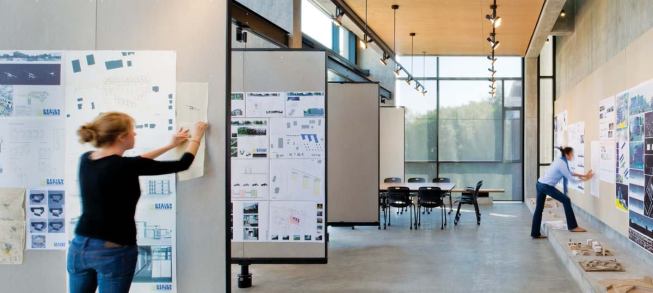
The north façade is a collage of clear and translucent glass. Inside, a series of rotating panels provides pinup surfaces on both sides. The panels turn and lock into position at 90-degree intervals on steel mechanisms, a solution Clark likens to Thomas Jefferson’s mechanical inventions at Monticello. Cherry benches are strategically located in each review room. On the second floor, one bench sits in front of a transparent north-facing window, where students’ models will be put on display.
Maxwell MacKenzie
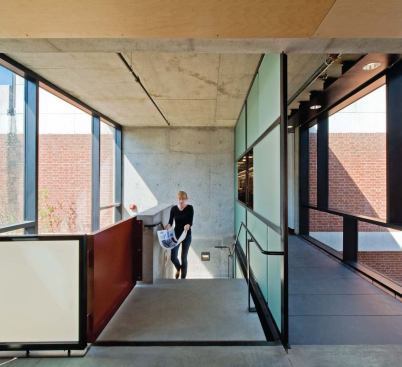
Connector bridge
The tower connects to the existing building by…
Connector bridge
The tower connects to the existing building by a bridge paved with Buckingham slate.
Maxwell MacKenzie
EAST ADDITION (VICTOR AND SONO ELMALEH WING), 2008
Designed b…
EAST ADDITION (VICTOR AND SONO ELMALEH WING), 2008
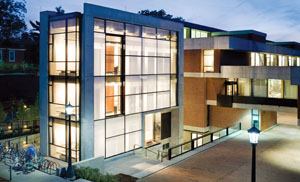
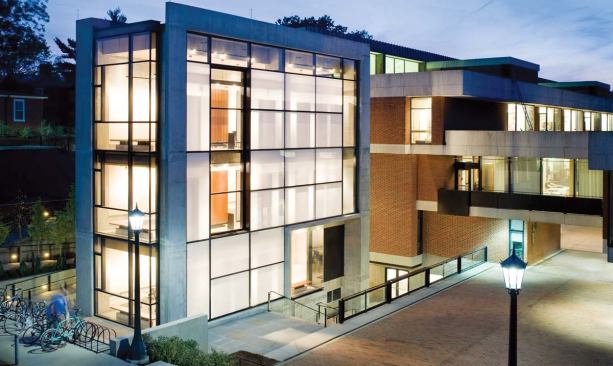
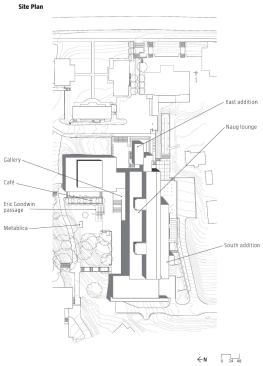
Designed by W.G. Clark in collaboration with SMBW Architects, the East Addition—a slender, four-story pavilion—is a new icon for the campus. Its east façade thrusts toward Rugby Road, a busy pedestrian route, dressing up the back-of-house image that has characterized this approach to the building for decades. Designed primarily to increase the School of Architecture's space for pinups, the addition includes three loftlike rooms with concrete floors, maple ceilings, and expanses of glass that allow passersby to view the activity inside. “The review room is an extension of the teaching experience,” Clark says. “I wanted the building to show what we do.”
Site Plan
NAUG LOUNGE, 2009
Working with New York designer Joel Sanders, …
NAUG LOUNGE, 2009
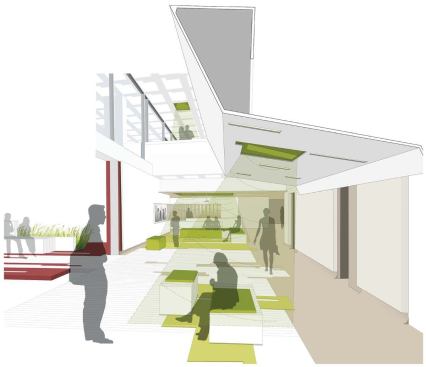
Working with New York designer Joel Sanders, Van Lengen herself is turning this double-height space into a hub where students can plug in an iPod to share music, tune in to a real-time lecture on campus, or select a channel that captures sounds of nature on campus.
Faculty Architect: Karen Van Lengen
Architect: Joel Sanders Architect_Joel Sanders, Chris Kitterman
Maxwell MacKenzie
VICTOR AND SONO ELMALEH GALLERY, 2002
The first "Campbell Const…
VICTOR AND SONO ELMALEH GALLERY, 2002
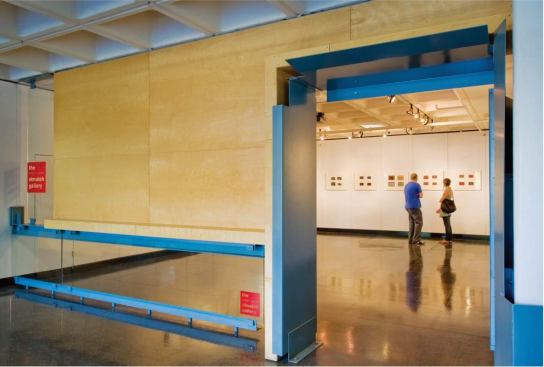
The first "Campbell Construction," this small project revamped the school's original entrance and created a new lobby gallery.
Faculty Architect: Tim Stenson
Student Assistants: Jim Kovak, Kirk Jensen
Steel Fabricator: Virginia Industrial Services
Maxwell MacKenzie
METABLICA, 2004
This student project, guided by professor Willi…
METABLICA, 2004
This student project, guided by professor William Sherman, produced three folded stainless steel tables that promote activity around a brick courtyard.
Student Design Team: Meredith Epley, Justin Hershberger, Nathan Petty, Elizabeth Shoffner, Michelle Shuman, Katie Spicer
Steel Fabricator: Lauren Danley
Finish: Roger Sherry, Plank Road Studio
Maxwell MacKenzie
ERIC GOODWIN PASSAGE, 2004
As a memorial to a member of the cla…
ERIC GOODWIN PASSAGE, 2004
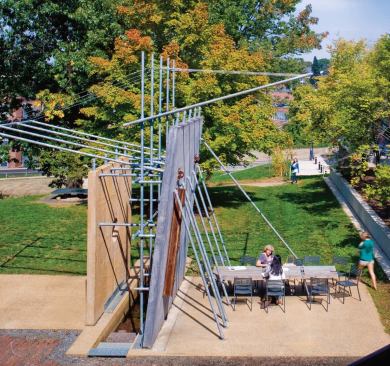
As a memorial to a member of the class of 2002, a pair of outdoor classroom spaces was erected by professor Peter Waldman's design/build studio. The construction—composed of two tilt-up concrete walls flanking a narrow passageway—is a study in opposing themes.
Faculty: Architect Peter D. Waldman
Student Design Team: Sam Beall, Justin Walton, Jennifer Findley, Daniel Wilken
Concrete Work: Allied Concrete
Maxwell MacKenzie
FINE ARTS CAFÉ, 2008
Designed by associate professor Judith Ki…
FINE ARTS CAFÉ, 2008
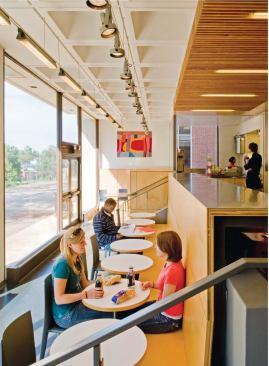
Designed by associate professor Judith Kinnard, this project took an uninspired snack bar—little changed since the 1970s—and injected it with energy. New materials wrap the existing concrete shell to provide spatial definition and social connections.
Faculty Architect: Judith Kinnard
Architect of Record: University of Virginia
Lighting Consultant: Mark Schuyler LC
LANDSCAPE, 2008
The additions to Campbell Hall provided an oppo…
LANDSCAPE, 2008
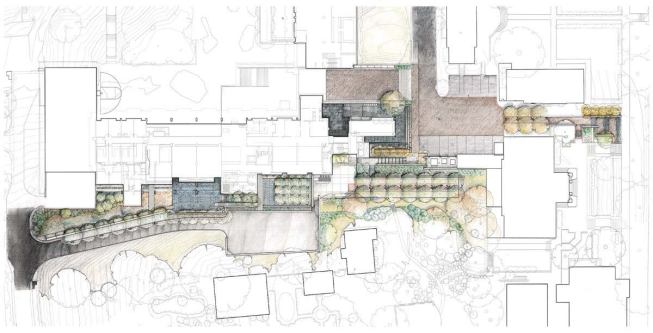
The additions to Campbell Hall provided an opportunity to reconnect the school to its immediate surroundings. Warren Byrd, former chair of the school's department of landscape architecture and a principal of Nelson Byrd Woltz Landscape Architects of Charlottesville, created a series of new and adapted landscapes that are expressive of regional hydrology, geology, and ecology. One of these, the Woltz Bioretention Garden, is a demonstration garden that addresses erosion and removes impurities from rainwater as it flows from the site. "There was always an intention that this would be a teaching landscape," says Byrd.
Faculty Landscape Architect: Warren T. Byrd Jr.
Landscape Architect of Record: Nelson Byrd Woltz Landscape Architects—Todd Shallenberger (senior project manager); Thomas Woltz, Serena Nelson, Emmanuel Didier, Sophie Johnston, Sara Osborne, Michael Stouse, Jason Kreuzer, Dan Norman, Anne Samuels (project team)
Architect of Record: SMBW Architects
Structural: Fox & Associates
Civil Engineer: Draper Aden Associates
M/E/P: Hurd & Obenchain
Maxwell MacKenzie
SOUTH ADDITION, 2008
Designed by associate dean William Sherman…
SOUTH ADDITION, 2008
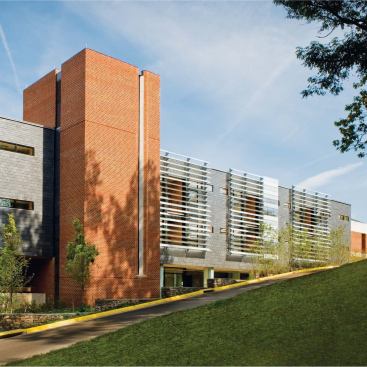
Designed by associate dean William Sherman in collaboration with SMBW Architects, the South Addition adds 26 new faculty offices to the building—a boon in a school whose faculty has tripled since the building’s completion. The addition’s adjacency to the design studios on the third and fourth floors (the faculty had previously been segregated on the lower levels) greatly improves communication with students. “It’s a way to reorganize the way the institution works, as well as the interaction between faculty and students,” Sherman says.
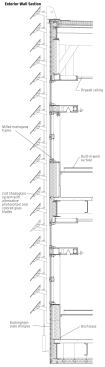
The south façade reflects Sherman’s interest in buildings that respond to climate. The exterior wall incorporates a louver system that combines frosted and clear glass panels that open and close in response to the sun’s movement. Open during the day, they admit light directly into the building; closed at night, they trap the accumulated day’s warmth, creating a greenhouse effect on the porches that connect faculty offices.
Faculty Architect: William Sherman
Architect of Record: SMBW Architects
Structural: Fox & Associates
Civil Engineer: Draper Aden Associates
M/E/P: Hurd & Obenchain
Contractor: Donley’s Construction
Maxwell MacKenzie
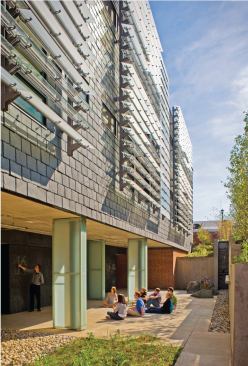
Outdoor classroom
Outside, a recessed area carved out of the fi…
Outdoor classroom
Outside, a recessed area carved out of the first floor provides two outdoor classrooms.
Maxwell MacKenzie
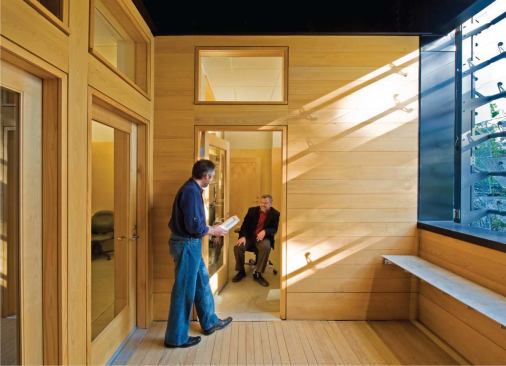
Porch connecting faculty offices
The offices are clustered in g…
Porch connecting faculty offices
The offices are clustered in groups of four around a vestibule that forms small communities of interdisciplinary faculty, and two new classrooms on the southwest corner add needed instructional space.
Exterior Wall Section
When Karen Van Lengen arrived at the University of Virginia (U.Va.) in 1999, the School of Architecture she joined as dean was full of talented people and fresh ideas. But the building it occupied, Campbell Hall, was sorely lacking in space for reviews, classes, and staff. The four-story concrete-and-brick facility, which was designed by Pietro Belluschi and opened in 1970, had been criticized by the National Architectural Accrediting Board. “There was a huge accreditation issue,” Van Lengen says. “I had to do something about it immediately.”
Even perceptually, the physical environment was lifeless. So, launching an initiative called “Campbell Constructions,” Van Lengen seized the opportunity to upgrade the building. Instead of hiring a name-brand outsider, her stratagem was to provide design opportunities for the U.Va. faculty. Starting with a rather modest gallery renovation, Van Lengen quickly moved on to bigger projects. A feasibility study by Bushman Dreyfus Architects, of Charlottesville, set the stage for three larger-scale projects—two additions and a new landscape plan.
Van Lengen worked with U.Va.’s provost to pay the faculty for their design work with summer salaries and stipends. She also insisted that the more ambitious projects be managed by an architect of record: SMBW Architects of Richmond. In addition to the logistical hurdles, there were political battles to win—in particular, with the conservative Board of Visitors’ predilection for traditional design schemes that cater to “Jeffersonian” precedents. “It was a hard sell,” says Van Lengen. “But we did it” Van Lengen also raised most of the $15.5 million cost of the three largest projects. A host of other, smaller initiatives was supported by private funds or university resources.
Van Lengen, who is resigning in 2009 after 10 years on the job, couldn’t be more pleased with the legacy she will leave. “Not only did we use our own family to make our own space, but we did it in a way that is not about image,” she maintains. “It’s about how we live together to develop more dialogue, more innovation, and more opportunities.”