
courtesy NOMA and NCARB
The National Organization of Minority Architects and the National Council of Architectural Registration Boards have published the latest findings of their seven-part “Baseline on Belonging”, report, which examines “diversity and attrition” along the path to architecture licensure, according to a joint press release. Previously, NOMA and NCARB released an overview and a section titled “Experience.”, the first two Baseline on Belonging sections, in 2020, which focused on the impacts of race, ethnicity, gender, age, and firm size on the professional experience requirement for the Architect Registration Examination, a six-part exam required for licensure in the U.S. The report’s third section, “Examination,” focuses on the test itself, finding inequalities for candidates of color and candidates over 40 years old.
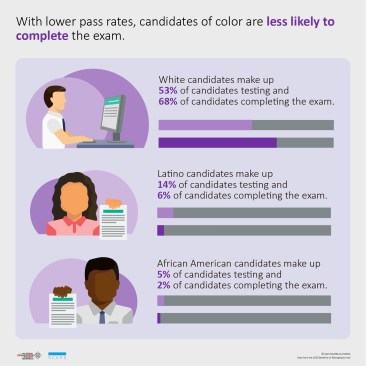
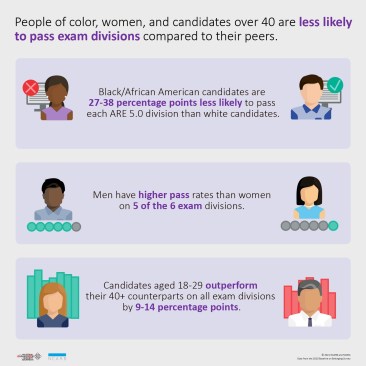
NOMA and NCARB invited approximately 70,000 targeted NCARB record holders and all NOMA members to participate in their survey, administered between Feb. 19 to March 4, 2020. From 6,902 complete or partial responses, the organizations found that people of color, women, and candidates over 40 are less likely to pass exam divisions than their peers. Black or African American candidates, who make up 5% of test takers and 2% of candidates completing the exam, are 27 to 38 percentage points less likely to pass each ARE 5.0 division than white candidates. Latino individuals make up 14% of test takers and 6% candidates completing the exam, and white individuals make up 53% of test takers but 68% of candidates completing the exam. Men generally outperform women on five of the six ARE exam divisions; however, Black or African American women tend to outperform Black or African American men on the exam.
courtesy NOMA and NCARB
courtesy NOMA and NCARB
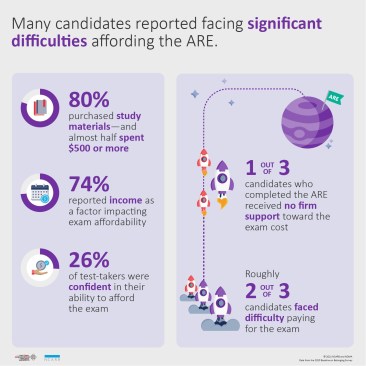
“Examination” also notes the ARE’s significant financial burden. Only 26% of individuals who have already taken one ARE division are confident in their ability to afford the remaining exam divisions, and approximately one-third of exam takers report not receiving firm support toward the cost of the exam. Two-thirds of candidates reported difficulty paying for the exam, and 80% reported personally purchasing study materials, with 42% spending upwards of $500.
Although two-thirds of respondents reported receiving firm support toward the cost of the exam, African American and Latino respondents were 7 and 9 percentage points, respectively, less likely to report their firm would contribute to the cost of the exam than their counterparts. African American and Latino respondents who had completed the exam were 5 and 6 points, respectively, more likely to report that they never received financial support from their firms.
courtesy NOMA and NCARB
courtesy NOMA and NCARB
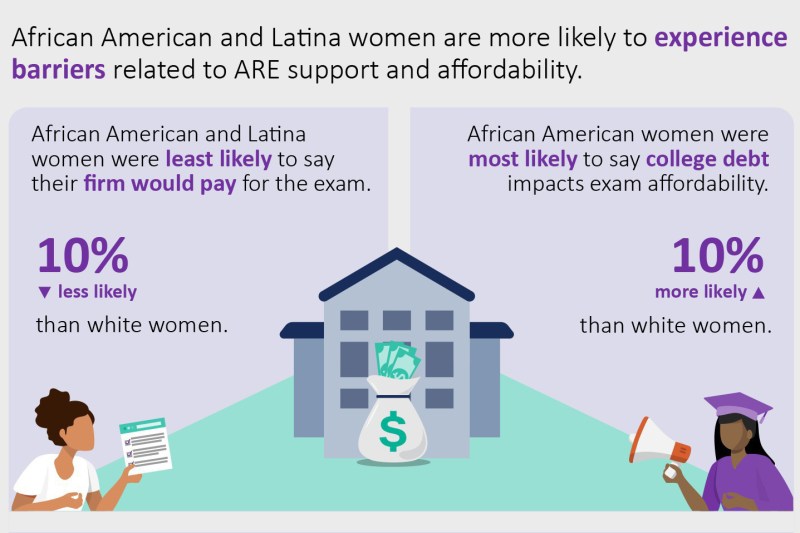
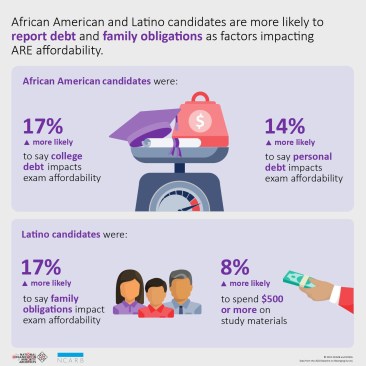
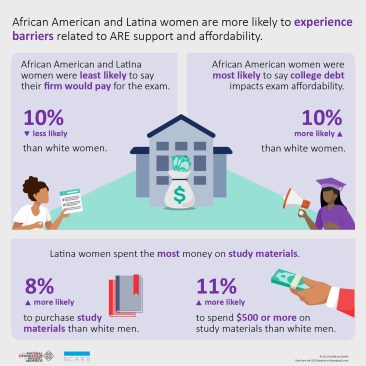
African American and Latino candidates were also more likely to report financial burdens due to the exam. African American candidates were 17 points more likely than their Asian peers to report college debt as a factor impacting ARE affordability, and 14 points more likely than their white peers, to report personal debt as a factor affecting ARE affordability. Latino candidates were 17 points more likely than their white peers to report family obligations as a factor impacting ARE affordability, and they were 8 points more likely than their white or Asian peers to spend $500 or more on study materials. These financial burdens differed among gender, with African American and Latino women 10% and 11%, respectively, less likely than white women to report that their firm would help pay for the exam. African American women respondents were also 10% more likely than white female respondents to report that college debt affected exam affordability.
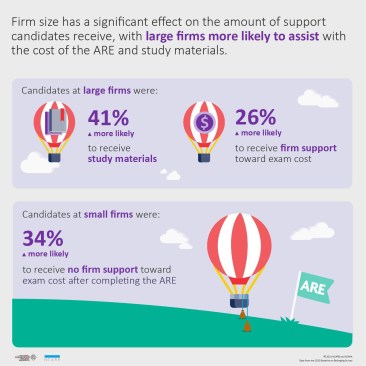
Firm size also played a role in the financial burden. Respondents at large firms were 41% more likely to report receiving study materials and 26% more likely to report receiving firm support toward the exam cost. Respondents from smaller firms were 34% more likely to receive no firm support toward the exam cost.
courtesy NOMA and NCARB
“The disparity in architecture exam pass rates is hard to see, but facing that number head-on empowers us to ask better questions, and create new programs and policies that help ensure a successful career in architecture is both accessible and achievable to those historically marginalized by the process,” said NOMA president and Gensler senior associate Jason Pugh, AIA, in the joint press release from NOMA and NCARB. “The path to licensure is long, non-linear, costly, and strenuous, but even more so without the appropriate milestones to benchmark successes for people of color—and most drastically for Black and Latina women.”
NOMA and NCARB began their report in early 2020, releasing a Baseline on Belonging survey to more than 70,000 individuals who had recently passed the ARE, taken at least one division of the exam, or were preparing to take a division of the exam; 22% of respondents had not begun preparing for the ARE. From that initial survey, NOMA and NCARB collected complete responses from more than 5,000 individuals, a total that included more than 2,800 people of color and nearly 2,500 women. The organizations analyzed the responses, taking into account race, ethnicity, gender, age, and firm size.
You can read the full “Baseline on Belonging: Examination Report” here.