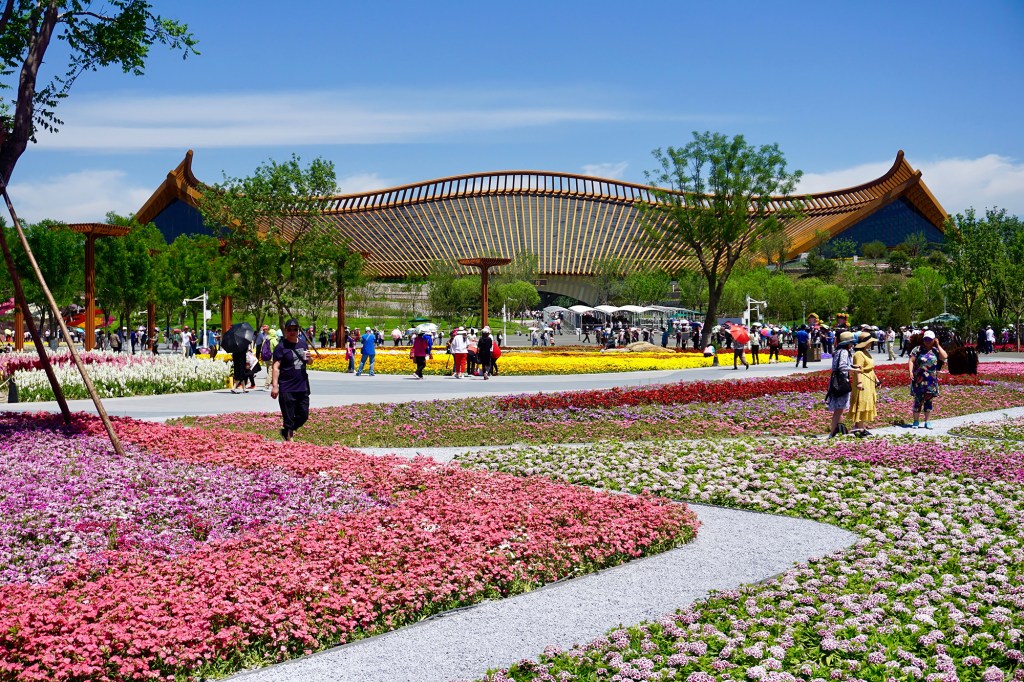
“Live green, live better” is the theme of this year’s World Expo in Beijing. With a thematic focus on garden cultivation and management, the festival is the largest China has hosted since the 2010 World Expo in Shanghai not to mention the largest horticultural show in history according to The Economist.
Located in the Yanqing District less than 50 miles northwest of Beijing, this year’s expo occupies a massive park of more than 2,000 acres—about 150 percent larger than the site of the 2008 Beijing Olympics—and will be open to the public from April 29 until October 7. As of June 3, more than 1.8 million people have visited the attraction, according to Xinhuanet. The expo also commemorates a politically significant milestone for the country: The 70th anniversary of the founding of China’s Communist state. In even broader terms, it symbolizes the latest chapter in humanity’s relationship with—and dominion over—natural systems.
The event invites reflection on less abundant times in the nation’s not-so-distant past. When it was published in 1931, Pearl S. Buck’s acclaimed novel The Good Earth (John Day Co., 1931) exposed Western audiences to the daily trials of Chinese peasant farmers. The book’s protagonist, Wang Lung, faces continual challenges such as droughts, floods, and locust swarms—all of which bring his family to the brink of starvation. Such was the reality of subsistence farming for many at the turn of the century, yet the difficulties Buck chronicled pale in comparison to what would follow decades later.
The Great Famine that occurred between 1958 and 1962 remains the most significant catastrophes in world history, resulting in at least 45 million deaths. Reports of the impoverished and mismanaged agricultural approaches of that time contrast sharply with today’s Beijing Expo. In its dazzling, technicolor profusion of foliage, the festival exemplifies the perspective that humanity finally exerts full dominion over the land. In this way, the exhibition conjures both the hopes and fears of the Anthropocene epoch.
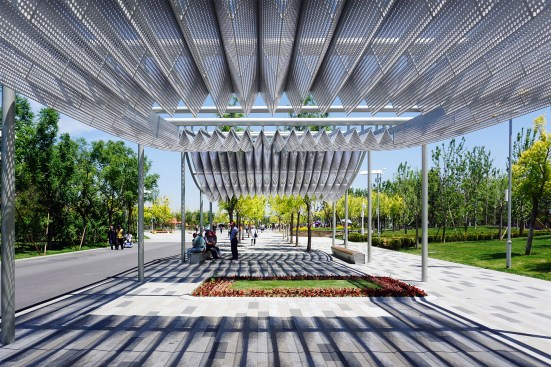
On the positive side, the expo demonstrates successful practices in conservation biology and land remediation. One example are flowers grown from endangered, indigenous varieties of peonies and orchids that scientists from the Chinese Academy of Agricultural Sciences have been painstakingly collecting, breeding, and transplanting to their native locations since 2012—the year the country launched a protection program for endangered plants. As a result, specimens of these rare wild organisms are now accessible to the public.
Furthermore, the establishment of the expo grounds was part of a much larger reforestation campaign: more than 1,600 acres of trees were planted in the Yanqing District three years ahead of the event. This represents a fraction of the 26,000 acres of forest coverage that have been expanded since 2012 as part of a regional planting initiative. This effort to create a “green Great Wall”, in turn, is part of a nationwide program to curb the encroaching desertification occurring across northwest China. According to the Chinese government, the nation’s desert-covered area has been shrinking by almost 600,000 acres annually since 2004, due in large part to this endeavor. According to a May article in The Economist, “Officials say China is the first country to have reduced the size of its deserts, and that foreigners could learn from its experience.” This announcement is bold promotional material for an international exposition on horticulture.
Yet, like many China-sized endeavors, the reality of the green Great Wall is mixed. According to Chinese scientists, the project has resulted in a mere 3 percent increase in vegetative cover in the Three North provinces—those with the largest deserts—since 1983. Based on exaggerated statistics and error-prone practices, only 15 percent of the trees planted in this region have survived. In some cases, the effort has actually intensified desertification, such as when incorrectly located trees remove scarce water from local grasslands and other native vegetation.
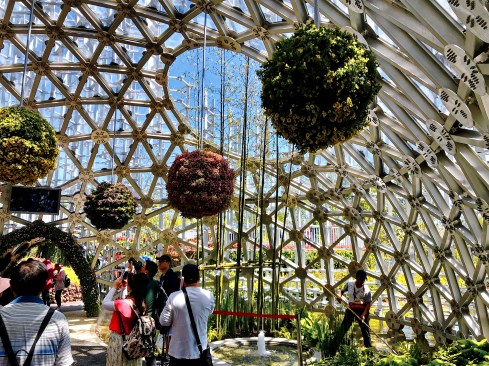
Similarly, questions have arisen concerning the planning and construction of the exposition itself. The government secured its 2,300-hectare site by appropriating farmland, leading to the displacement of hundreds—and perhaps thousands—of residents, with reportedly insufficient compensation. Establishing an immense new park in a historically dry area also required the diversion of water from the remote Yangzi river basin. Never shy when it comes to building infrastructure, Chinese officials approved the construction of a new highway, paved parking for 22,000 cars, and even a tunnel under the Great Wall as part of the project. The expo park’s buildings, pavilions, gardens, and auto-centric infrastructure represent a spectacular investment in materials, energy, and money. Regarding the plants themselves, the sheer number and variety of resource-intensive, high-maintenance, polychromatic specimens paint a picture of theme park–perfection—no weeds, invasive species, or volunteer specimens allowed.
This attainment of the ideal at such an unprecedented scale implies a transformation in the paradigm of horticulture itself, as well as related disciplines such as agroforestry. Traditionally focused on the proximate and tangible, horticulture has conceptually expanded to take on the planet. This global gardening phenomenon is reinforced further by the government’s campaign entitled, “Chinese plants that have changed the world.”
Despite teeming with conservation, the Beijing World Expo remains the opposite of wild. It is instead highly manufactured. The park symbolizes nature relegated to our shadow: We, the stewards of the planet, without whom many of our most popular and highly cultivated plant species would not survive. It is a grand gesture, made with a heavy hand. But does nature require our dominion for its survival? Or is the underlying goal to make ourselves indispensable in a world in which we are dispensable?
Blaine Brownell, AIA, is a regular columnist for ARCHITECT. His views and conclusions are not necessarily those of ARCHITECT magazine nor of The American Institute of Architects.