
This post is part of a monthly series that explores the historical applications of building materials and systems through resources from the Building Technology Heritage Library (BTHL), an online collection of AEC catalogs, brochures, trade publications, and more. The BTHL is a project of the Association for Preservation Technology, an international building preservation organization. Read more about the archive here.
As temperatures fall and days get shorter in the Northern Hemisphere, households around the nation have transitioned from cooling to heating systems to ensure indoor comfort. But as with all technology, it wasn’t always so easy. Below, the BTHL chronicles the technological advancements in heating systems from the late 19th century to the mid-20th century.
The Patented Wrought Iron Air-Tight Furnace for Burning Anthracite and Bituminous Coal, Coke or Wood, J. Reynolds & Sons, Philadelphia, c. 1875
Made from wrought iron plates, these early hot-air furnaces could burn anthracite, bituminous coal, coke, or wood for power. Users could control the temperature using a draft door.
The Johnson Heat Regulating Apparatus in Schools, National Electric Service Co., New York, 1887
This 19th-century thermostat utilized electricity and fluid pressure to control furnace temperatures in educational buildings.
Combination Heaters, by M. Mahony, Troy, N.Y., 1891
Mahony offered a combination hot-air furnace and hot-water heating system. According to the manufacturer, the hot-air system offered superior ventilation, while the hot-water heating system distributed heat better.
Healthful Heat, Homer Furnace Co., Homed, Mich., c.1910
To utilize the Homer furnace was a gravity system, homeowners were required to install the apparatus in their basements and assemble first-level flooring with openings or slats that allowed hot air to rise throughout the house. While the system was pipeless, some versions offered limited piping runs to directly heat spaces like a bathroom.
International Queen Warm Air Furnace, International Heater Co., Utica, N.Y., 1914
According to this catalog, “Scientific experts all agree that an abundant supply of fresh air is absolutely essential in the home.” Unlike boiler stoves, furnaces introduced fresh air into a house.
Boomer Furnaces, Hess Snyder Co., Massillon, Ohio, c. 1920
This catalog includes equations for calculating the furnace and ductwork size for a single basement furnace serving a house or small building. For schools, the furnace required an outdoor air intake for maximum ventilation.
The Reed Furnace Filter Keeps Walls, Drapes, & Furnishings Clean, Reed Air Filter Co., c. 1925
While air filters are an industry standard today, in the early 20th century, they were considered a major advancement for gravity and forced air systems.
The Inside Story of the New Fuel-Saving General Electric Oil Furnace, General Electric Co., Schenectady, N.Y., 1930
This GE oil furnace could be used for hot air and radiator systems with improved burner efficiency. The forced air system could also be utilized with air conditioning, an innovation that entered the market in the 1930s.
Oil Burning Superfex Furnace, Perfection Stove Co., Cleveland, 1939
Perfection Stove Co. offered “24 hour air conditioning,” which meant humidification and a constant airflow utilizing a variable speed fan.
Lennox Special Defense Housing Furnaces; Lennox Furnace Co., Columbus, Ohio, 1942
Housing construction was greatly curtailed during World War II, but defense housing remained a national priority. Lennox offered both gravity and forced air units with coal or gas as the fuel source for these structures.
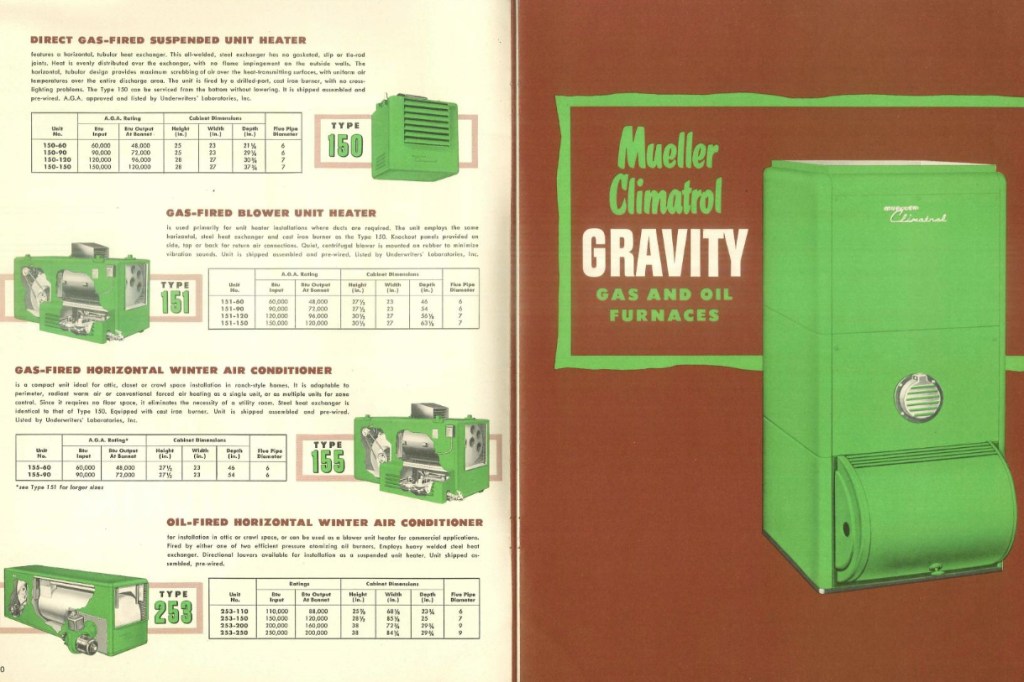
Mueller Climatrol, L.J. Mueller Furnace Co., Milwaukee, 1953
Mueller offered a full line of furnaces with air-conditioning and various fuel sources. They also sold a “conversion unit,” a gas burner that could be installed inside an older coal fired unit for more efficient heating.
Modernaire Gas and Oil-Fired Furnaces, Ohio Furnace Co., Columbus, Ohio, 1962
These furnaces could be operated using gas or oil. The units were designed for placement in the basement, main floor, or overhead installations for greater design flexibility.