



Courtesy HOK
James Cancer Hospital, and Solove Research Institute, and Critic…
HOK’s design for the critical-response center takes the clinical staff’s experience into account. The “off-stage” aspects of the floor—spaces away from patients and families where staff confer, transport soiled materials, and access equipment—include rooms lit by natural daylighting to help alleviate staff stress. “We’re all familiar with the drama for the patients and families,” Chao says, “but if you’re working in the critical care area, day in and day out, that’s stressful.”
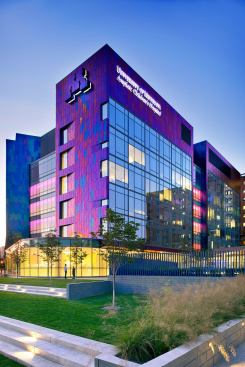
Building in redundancies in crisis-response centers is the main way that designers can help to eliminate waste. Sandra Hagstrom, the advanced-practice nurse leader for the pediatric intensive-care unit (PICU) at the University of Minnesota Amplatz Children’s Hospital in Minneapolis, says that some up-front costs pay for themselves in terms of the improved efficiency for medical staff.
“There is a cost downside when you’re building same-handed rooms that don’t use headwalls. You can’t plumb your walls with electrical and have two rooms with the headwall running between them,” Hagstrom says. The hospital, which was designed by Tsoi/Kobus & Associates (TK&A) with HGA as the local partner, opened in April. It features identical, same-handed children’s critical-care rooms. “You don’t have to stop and think, ‘Is this on the right or left side of the room?’ You can walk in, and you can just intervene.”
In lieu of mounting medical equipment on headwalls, the same-handed rooms employ movable boom mounting to suspend the medical equipment and supplies over the patient—which gives medical staff 360-degree access to patients. The beds are situated in the center of the PICU rooms. Some procedures, such as intubating a patient, are easier to perform from over a patient’s head, Hagstrom says.
The PICU rooms at the new 231,500-square-foot Amplatz Children’s Hospital are larger than those at the old University of Minnesota children’s hospital. At 390 square feet each, the rooms boast almost twice the square footage, but they feature the same number of beds. Hagstrom says that the larger room design has staff running around much less.
“A huge cost is for the nurse not to have to run back and forth. When we received a critically ill patient back from the operating room, there would be a lot of running to get things [in the old PICU],” Hagstrom says. “That’s a critical time for the patient.”
By stationing supplies and equipment in readily and consistently available places in the PICU—and by using glass walls to promote visibility between pediatric units—TK&A’s design saves time for nurses. According to senior principal Rick Kobus, FAIA, nurses who walked an average of 9 miles per day at the old children’s hospital now walk an average of 5 miles per day.
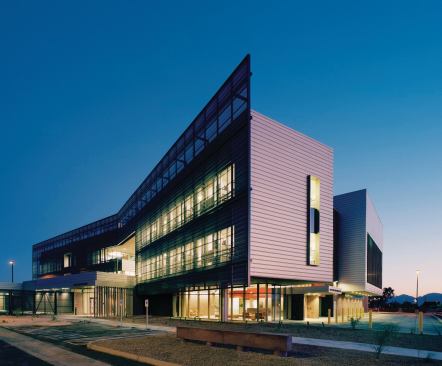
Cannon Design, who designed the Pima County Behavioral Health Pavilion and Crisis Response Center in Tucson, Ariz., worked with an in-house cost-estimation group from the very start of the design stage. “Any design team is going to look at capital costs and work with an owner to come to the right resolution for that particular owner’s circumstances,” says Tim Rommel, AIA, principal at Cannon Design in Los Angeles. The final project cost was a modest $54 million. “We also look at it in terms of operational costs. We looked at it even down to the staffing within the facility itself.”
The 96-bed acute psychiatric hospital, which opened in August, differs from other crisis-response centers by its emphasis on patient and staff safety. “We consider everything from the type of screws or fasteners used all the way down to the layout and efficiency of the room itself,” Rommel says. “The patient’s bedroom is the most dangerous location in a behavioral healthcare unit. That’s where it’s to be expected that a patient will be by herself for an extended period of time.”
Illuminating hiding spaces and providing clear views for staff from the door into the full interior of a room helps to prevent patients from acting out through violence. “When a patient’s in crisis, they’re reaching out. They can injure themselves or others, whether it’s attempting suicide or something else.”
Serenity is another crucial aspect of a behavioral healthcare facility’s interdisciplinary program, and the Pima County Behavioral Health Pavilion and Crisis Response Center buildings face out onto multiple gardens, providing daylight and views to all patients.
The county had specific requirements for different in-patient units. Cannon Design focused on the common denominators between the units to make them as universal as possible. Regularizing the units controls design costs, but it also enhances the value of the Crisis Response Center, whose needs will invariably change.
Crisis-response centers—in particular those providing mental-health services—face rising healthcare costs as well as dwindling public support. As the National Alliance on Mental Illness reported in March, states slashed non-Medicaid funding for mental health services by more than $1.6 billion between 2009 and 2011. Deeper cuts projected for 2011 through 2012 mean that projects today must be designed with the future in mind.
“As those diagnosis groups change over time over the lifetime of the building—whether it’s an adolescent group or geriatric group or forensic group—if we’ve been successful, those units are going to serve the owner satisfactorily or even really well as they change diagnosis groups,” Rommel says, “without having to make changes to the physical environment.”
Note: This story has been updated since first publication to add that Rick Kobus is a fellow of the American Institute of Architects.