
The new Zaha Hadid Gallery exhibit “Meta Utopia – Between Process and Poetry” opens today in London, and will be on display until Dec. 9. Featuring a collection of 46 objects, including furniture pieces and sculpture series realized through digital fabrication methods, each item accents Hadid’s museum’s fluid and innovative forms. The work found in this exhibit aims to go beyond traditional architecture practices—as its name suggests—and is the reason for why the majority of artwork was designed on computers and then fabricated by 3D printers.
Courtesy Gilles Retsin and Manuel Jimenez Garcia
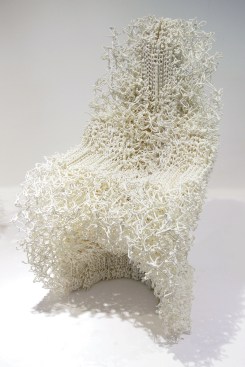
CurVoxels
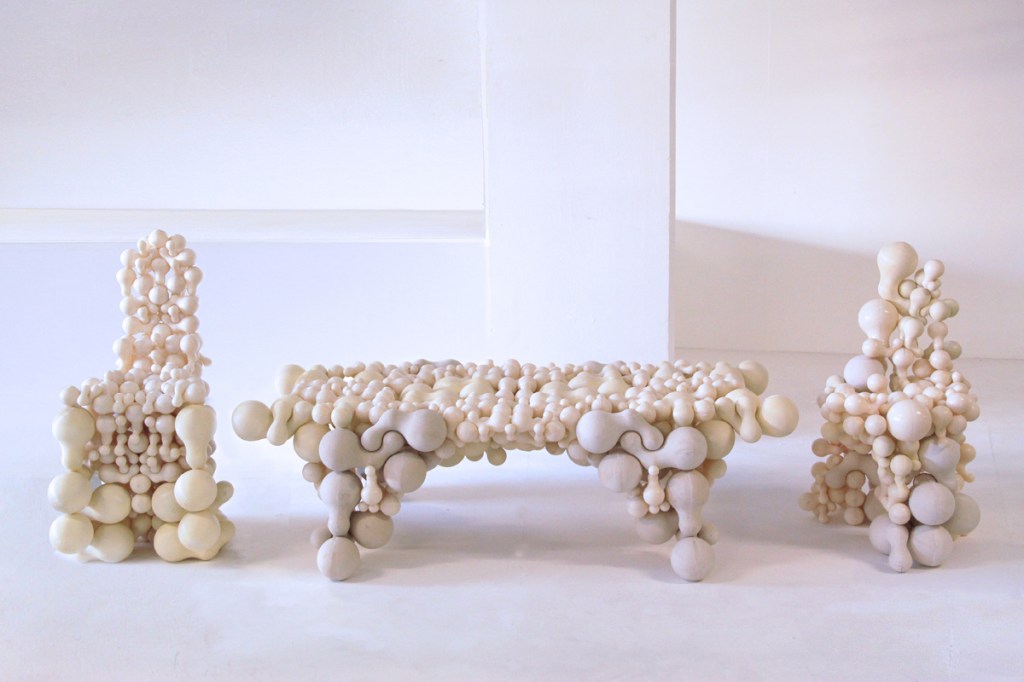
Three chairs, Mickey Matter, INT, and CurVoxels, were produced by Bartlett School of Architecture graduate student teams and supervised by tutors, Gilles Retsin and Manuel Jimenez Garcia. Aiming to use minimal human interaction for all three pieces, their Mickey Matter chair and table was assembled by a robotic arm and cut out of computer-designed plastic segments. The INT chair was made of CNC-cut wood, and the CurVoxels chair was 3D-printed from ABS plastic.
Courtesy Eragatory/Isaie Bloch
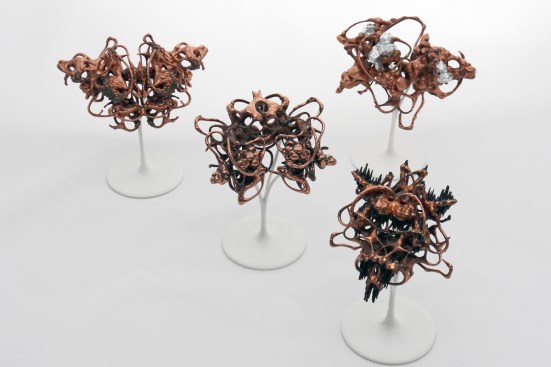
Rocky
Belgian architect Isaïe Bloch, founder of London-based firm Eragatory, has three sets of 3D-printed pieces in the exhibit. The first titled Chroma is a series of eight ceramic vases that meld 3D printing and the traditional form of casting. Each vase begins with a smooth top and transitions into ornate, sinuous details at the bottom. One of the eight is coated in gold lustre for additional emphasis. Rocky, the second series comprised of four pieces, was also 3D-printed out of polyamide and plated with oxidated copper, and has thin, almost skeletal filaments that weave around each other to create an abstract body.
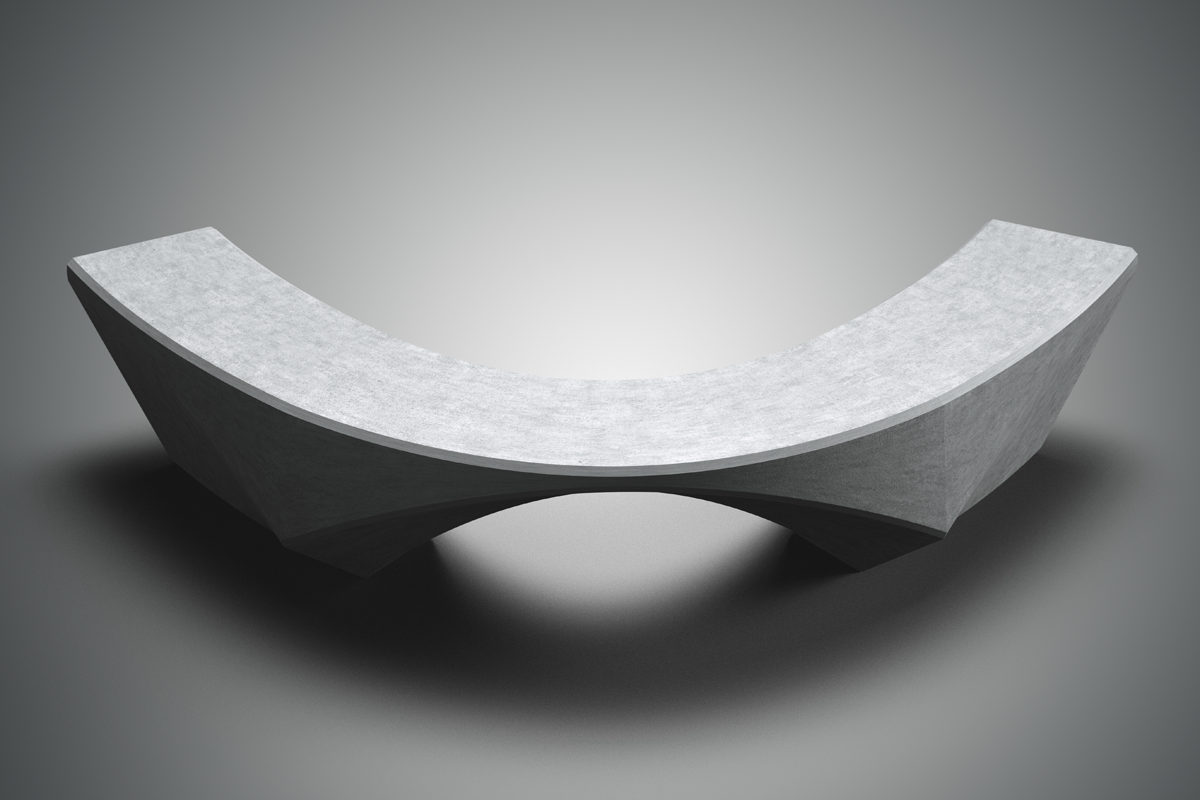
Other works in the exhibit include a Hot Wire Cut Bench designed by Patrik Schumacher, principal of Hadid’s synonymous firm, and Zaha Hadid Architects Computation and Design Group; XenoCells by Alisa Andrasek, founder of experimental computational design studio Biothing; Topology Optimized 3D Printed Chair by Zaha Hadid, Schumacher, and 3D printer manufacturer Stratasys; as well as SpaceStream by Bartlett School architectural design research cluster six, Daniel Widrig, Igor Pantic, Soomeen Hahm, and Stefan Bassing.
Courtesy Patrik Schumacher with ZHA Code
Wire-Cut Concrete Benches
Correction: This article previously listed Gilles Restin and Manuel Jimenez Garcia as graduate students, but they are in fact tutors at the Bartlett School of Architecture. The story also reported that the individuals responsible for producing the chairs were Restin and Garcia, when they were produced by teams of graduate students. Additionally, the article stated the exhibit had nine objects when it actually features 46.
This story has been updated.