I have always wondered why the Dutch model of housing development has not caught on anywhere in the United States. Dutch design is certainly popular, and Dutch approaches to integrated water management and landscape architecture have also had some influence, but the models of housing and concentrated urban development combining different income levels that the Dutch have used to create millions of new housing units in neighborhoods under the “VINEX” (Vierde Nota Ruimtelijke Ordening Extra, or, Fourth Memorandum Spatial Planning) program has not had, as far as I know, any American followers. It is a shame, because Dutch planners have shown us how to design neighborhoods that start to make sense out of sprawl, creating moments of urbanity that preserve the relationship to the landscape and existing structures that is so crucial to replacing bulldozer-based development with something more sane and livable.
Fulcrum Properties
Bridge District
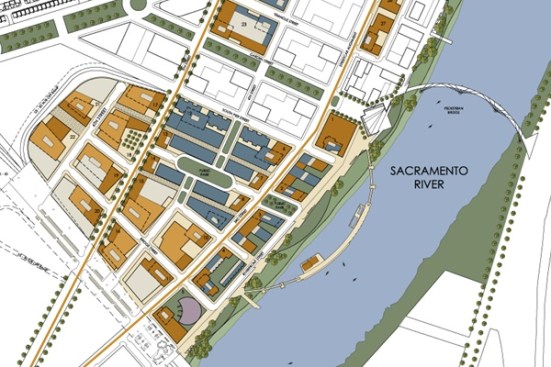
Now Fulcrum Property in Sacramento has constructed the first phase of the Bridge District, a mixed-use project that will encompass 4,000 residential units, 5 million square feet of office buildings, and 500,000 square feet of retail space once it fills out its 188-acre site across the Sacramento River from downtown (full disclosure: Fulcrum’s president, Mark Friedman, is a supporter of the Frank Lloyd Wright School of Architecture, where I am dean, and its design director, Stephen Jaycox, is an old friend and former student). Two rows of houses are finished and can serve as a proof of concept; another block is now under construction.
The basic layout of the Bridge District, from EDAW (now part of AECOM), is conventional: a slightly deformed grid in which taller elements punctuate edges and frame entrances. What is remarkable is the form the first phase has taken. Friedman and his designers—including Mark Dziewulski, AIA, principal of DZ Architect—traveled to the Netherlands and based the Bridge District design on Borneo Sporenburg, the Adriaan Geuze-planned community in Amsterdam’s old harbor district. For the Bridge District, Fulcrum created nearly-identical row houses that each have a slightly different appearance. They sport stoops in their front façades facing a shared park, while cars drive into the garages that hide behind those stoops from the rear. Four-story apartment buildings anchor the vest-pocket neighborhood. The buildings present themselves as stripped-down compositions of planes and blocks, but their variety and repetition makes the whole feel lively and human-scaled.
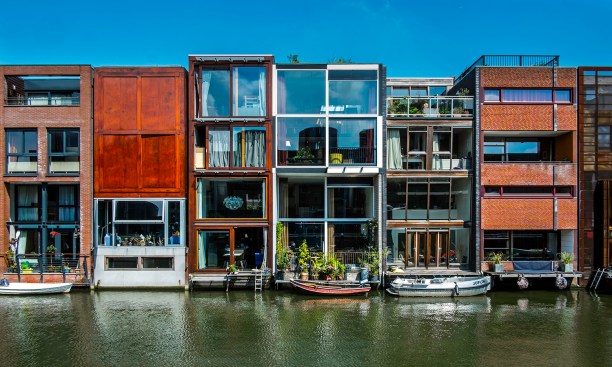
Borneo Sporenburg
The scale feels right, the variety creates a lively visual field, and the park is designed with enough amenities to be usable, even on the hot afternoon we were visiting, while not being crowded with too many doo-dads. Even though the surroundings are still empty fields, the part of the Bridge District feels immediately like a real place that, unlike its New Urbanist counterparts, actually opens up to its surroundings.
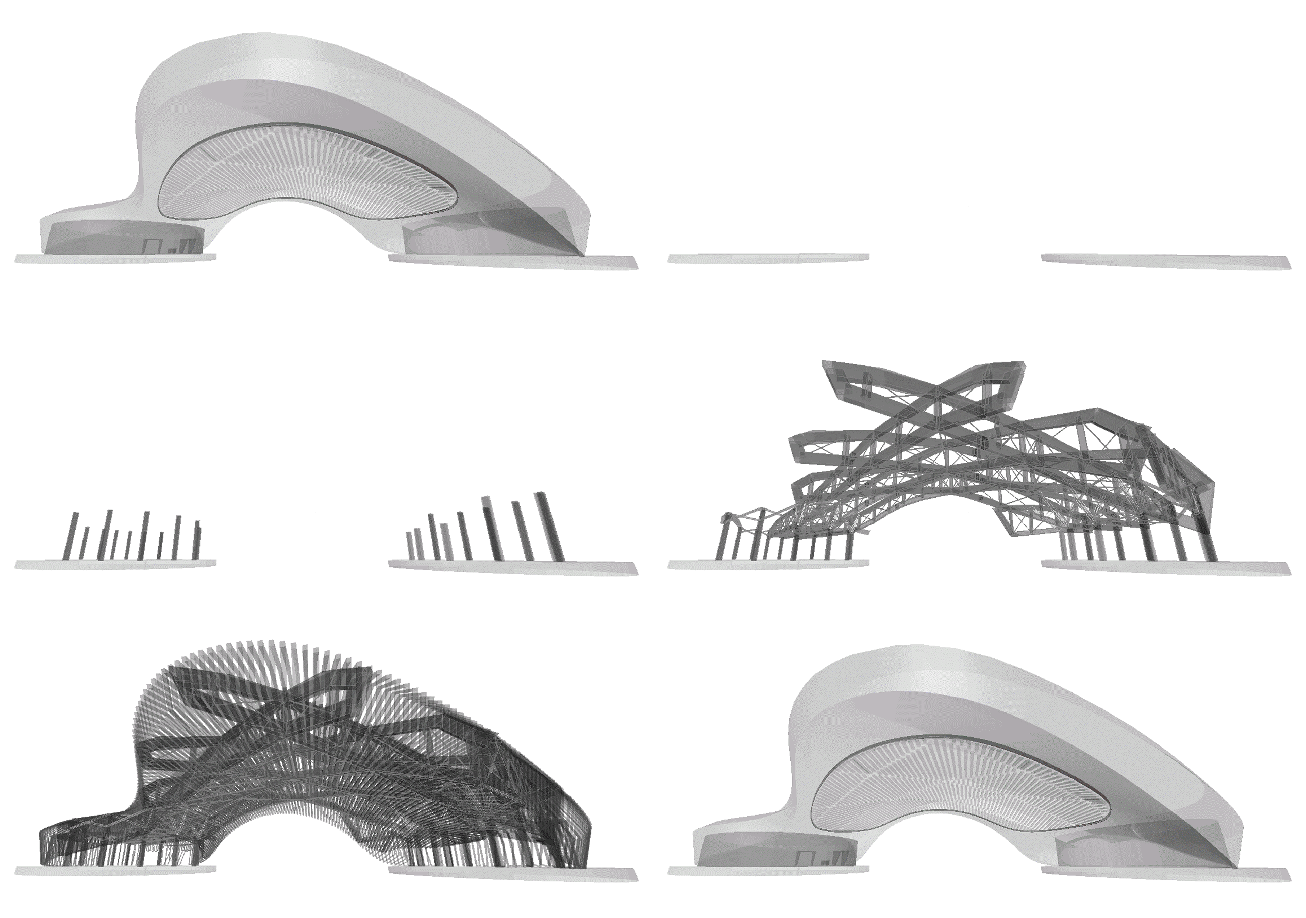
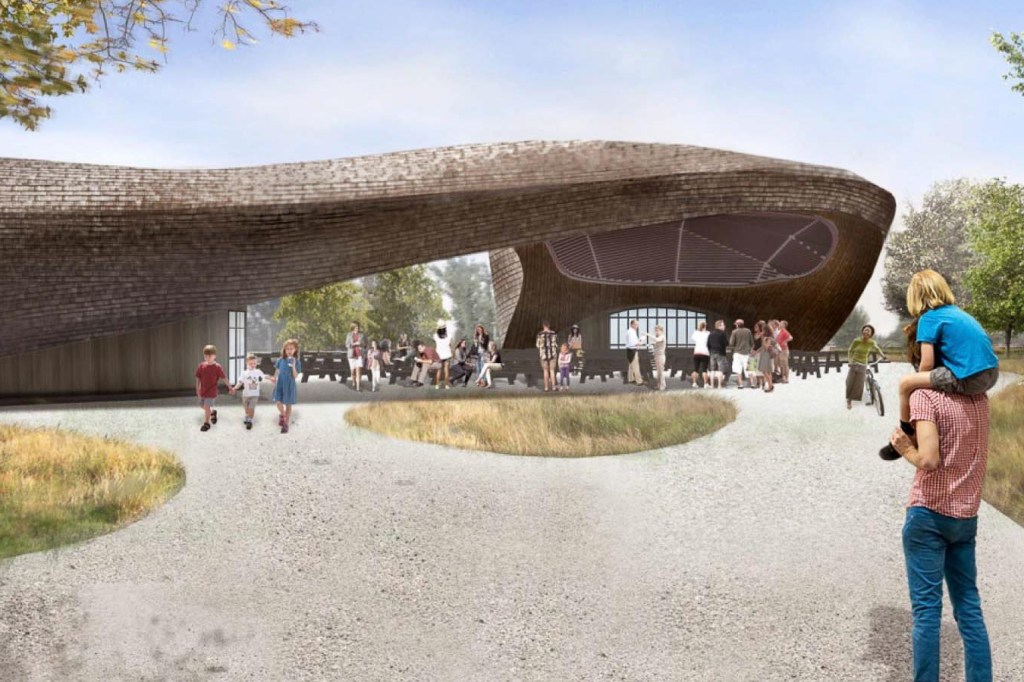
Fulcrum is anchoring the Bridge with a “Barn:” a tilted boomerang clad in cedar shingles that curves its way out of the grid, framing views of downtown while providing a focal point for the neighborhood. Friedman and Jaycox are still figuring out exactly what the Barn, designed by Dutch landscape architect Jerry van Eyck, will be; it is meant to act as a community center of sorts, a venue for concerts and fairs, and an event space with a catering kitchen. It is also a large object that breaks the grid and provides a sense of scale and unpredictable, picturesque variety (Van Eyck worked with Geuze on Borneo Sporenburg, which includes a similarly unpredictable object). Friedman, van Eyck, and Jaycox see the Barn as a medium-scale urban attractor appropriate to a neighborhood, as opposed to larger amenities such as stadia (there is a Triple A ballpark on the site already) and cultural facilities. It is certainly a beautiful object, rising out of the landscape to evoke both the tradition of agriculture that is so central to the region and the fluidity of modern urban life.
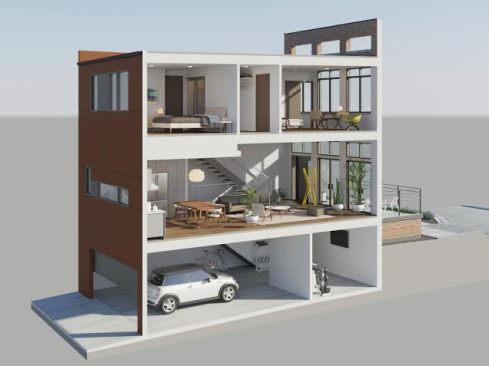
Fulcrum Properties
Typical unit within The Moderns, a planned housing development within the Bridge District
It is, of course, too early to be able to tell whether the Bridge District will be a success. It is also true that, given the amount of investment Fulcrum is making here and the prices they are asking for the spaces, the whole neighborhood will not have the social variety that is part of what makes the Dutch examples so compelling. It is evident by now, however, that the Bridge District is off to a good start. It offers an alternative to both cookie-cutter cul-de-sac development and the kind of cheap and ugly rental prisons thrown up with Type 3 construction that are becoming more and more common when developers make “dense” housing. I hope not only that its future phases will live up to this promise, but also that the Bridge will prove that some of the urban forms developed in the Netherlands might help us figure out how to make sprawl work better in this country.
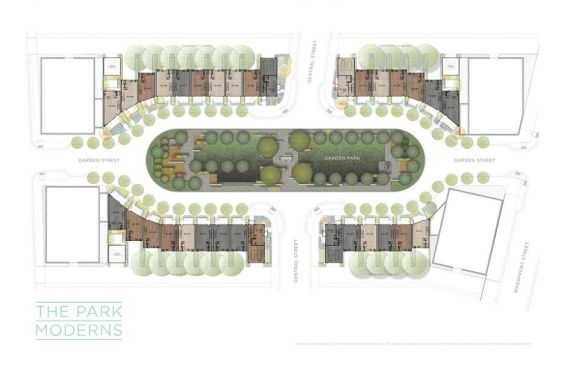
Fulcrum Properties
A planned housing development, The Moderns, within the Bridge District
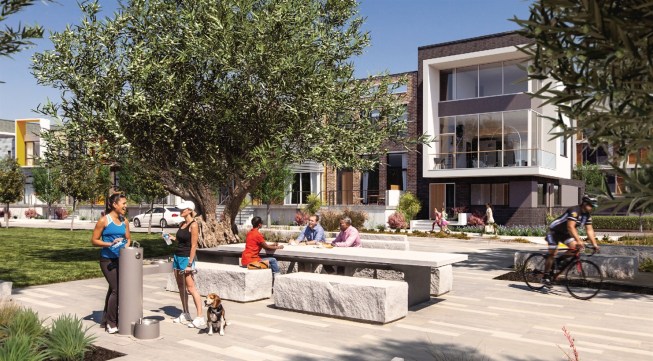
Fulcrum Properties
Rendering of The Moderns, a planned housing development within the Bridge District