
At the Venice Architecture Biennale, should one judge how well an exhibition fits the designated theme or just go for what one likes? I would make a terrible jury member, I realize, as I first look for things that move me. I already described my pleasure with Alvaro Siza’s wine-red walls. I was almost as smitten by the transitory installations of Italian lighting designer Mario Nanni, who set a 50-meter long plank in one of the shacks of the Arsenale and to either side left conceptual essays on light, one an artificial eclipse another reflections of televisions into mirrors, and at the end a bronze pool which collected drips from a leaking roof and magically projected the reflections of the ripples into a shady corner. The Irish entry, a segmental teeter-totter in eight parts, literally moved me by sitting upon it, while trying to decipher the enigmatic graphics that describe the visitor’s center of the Giant’s Causeway in Antrim. Their Irish colleagues O’Donnell + Tuomey created the prettiest object in the whole show, a colossal wooden tower, set in the midst of the Corderie space, a porose fabric made of 4 by 4 studs stacked in a twisted composition of shifting angles that generates intriguing shadows.
When there is an excess of information I tend to move on quickly, looking for the few projects that have little or no content. The designers of the Serbian pavilion filled their hall with one enormous white table, leaving only a 1.5 wide passage way around it. Its taut surface became an unintentional sounding board suspended over the floor at waist height—people loved to take a swat at and hear the rebound. Next door the Polish pavilion offered a complimentary vision of an equally voided oblong space repaved with a smooth wooden floor that was subtly inclined. The sounds of the pavilion were intensely amplified causing the floor to vibrate. I was also quite taken with the 32 objects in the Nordic pavilion, gathered from young architects in Finland, Sweden, and Norway. Each offered a conceptual model of how daylight affects a building, and the interlocking U shapes of Petra Gipp’s model gained my deepest sympathy.
But this year’s Biennale succeeds best in the telling of stories, as the notion of Common Ground belongs to everyday lives of people who are not usually the patrons of architecture. The Golden Lion prize for a national exhibit almost went to the myriad of self-build stories collected in the U.S. pavilion, and the secret narratives found in the Russian pavilion, which on the ground level exposed the 60 secret research cities built by the Soviets during the cold war, and on the upper produced an equally enigmatic display of the high-tech new town being built on the outskirts of Moscow, wallpapering the pavilion with QR codes that could only be deciphered using Ipods. The winning Japanese Pavilion, curated by Toyo Ito, took the prize with a story that literally shook the world, the great earthquake and tsunami of March 11, 2011.
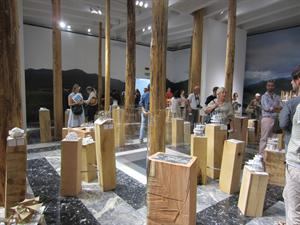
Ito invited three young architects to help resettle families in Rikuzentakata, and the exhibition documents their participatory process. The disaster left in its wake a huge amount of logs, which became the leitmotif of the show, starting from the logs nested between the pilotis that raise the pavilion off the ground. The interior was animated by two dozen of the randomly placed logs, and a large collection of models set on chunks of woo. They illustrate the sort of tree-house ideal proposed for the community’s meeting center and for the prototypical replacements for their homes. The proposals looked surprisingly flimsy and crude, yet one knows that trees, and by correspondence logs if they are set deep into the earth, have a surprising seismic resistance. The story concludes with the raising of the first structure, using the logs that were, as is appropriate to this Biennale, commonly found on the ground.