
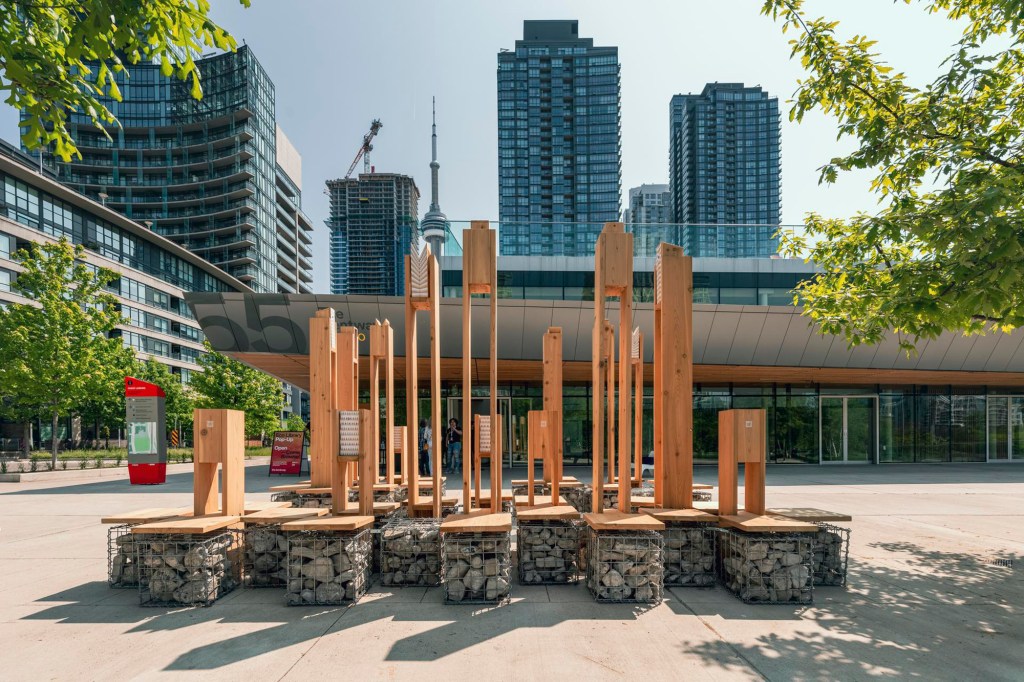
Commissioned by the Bentway Conservancy, the Multispecies Lounge project by Double Happiness—a collaboration between architects Joyce Hwang and Nerea Feliz—encourages co-occupation between animals and humans, aiming to amplify urban wildlife in and around the Bentway and Canoe Landing Park in Toronto. Comprising a field of public seating, the scheme offers an urban “lounge” for human recreation, while acting as an aggregation of spaces designed for animal inhabitation and awareness, including birdhouses, insect boxes, and hibernacula for small terrestrial animals. Habitat conditions in the project cater to familiar species of popular appeal, such as American robins, barn swallows, and other songbirds. The spaces also provide shelter for less-recognized urban animals such as solitary bees and local snakes. Using renewable resources such as red cedar, as well as recycled and upcycled materials such as discarded construction waste, the project’s material ecology advocates for circular economies in design and construction.
Through QR codes mounted on the wooden structures and available on the Bentway’s website, the project facilitates information-sharing about local urban wildlife through links to an online video series titled “Lounge Voices,” which features short, fictionalized narrations from the perspectives of neighborhood species. For example, the sweat bee (which is Toronto’s official bee) tells viewers about how it lives in solitary settings such as small holes, cracks, and crevices instead of in hives, while the northern mockingbird discusses how it uses trash to build nests. To approximate nonhuman experiences, the installation features UV reflective graphics as patterns on each birdhouse and insect habitat as a nod toward insects and birds and their ability to see beyond the light spectrum visible to humans. While the pattern appears static to human eyes, the use of UV or black light to illuminate the structure at night will give visitors the opportunity to experience the installation as animals would, amplifying visual perception through a nonhuman lens.
This article first appeared in the October 2023 issue of ARCHITECT, which was guest edited and designed by Dark Matter U. It has been updated.