It is always dangerous to write about a building under construction, but then again, seeing a structure far enough along that all the spaces are defined and the structure’s place in the whole experience is clear, without finding yourself distracted by the content, can give you a sense of the architects’ intention. Of course, by that very toke you are then defining the structure as a monument that has a life and a meaning beyond its function. Though that is an issue for a house or even an office building (and leads to architects desperately trying to photograph their buildings before the owners move in and “mess things up”), for a structure such as the Shed, New York City’s latest cultural palace, the perspective also seems appropriate.
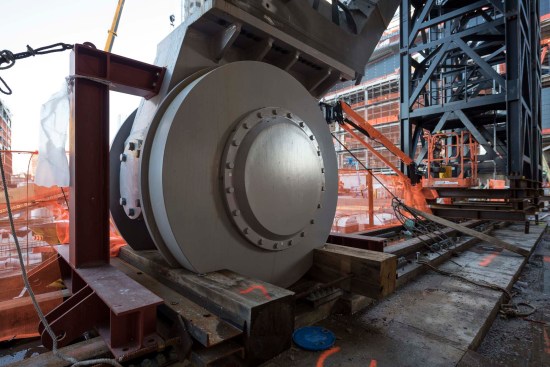
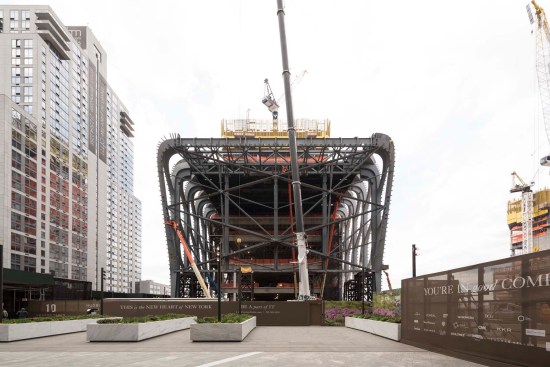
The Shed represents one of the biggest and most extreme examples of a “move”—as in the first architecture lesson I ever learned: “get in, make your move, get out fast”—that I have seen in recent years. It is intended to be the ultimate multipurpose building with over 90,000 square feet of open-span exhibition, performance, and event spaces that can expand by another 17,000 square feet when the shed of its name (which is officially called the McCourt) wheels out over an adjacent plaza. When I first watched as its designers, Diller Scofidio + Renfro (with New York–based collaborating architect Rockwell Group), presented the idea in their office, I filed it away in the “utopian designs, never realized” folder in my mind. Then Elizabeth Diller and Ricardo Scofidio, AIA, lectured at the School of Architecture at Taliesin and showed the giant wheels, each as big as a truck, being forged at an Italian factory, and I realized that the Shed was becoming a reality. Now, it is just about built, with the wheels ready to ride on their tracks by the time of the opening on April 5.
Courtesy of Diller Scofidio + Renfro
Courtesy Timothy Schenck
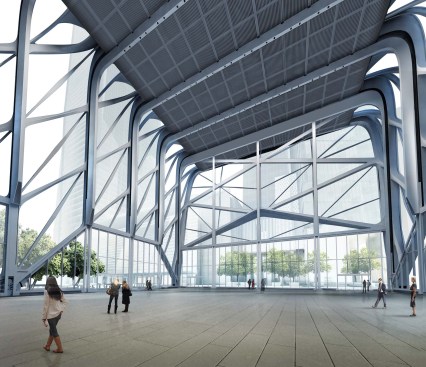
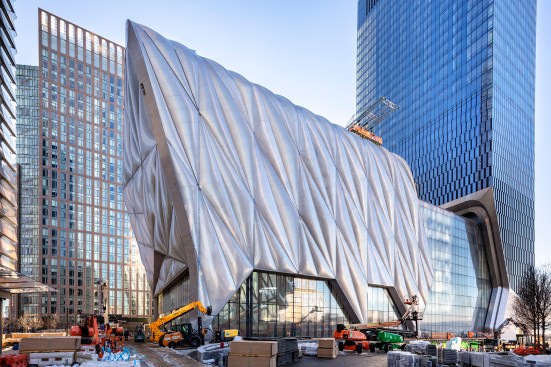
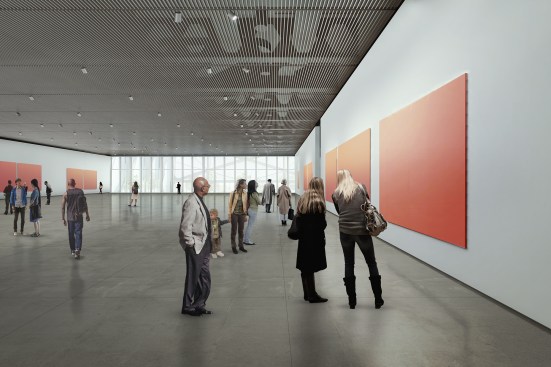
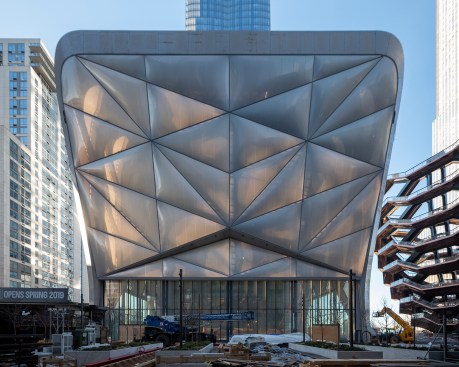
The “move” in this case is a literal one: The cowl of inflated ETFE (ethylene tetrafluoroethylene) panels nests on top of a four-story stack of exhibition, performance, and event floors, the first three of which sport a 12,500-square-foot clear-span space. When Kanye West or the Bolshoi come to town, or when New York Fashion Week unfolds (which the Shed thinks will be their real moneymaker), the cowl takes a 5-minute journey along the tracks and covers the adjacent place, creating a fully enclosed, lit and conditioned, not to mention grand, space with a flexible floor plate and a 110-foot ceiling height.
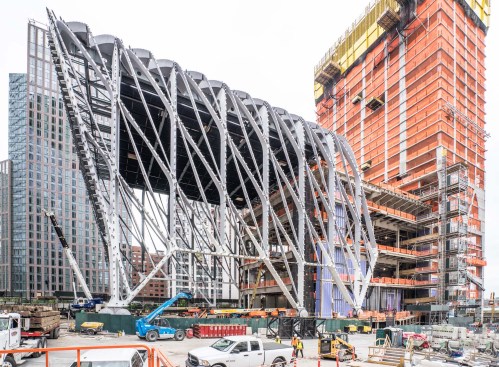
The shed structure is now sitting over the plaza, while workers finish the lighting and the floors, not to mention all the other details that will make it work. And it is spectacular. The combination of the lacey steel structure and the translucent panels summon the image of a Gothic cathedral that has become abstracted and stretched into a thin membrane. They leave not a nave, but a modernist cube of a giant scale to house the worshipers of whatever modern culture the organizers choose to throw at the New York scene. The diagonal panes and struts, not to mention those supersized wheels, have a kinetic beauty even when they are fully stationary.
Courtesy Timothy Schenck
Brett Beyer
That is really all there is to the Shed. The main entrance, on a lower floor underneath the High Line (which DS+R also co-designed), is a serviceable space whose one trick is a skylight that gives you a view of that reused train track’s bottom. The escalators that take you up into the spaces above are designed as cleanly and with as much reserve as the architects could muster. My only fear is of a repeat of DS+R’s experience at the Broad museum in Los Angeles, where dreadfully proportioned and positioned walls leached all the grandeur out of the top-floor gallery—a gallery that was meant to be the institution’s big payoff.
I also wish that DS+R had managed to find a way to stage the entrances and the unfolding of the spaces with a few more transitions, but I understand the lot was tight and the opportunities for such ceremony few. One of the biggest issues is that Related, the company developing the Hudson Yards project of which the Shed is part, decided to place another big move right next to the Shed. It is Thomas Heatherwick’s surprisingly blingy Vessel (as it is clad in a shiny copper-colored steel), a bulging tribute to M.C. Escher that provides endless staircases to nowhere stacked up higher than the Shed, right to its north, cutting off any possibility of seeing DS+R’s structure, except from odd angles.

Courtesy of Diller Scofidio + Renfro
Courtesy of Diller Scofidio + Renfro
On the other hand, the way in which the Shed’s structure slots into the 70-story 15 Hudson Yards residential structure, which DS+R also designed as lead architect, with the Rockwell Group as lead interior architect, and with which it shares a number of base elements, is quite magnificent. This gives the residential tower—whose transition from a square to four bundled tubes was value engineered into something not nearly as expressive as the architects intended—a sense of either spewing forth or eating up the Shed.
But, in the end, the Shed is all about the shed. It is the realization of many architects’ long dream to create a big, technically infused, (semi-) public space of the sort of which Cedric Price dreamed (with Joan Littlewood) in his 1964 Fun Palace, as well as its dreams of a mobile, changeable, and mutable architecture like London-based Archigram’s visions, all rolled into one and actually built. The opening series of concerts and events—including collaborations between Steve Reich and Gerhard Richter and Richter and Arvo Pärt, as well as a five-night series of concerts celebrating the influence of African-American music in the United States—promises to make the space come alive.
My favorite moment in the building, though, is not quite there yet. Working with the Shed’s management, DS+R decided to open up the second-floor wall that faces the plaza with accordion doors, so that the space turns into a balcony from which you can watch the events downstairs. It promises to be a vertiginous experience that will live up to the Shed’s full potential, dissolving architecture into spectacle. For that is what the Shed’s move produces: not frozen music, but frozen spectacle.
Courtesy Timothy Schenck
Timothy Schenck