
Catalogtree
ZweigWhite's Hot Firms list ranks the top 100 fastestgrowing U.S…
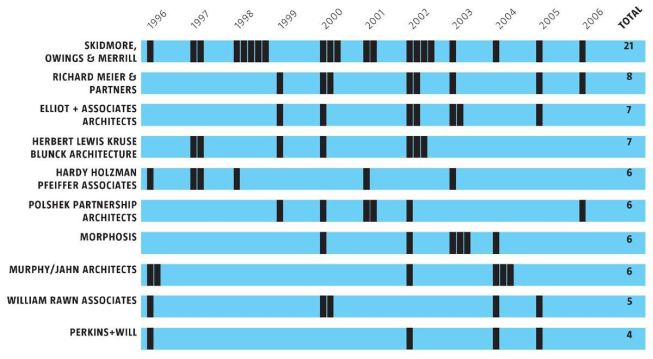
Size can offer advantages. Two large firms in particular Skidmore, Owings & Merrill (SOM) and Perkins+Will?combine high revenue with WPH Architecture, Portland, Ore., and Las Vegas an impressive haul of AIA National Honor Awards (see PDF). SOM hits the trifecta, touting as their own four of the 11 tallest buildings completed by U.S. firms since 2004.
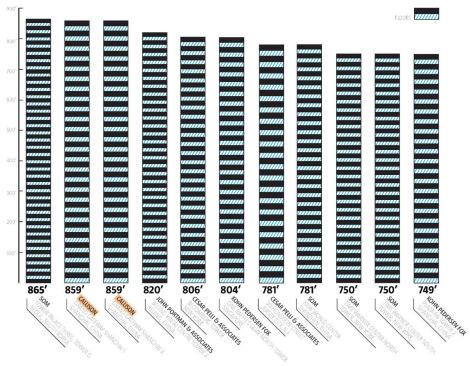
Tall buildings still create considerable buzz. While several 2,000-foot-plus towers will soon be coming online, recently completed buildings designed by American firms haven’t topped 1,000 feet (see ranking [PDF]). And although many of these same firms now have big towers under construction, mega-skyscrapers are no longer strictly an American-made product. Local firms from Sydney to Shanghai are redrawing skylines with as much confidence as we once mustered. The Far East and New York are home to many of these behemoths, but who expected Jersey City to be in the top 10?
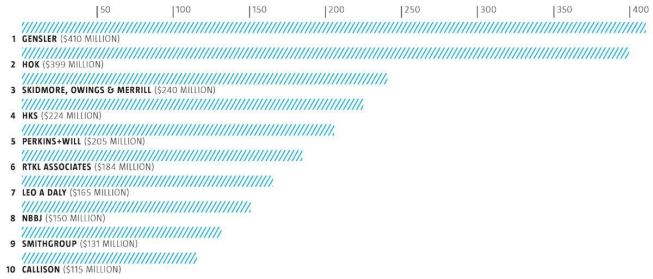
Skyscrapers require specialized technical expertise. SOM, Pelli Clarke Pelli Architects, and KPF (Kohn Pedersen Fox Architects) are expected standard-bearers. However, with its Grand Gateway towers in Shanghai, Callison topped all but one of SOM’s highest towers. This seldom-mentioned Seattle firm breaks the top 10 in revenue as well, making it a power in two rights (see profile [PDF]).
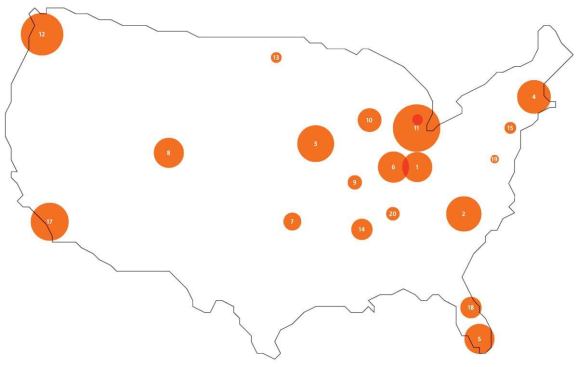
It’s widely assumed thanks in part to media coverage that New York, Los Angeles, and Chicago are the cities where worthwhile design originates. So, do those cities have all the professional opportunities for architects? Not if you want to be employed by one of the U.S. firms ranked among the best places to work (see ranking [PDF]). If you live in New York or Chicago and hope to work for one of those firms, you’re out of luck. If you prefer Los Angeles, you fare a little better but you’re not going to be working in Santa Monica or Venice or any of the other hip L.A. spots; you’ll be in glamour-challenged Long Beach, where Perkowitz+Ruth Architects is based.
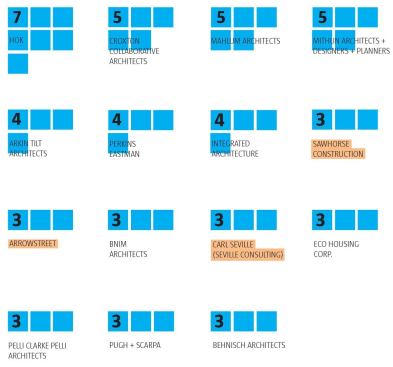
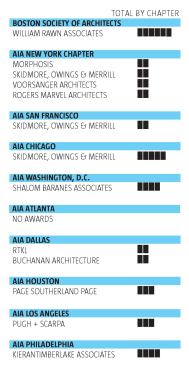
By contrast, relocating to Des Moines gives you options. You can choose the home office of BSB Design (formerly Bloodgood Sharp Buster Architects & Planners), which is the third-best architecture firm in the country to work for. Or you might try Herbert Lewis Kruse Blunck Architecture, the third-ranked producer of AIA Award-winning projects, ahead of powerhouse designers Morphosis, Murphy/Jahn Architects, and Perkins+Will. If having an AIA Award- winning project on your résumé is important, you might also consider Oklahoma City-based Elliot + Associates Architects, also third in the rankings, who surpass all but SOM and Richard Meier in capturing these coveted honors.
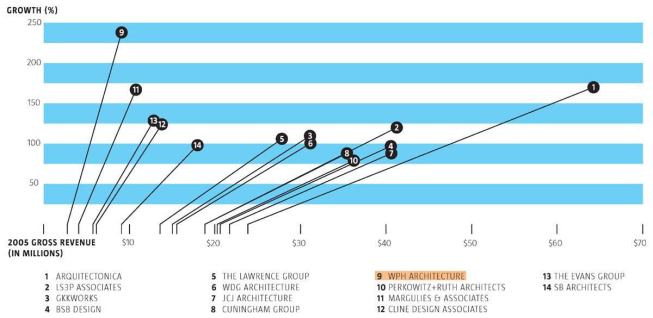
ZweigWhite’s list of “hot firms” (see PDF) is based on revenue growth over the preceding three-year period. ZweigWhite considers both dollar growth and percentage growth to compute its rankings. With the exception of BSB, nobody on this list made the cut on another. Perhaps it’s evidence of the divided nature of a profession in which superior business and design skills seldom make good bedfellows.
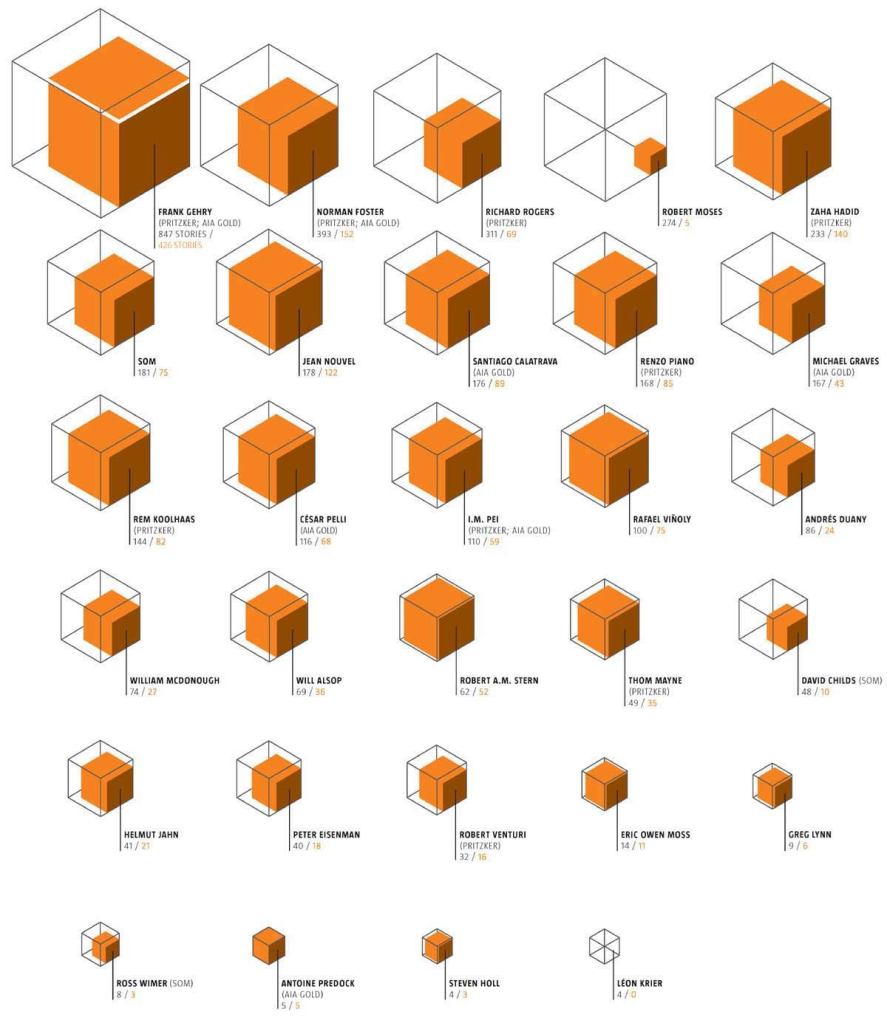
We compiled our list of top newsmakers by searching the LexisNexis database for all mentions of specific, “brand-name” architects during a recent 90-day period. International prize winners predominated do we need any further proof of Frank Gehry’s influence? On average, Gehry generates almost 10 press mentions every day of the week, far more than twice those devoted to his closest competition, the lords Foster and Rogers. But enter the name of a long-dead nonarchitect?Robert Moses and he reaps the most LexisNexis hits. No doubt the recent book and museum exhibitions on his legacy have skewed the numbers a bit. (For more on Moses, see “An Indecisive Democracy” and Q&A.)
Architects do have real power in their ability to shape the physical environment. But the rankings we compiled suggest something that most architects intuitively understand: Power, or influence, is shared by so many in our field that it has become diffuse and must be acquired with steady effort. Even the biggest firm or most celebrated architect faces competition. We all have to make our mark one project at a time.
Of course, the most powerful architect of our era may well be a fictional creation every undergraduate’s favorite cardboard hero, Howard Roark in Ayn Rand’s The Fountainhead. His Nietzschean drive was so absolute that he could dynamite a building when clients dared revise the product of his genius. Some architects still conjure that fantasy after a particularly bad meeting, but most of us have moved on. These lists shed light on where we are now.