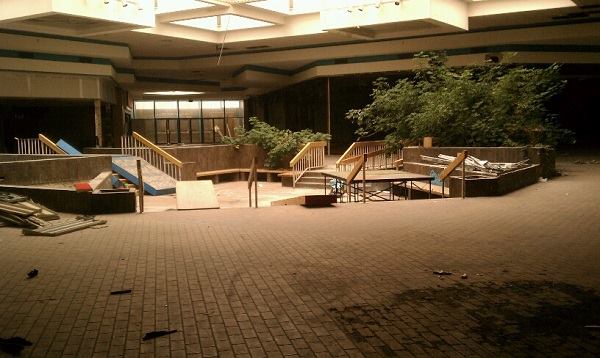
Dead malls are coming back to haunt us or, to be more specific, the social sites where we all live. Deadmalls.com and the Facebook page “Dead Malls Enthusiasts,” both of which generate millions of weekly views and visits, publish the images of retail emporia once filled with shoppers and goods, but now abandoned and forlorn. Stories of these places, memories, and lots of amateur photographs make it clear that, though they are gone, they still exert an attraction. They certainly do to me.
One of my strongest memories growing up was the opening of the first big mall in my town. It was a glitzy affair, slathered with marble and brass: a labyrinth of seduction. The best restaurants and stores all moved there. It eventually lost some cachet when it later became a site for gang warfare.
When I lived in Los Angeles during the 1980s and 1990s, malls were still magnets of activity. We went there not just to buy clothes and find the latest gadgets, but to go grocery shopping, to eat, and to go to movies. I became fascinated with how they worked, and found myself visiting the local variants wherever I went. The notion of these inward-turned behemoths that invented a whole world all their own, one where everything seemed available, and where there were no edges and no hierarchy, seemed to offer a model that I hoped architecture could pick up in another form. It never did.
The only reason I have been to a shopping mall lately has been to go to the Apple store, and even that now seems like a superfluous activity. I have a feeling that most malls will join the related retail corpses before too long, with only the super-luxury or super-discount ones surviving.
These were just the standard malls, the ones anchored by Sears on one side and an equivalent of Macy’s (or, now, only Macy’s) on the other. The buildings have recognizable characteristics, from the central atrium with its diagonal escalators to the way that each corner elides into a diagonal that draws further through the lines of national franchise stores.
In the really far-gone malls—like Rolling Acres in Akron, Ohio—nature has crept back in, turning them into something akin to a classical ruin. Dixie Square Mall in Harvey, Ill., which served as a film set for The Blues Brothers, has become a skeleton. Perhaps the eeriest examples are the ones, like Crestwood Plaza in St. Louis, where enough of the postmodern pink and teal color scheme, the lay-in tiles, the dying trees, the empty storefronts, and the gleaming food courts remain to make the place seem almost alive.
The attraction of these photographs is not just the memories they evoke, but also the ruin porn they represent. Buildings under decay are much sexier than finished ones, perhaps because they remind us of our own mortality, or maybe because you see a much more varied array of textures, forms, and materials. Their emptiness beckons us because we fill it with our memories. Even the style has a certain force, as the complexities and contradictions of the era when malls reigned supreme has a strange attraction to us today.
The generic mall is dying, and, of course, my rational self says that is a good thing. It was a place of mediocre design, turned away from their context, filled with air conditioning and fluorescent light, generating vast amounts of unnecessary car trips, and creating a teen culture built around consumerism. Yet I, like apparently millions of others, can’t keep my eyes off of the remains of the places where America’s answer to community was created.
Aaron Betsky is a regularly featured columnist whose stories appear on this website each week. His views and conclusions are not necessarily those of ARCHITECT magazine nor of the American Institute of Architects.
Images used via Creative Commons licenses with Flickr users Michael Meiser and Julian Meade.