

The following is a press release from the Museum of Modern Art in New York announcing the street-level gallery presentation of its Broken Nature exhibition from Nov. 12, 2020 through the summer of 2021.
Celebrating design’s ability to offer powerful insights into the key issues of our age, The Museum of Modern Art will present Broken Nature in its street-level galleries from November 21, 2020 through Summer 2021. The exhibition will highlight the concept of “restorative design” and present objects and concepts that offer diverse strategies in the effort to help humans repair their relationship to the environments that they share—with other humans and with other species. A collaboration with the Triennale di Milano, Broken Nature was originally organized in 2019 as the main exhibition of the XXII Triennale, with a curatorial team composed of Paola Antonelli, Ala Tannir, Laura Maeran, and Erica Petrillo. Featuring approximately 45 works—some of them new acquisitions in the Museum’s collection and others loans—drawn from the more than 100 in the Milan installation, the MoMA chapter of Broken Nature will explore the complex, interconnected systems humans inhabit, and the reparative roles design plays within these systems. The exhibition at MoMA is organized by Paola Antonelli, Senior Curator, Department of Architecture and Design, and Director, Research and Development, and Anna Burckhardt, Curatorial Assistant, Department of Architecture and Design.
Broken Nature will promote the important role of creative practices in maintaining and strengthening our bonds with the complex natural and human-made realms, and in designing reparations when necessary, through objects, concepts, and new systems. The projects and designers selected for this installation, including Mustafa Ali Faruki, Aki Inomata, Alex Goad, Julia Lohmann, Christien Meindertsma, and Studio Swine, among others, demonstrate design’s inherent restorative potential. Some projects propose practical and tangible amends, while others manage to instil new behaviors and lead citizens to a more responsible attitude toward the world they occupy and shape. Still others point at possible future consequences of our choices of today.
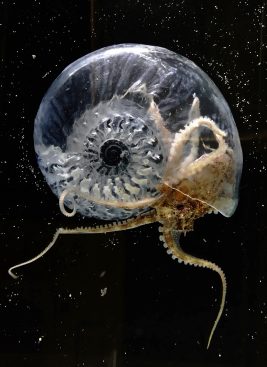
Courtesy Aki Inomata and Maho Kubota Gallery
Think Evolution #1: Kiku-ichi (Ammonite). 2016-17. Monitor, high-definition video (color, sound, 2-minute loop), ammonite fossil, resin, 5.7 inches by 4.7 inches by 2.3 inches.
“From reviving the coral reefs that are bleaching at unprecedented speed due to increasingly warm waters, to contemplating scenarios for feeding an overpopulated planet, Broken Nature argues that design and architecture can and have been instrumental in jumpstarting constructive change on different levels, for different contexts and circumstances, and across different spans of time,” said Antonelli.
Appreciating the idea of environment from a variety of interconnected perspectives, the exhibition will consider economic, social, and political systems in addition to natural ecosystems. The broken bonds that restorative design can tackle thus include not only the touchstone issues of the environmental crisis, like pollution, material consumption, and global warming, but also issues around such fundamental institutions and concepts as family, gender, race, class, and nationhood. Some projects examine circularity by looking at waste— an abundantly available material—as a new resource, while others pursue new technologies and materials that will allow us to devise new ways to make and build, and plan for decay and reuse. Others still highlight the rapid changes in our environment in the short and long terms, or seek a more balanced equilibrium for all the world’s denizens—whether human, animal, plant, or AI.

Courtesy Triennale di Milano, photo: Gianluca di Ioia
Julia Lohmann. Oki Naganode. 2013. Seaweed, rattan, aluminum, 118 inches by 138 inches x 138 inches. Installation view in Broken Nature: Design Takes on Human Survival, the XXII Triennale di Milano, Mar. 1, 2019–Jan. 28, 2018.
By relying on collaboration among design, the life sciences, and the social sciences to confront some of the most important issues of our age, designers have also ventured into experiments in social justice and mobility, economic development, and more. The works included in the exhibition, which correspond to the different themes covered in the original iteration of Broken Nature, will highlight the shared relationships that exist among designers, engineers, artists, and scientists, and the ways in which these communities continuously collaborate and influence one another.

Courtesy NASA, left photo: U.S. Geological Survey (USGS), Landsat Missions Gallery, U.S. Department of the Interior / USGS and NASA
NASA. Images of Change, Three Gorges Dam, central China. September 24, 1993 – August 22, 2016.
An accompanying catalogue, published in conjunction with XXII Triennale di Milano, will be sold in the MoMA Stores.