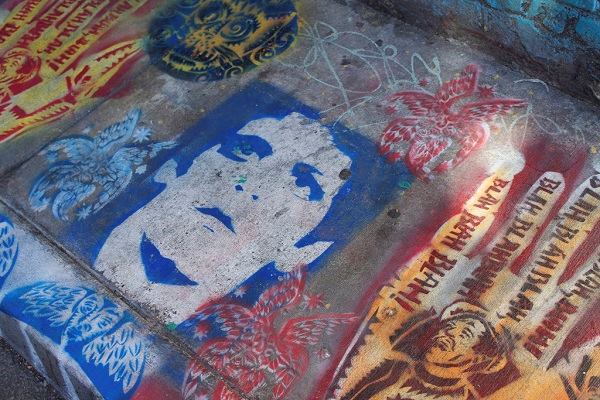
When I first moved to this country after growing up in Europe, I kept singing: “We’ve all come to look for America,” from the Simon & Garfunkel song “America.” I dreamed of long bus rides through a misty country I didn’t really know, about “the moon rising over an open field” and “counting the cars on the New Jersey Turnpike.” Reality turned out to be harder, in every way, and so I started listening to Lou Reed, who passed away last week.
Lou Reed was an important part of the soundtrack of my coming to America. In my college days, there was his invitation to explore both my own sexuality and the fluid world that swirled around Times Square. On Transformer (1972), he also evoked what I loved about New York in “Perfect Day”: Just a perfect day/ Drink sangria in the park/ And then later/ When it gets dark, we go home/ Just a perfect day/ Feed animals in the zoo/ Then later/ A movie too, and then home.”
I never tried heroin. Reed certainly made the place it put you in sound pretty good—and horrible: “When I am rushing on my run/ And I feel just like Jesus’ son…And I guess that I just don’t care.” This was no dumb escapism. Reed sang about a world that was steeped in history and culture as much as it was in counter-culture, and the jarring chords announced chaos that was always near at hand. Postmodernism made sense when I listened to him.
In the 1980s, I hummed a different tune—this one by the Clash. “You grow old, you calm down and you’re working for the clampdown/ You start wearing the blue and brown and you’re working for the clampdown.” But Lou Reed’s “Sweet Jane” still registered with me: “Some people like to go out dancing/ Other people like us, we have to work.” Reed became introspective, and his music became denser and more ethereal. He hooked up with one my new favorites then, Laurie Anderson. He was sober and largely somber.
I moved on to other sounds. When I was in architecture school, Elvis Costello asked “Do I have to draw you a diagram” (“Human Hands,” 1979) and we all shouted the lines out together, mocking our teachers. We delighted in the fact that a more-or-less major rock band called Orchestral Manoeuvres in the Dark could release an album called Architecture and Morality (1981) and some former architecture students, the Talking Heads, put out one called More Songs about Buildings and Food (1978). Obviously what we were doing mattered: Architecture was the backbone of a music that was becoming increasingly more complex.
Then the Talking Heads released their ironic paean to suburbia, Nothing But Flowers (a genetic precursor to Arcade Fire’s Suburbia): “There was a shopping mall/ Now it’s all covered in flowers…I fell in love/ With a beautiful highway/ This used to be real estate/ Now it’s only fields and trees…I miss the honky tonks,/ Dairy Queens, and 7-Elevens.” The lack of good architecture and the dangers of dreaming of utopia became a subject for rock and roll. Our built environment was something to question. It was not buildings or even diagrams or parks that mattered, but change, fluidity, and the mythology of urbanization.
Maybe it is me, but I don’t listen to rock and roll much anymore for inspiration. I think LCD Soundsystem was the last band that made me feel that somehow, somewhere, there was architecture lurking behind those danceable bleeps.
Lou Reed’s passing marks another moment of closure, reminding me of a youth that was not quite innocent and not quite wasted, but a curious combination of both states. The scenery of that time had the same qualities of grittiness and wonder mixed together. I will miss the beauty of that sound and that space.
Images used with permission courtesy of Creative Commons licenses with Flickr users Peat Bakke, Chelsea Marie Hicks, and Hello Turkey Toe.
Aaron Betsky is a regularly featured columnist whose stories appear on this website each week. His views and conclusions are not necessarily those of ARCHITECT magazine nor of the American Institute of Architects.