
This is the third article in a three-part series about the most important light-managing medium, glass. In this final installment, design ideas involving glass and light are reviewed.
When seeking to provide a really “special effect,” not every design must involve hundreds of thousands of dollars to be “effect”-ive. Some pretty basic and affordable lighting systems can be used to make artful and appealing designs that achieve effects unattainable using just shape, pigment, and texture—just add glass.
THE ILLUSION OF SOMETHING BEYOND
THE COLOR BOX
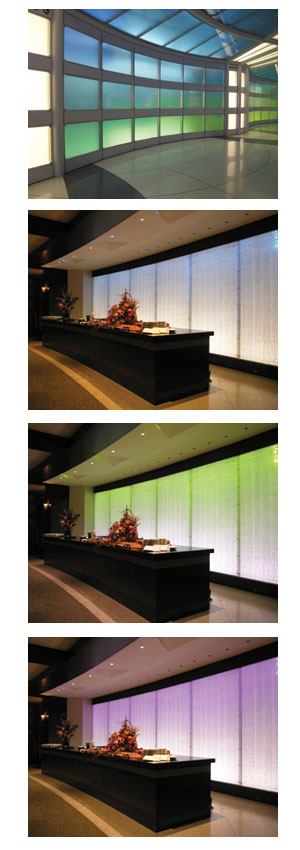
While it may seem simple, the idea of a large light box is still a very useful tool for modern design. At Light+Building 2004, Zumtobel used light boxes to create a Mondrian-like pattern of color-changing walls. While we may think of LED-based RGB systems for this design, in fact the T5HO lamp in primary colors is the best way to make this work, especially with a large enough box.
The real challenge of this design is to make each panel appear almost perfectly illuminated all the way to the edge. Finely detailed acrylic is probably the best way to do this, using the diffusing quality to carry light over a thin box edge. Stretched polymer sheet produces a similar result. If the box is deep enough, three prime-color fluorescent lamps with dimming ballasts and a suitable controller can turn a simple box into a colored light system of almost endless variety and subtlety.
Movement and Sparkle (without actual movement)
Random sparkle is magical. A simple way to create this effect is to use tungsten bud lights or LEDs in a grid, fired to give the sense of random flashing. We have been doing this detail for decades, and it still works. But in current design, it is a bit too simplistic and, well, basic. Architects and interior designers today will want more movement and randomness and a diminished appearance of being a lighting effect.
Glazing products with embedded mirrors in random locations cause little tiny reflections or sparkle. Current products employ a vast array of tiny mirror elements at varying angles to catch light and sparkle as often as possible. The challenge is how to create what appears to be random movement.
The secret of this design is the use of a moving light projector on the material at an appropriate angle. What better than a simple video projector? Fed with a constant stream of comparatively random video, even I Love Lucy will turn a wall into a seemingly endless stream of oscillation and movement.
ADDING DEPTH
A basic theatrical technique is using color temperature to emphasize depth. Warmer colors come forward and cool colors recede. Other than using holography, depth is almost impossible to create in two dimensions. In the theater, a scrim (fine white screen) can be used for the foreground; in architecture, using glazing and a little physical depth, a great illusion can be created. The key is to wash the glazing with a gradient of light so the light on the glazing dies off and permits viewing through to the wash on the surface behind.
Dichroism is fascinating, an other-worldly effect that seems to defy common sense. Its greatest quality is the saturation and depth of color, and many enjoy its color variability as the viewing angle changes. Imagine what happens if dichroism is applied to uneven glass surfaces—a glass block with one surface coated in dichroic, for example. Use it in a wall, and by day light will pass through the coating’s basic color. By night, however, it will become a mirror of interior light, with wavy blends of color that move and change with the viewing angle. In other words, the color from it varies tremendously as conditions in the space evolve. Most importantly, it is a genuine lighting effect that cannot be created any other way. In addition to coating glass block, it is possible to apply dichroic coatings to just about any glass up to about 5 square feet in size, and the surface does not have to be flat.
FUTURE CHOICES
In many ways, these ideas are not new. Stained glass has been used for centuries, and since electric lighting, we are able to give glass an appealing night quality as well.
But I happen to believe that sustainable design will demand that interior lighting will rely increasingly on daylight, and not only will we use more glass but we will want to do more with it. Using ideas discussed in this three-part series will permit daylighting that is more than just windows, with the added possibility of an electric lighting alternative that provides an interesting and artful nighttime character. Look at glazing as a new opportunity for lighting design where the changing light of day is used as part of a design in which electric lighting is only part of the solution.