


The eye never has to wander inside a building designed by Tadao Ando. Without saying a word, the renowned Japanese architect guides your gaze—down a home’s long corridor toward a distant tree, upward to slits of light beaming through cut concrete in a church, or along glass structures that seem to float above water beside a museum’s reflecting pool.
Ando choreographs every aperture, shaft of light, and reflection in glass with complex compositional precision. His sleight of hand in choosing what to reveal and what to withhold helps forge an emotional connection between a structure and its inhabitant.

Studio House in Seattle, by Olson Kundig. Photo by Michael Burns.
Like Ando, other contemporary architects embrace an artistic use of windows, doors, and other openings—sometimes experimentally—to frame specific views and direct light while dissolving boundaries between inside and out.
Managing the View
“Windows are our biggest design driver,” says architect Michael Kothke, of Tucson, Ariz.-based HK Associates, the firm he co-founded with his wife and architect Kathy Hancox. “Our biggest influence and inspiration is the landscape and the views,” Hancox adds. “That’s what we start with.”
When the architects renovate a house, they might turn the spaces inside out to new views and bring in light for the first time. In other instances, spectacular views are strategically restrained to create moments of surprise and deepen the engagement with the outdoors. “We’re trying to entangle the inside and the exterior spaces, to entangle daily life with the environment—and windows are our main tool for doing that,” Kothke says.
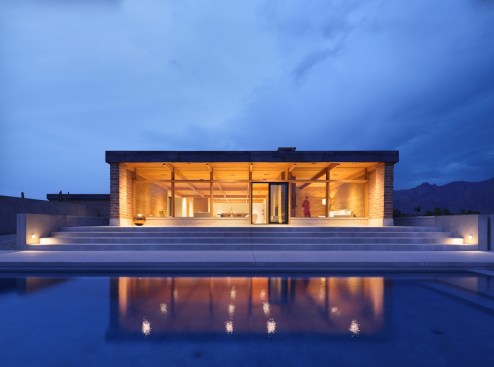
Casa Luce in Tucson, Ariz., by HK Associates. Photo by Ema Peter.
The firm’s work on the 2024 RADA-winning Casa Luce reimagined a 1960s midcentury modern in the Catalina foothills near Tucson that originally had an inward focus, largely ignoring the surrounding scenery. By removing interior obstructions, the design now opens toward floor-to-ceiling windows that, for the first time, embrace the surroundings and natural light. “We doubled up on the experience of the window,” Kothke says.
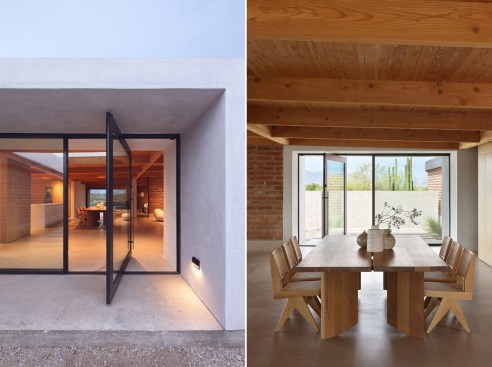
Casa Luce in Tucson, Ariz., by HK Associates. Photo by Ema Peter.
The home’s dining room connects the outdoors with a window wall that features a 6-foot-tall glass pivoting door opening to a private courtyard. Sliding doors could have been an option, but the pivot door “is fun,” Kothke says. “It gives you this sense of arrival, and you can walk on either side of it wondering do you push or do you pull on it? It leads to some engagement.”
Inviting Engagement
It’s precisely that human interaction with the built environment that creates a deeper relationship between people and their homes, says architect Tom Kundig, principal/owner and founder of Seattle-based Olson Kundig. The globally recognized firm is perhaps best known for making those connections through kinetic devices that operate large-scale windows and doors to open interior spaces to the outdoors, expand rooms within the interior, and create uniquely shaped thresholds with strong proportions.

Chicken Point Cabin in Northern Idaho, by Olson Kundig. Photo by Benjamin Benschneider.
“Architecture is about problem solving,” Kundig says. “For me, seeing the landscape through a window or door and being unable to connect with it felt like a problem worth solving.” The firm’s kinetic “gizmos” are a way to connect the homeowner to their dwelling with an enhanced awareness of the surrounding environment, he says. “Interacting with a kinetic is not only physical but emotional. When you’re touching the building through a kinetic, you’re becoming part of that device. It can’t move without your geometries and your systems—you’re the motor.”

Chicken Point Cabin in Northern Idaho, by Olson Kundig. Photo by Benjamin Benschneider.
For a family in Northern Idaho, Kundig designed a 20-by-30-foot manual window wall that opens to the water, dissolving the boundary between the cabin and the landscape. The gizmo’s gears are counterbalanced like a bicycle so that a light crank of a wheel is all it takes to pivot the six-ton steel-and glass window to an open position. “Kinetics require you to think about how you take up space, so they deepen your awareness of the environment around you,” Kundig says.
Finding a New View
Likewise, HK Associates’ projects employ innovative solutions such as a periscope reflection to create a dialogue between exterior and interior. For a house in Tucson’s Barrio Historico, the architects were challenged by historic neighborhood guidelines that didn’t allow for the rooftop deck their clients had requested. “There was no way to get a mountain view unless you are on the roof looking over the top of all of these one-story historic buildings. So, we thought, How can we bring the view into the house?” Hancox says.
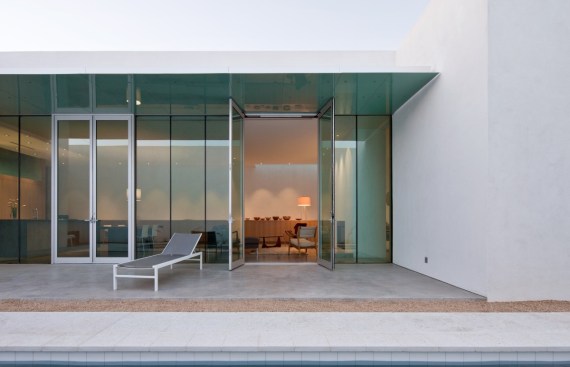
Barrio Historico House in Tucson, Ariz., by HK Associates. Photo by Ema Peter.
The couple designed a long rooftop periscope above the kitchen to bring a distant mountain vista into the home. The periscope view, captured with mirrors at a 45-degree angle to redirect the view and light, is so convincing that it looks like a clerestory window. “There’s ambiguity between what’s the sky and what’s not. It’s very transportive,” Kothke says.

The periscope view in the Barrio Historico House in Tucson, Ariz., by HK Associates. Photo by Ema Peter.
In other instances, the architects focused a photographer’s eye to frame specific views while blocking out other distractions with the unexpected placement of windows. “We crop and edit out,” Kothke says. A house in the Sonoran Desert features square windows that the architects placed near the floor to frame peeks toward the low-lying desert landscape and the wildlife that wanders into view.
“The low window amplifies the detailed view of the desert where these animals—coyotes, rabbits, bobcats, deer, wild pigs, lizards—come up,” Hancox says. “It’s also blocking out what we don’t want to see, then the corner opens up to the view we want to showcase.”

The Real House in the Sonoran Desert near Tucson, Ariz., by HK Associates. Photo by Ema Peter.
The counterintuitive approach provides a fresh perspective for the homeowners. “We’ve found that if you have an all-glass house, which seems like what everybody would want, that you actually take the view for granted,” Hancox says. “So, it’s nice to have moments where the view is taken away from you—so that then, when you come upon it, you really stop and see it.”
Artistic Inspiration
Key to creating these atypical design solutions comes from years of artistic inspiration. Hancox and Kothke say a lifetime of studying art, photography, and science has fueled their imagination. “It’s cultivated over time,” Kothke says. “We’ve found ourselves drawn to artists who have this similar sensibility of blurring boundaries of reality.”
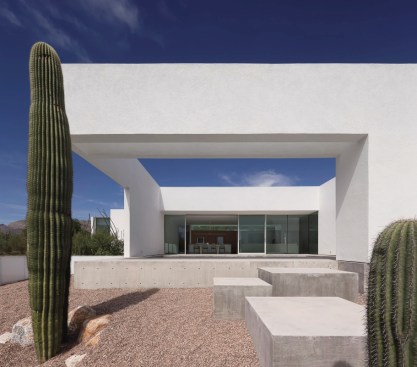
The Real House in the Sonoran Desert near Tucson, Ariz., by HK Associates. Photo by Ema Peter.
He cites artist Gerhard Richter’s photorealistic paintings among their inspirations—most notably the artist’s Eight Gray commission for the Deutsche Guggenheim Berlin (now part of Guggenheim’s New York collection), which features eight enameled glass panels that reflect interior and street views, resulting in a blur between pictorial representation and reality. The couple also leave space for the unexpected. “We can construct accidents and premeditate chance so that you can anticipate what might happen, but there’s often surprise to it,” Kothke says.
“We can set up situations where we can see what the reflections will be like, but we always know that there are things that are going to happen that we could never have known,” Hancox says. “It usually ends up better than we imagined.”
Read other stories in our Framing the Future series.