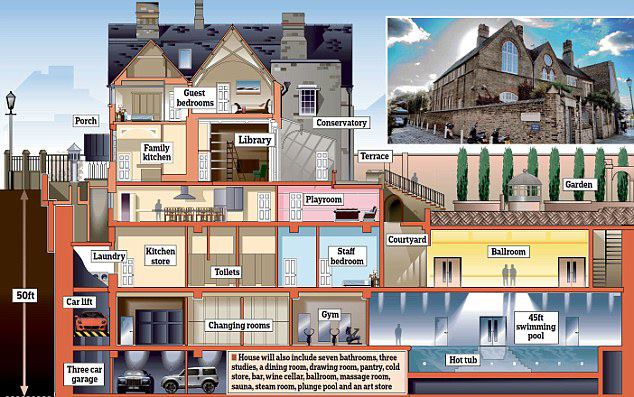
Recently, underground dwellings in two different cities have been making headlines in regards to contrasting living arrangements. London, with its “iceberg” homes, and Beijing, with its underground bunker-like rooms.
Like most cities, London has problems of its own: grim weather, soaring rents, and a lofty cost of living. For the well-heeled living in historic residences, building an addition is another issue thanks to codes governing historic properties. Peculiar to the city, though, is the fact that the past several years have witnessed the digging of preposterous basements sized to match the homeowners’ egos. Neighbors, unsurprisingly, have been fervently opposed and headlines have been made about noise, vibration, and the literal motorcade of trucks that line the street once a project is undertaken. In 2012, a project in the Royal Borough of Kensington and Chelsea even left a neighbor unable to leave her own home.
Meanwhile, Beijing’s exploding housing market has left some with no other option than to look under—not up—for an affordable place to live. For many, tiny, unventilated, repurposed air raid shelters with no safe infrastructure are where they call home. The demographic living in these bunkers of sorts tends to be young men and women migrated from the mainland and working in the service industry, who would rather dish out roughly $80 a month than $500 for better living conditions. More often than not, these make-do living situations are found under luxury apartment complexes, creating a stark contrast between the haves and have nots.
Over the past few years, it has become increasingly difficult to dig basement additions in London homes. As wealthy Londoners (and realistically, foreigners) circumvent regulations preventing them from building up, more regulations and zoning permits have led expansionist homeowners to reconsider their options. The U.K. government is in the process of passing a bill to regulate such gargantuan, subterranean projects.
Another aspect of the dig-down to consider is the actual process: the time it takes, anywhere from six months to two years, the cost of living elsewhere, and the dubious value it adds to the house. “The market has got a little carried away with expectations of rate per square foot that wouldn’t really apply when you take it to the market or go to [an assessor] who is acting for a bank, such as me. If you go deeper and deeper, the value is not as great as people think,” real estate agent Anthony Griffiths told Financial Times.
China’s subculture of underground tenants, called the “Rat Tribe” by Beijing-based photographer Sim Chi Yin, have admittedly made headlines for questionable living quarters, in lieu of in-home theaters reflecting a managing director’s year-end bonus. Interestingly enough, though, two leading cities on different continents have found ways to maximize living space for completely divergent reasons—and people.