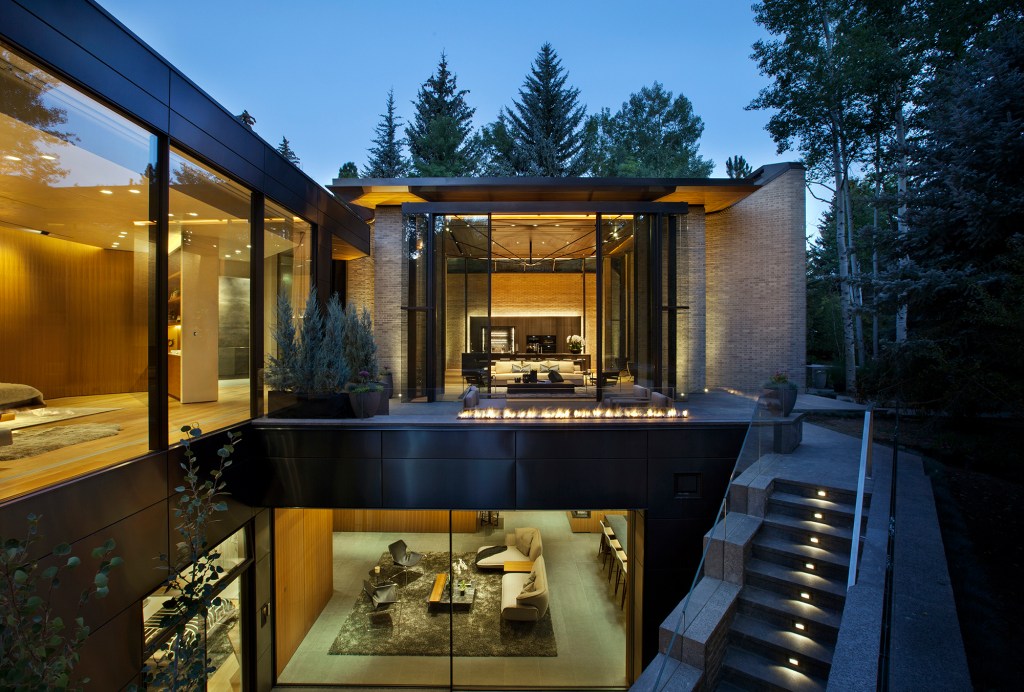
The latest mansions in Aspen, Colo., represent an extreme test case for the mansification of America. That is because land prices there, which were already in the stratosphere, have recently soared at rates at least as steep as the mountain town’s famous ski slopes. Situated at the end of a long valley and endowed with beautiful and difficult-to-navigate terrain and strict zoning laws, Aspen, like many much larger cities, has recently seen an influx of wealthy inhabitants who are moving back towards its tiny downtown, where the rich and famous don’t have to even use their Bentley SUV to get to the local Prada. I recently saw two recent spec houses that illustrate the limits and the possibilities inherent in this situation.
The first of these, whose architect and client will remain anonymous to protect the guilty (and who’s sale appears to be pending, as it has since been taken off the real estate listings), has the advantage of a view from the back of the site towards Hallam Lake, a small body of water that reflects the Rocky Mountains in the distance. Its front façade, however, is right on the street, and it is hemmed in by other houses to either side. Moreover, Aspen has strict height and bulk limits, so what is technically a remodel of a nondescript house can only maximize what was already there. So, as many other new houses there do, it uses what is below the surface. They used to mine silver in Aspen—now they dig for man caves.
What is remarkable is how the architects wasted whatever possibilities they did have. They used the basement for the kind of rec room that you find in many suburban homes, but left it with no particular features, while also sticking a pair of what I assume are staff rooms down there with only a tiny light shaft providing illumination to these prison cells. Digging might have gotten them more square footage, but it didn’t get them any quality space.
The main living area is not much better. A good chunk of it is eaten up by a staircase that confronts you as soon as you enter, but one with no particular beauty or elegance. The space left is laid out for doing whatever it is rich people do when they are on vacation. That remaining living space, however, is blocked from the most prominent vista of the lake by the master bedroom suite—a room you would only inhabit during the dark. This bedroom is, of course, paired with the kind of lavish bathroom slathered with marble and a huge walk-in closet that the prospective clients apparently cannot live without.
The rest of the house is even more mundane. The architects did strew marble and other precious stones and metals all around, as if hoping to distract you from the utter banality and the stupidity of the space planning. But, hey, all this can be yours for a mere $24 million (assuming it falls out of escrow).
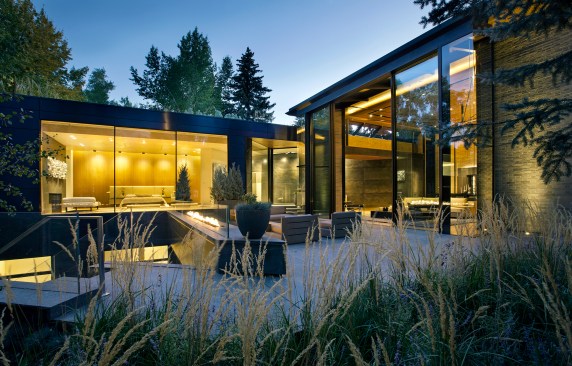
Derek Skalko
301 Lake Avenue Resdience – Remodel/ Reimaginaion, Existing Vitor Lundy Residence voluntarily designated for preservation and reworked to accomodate desires of Aspen Colorado 2018.
Instead, for an extra $5 million (but who’s counting at this point), you could have a piece of real architecture. Across the street from the failed balloon of bad design we just talked about is a house designed by Texas architect Victor Lundy, FAIA, which has now been expanded to over 10,000 square feet by local designer Derek Skalko, Assoc. AIA, and his firm 1 Friday Design. Here, all that additional space is actually impressive, livable, and outfitted with materials that are luxurious but honest and clear in their applications.
Lundy’s original house was an exemplar of (relative) modesty. A cube whose roof the architect held together with metal tie rods he expressed with great bravura, it was essentially a loft for living and entertaining. He tucked whatever else the house offered—including a few bedrooms, a kitchen, and service spaces—into a stack appended toward the rear of the lot.
First, Skalko fixed structural issues and cleaned up the cube, adding large sliding glass doors and restrained details in wood and metal. He then extended out and dug down. A wing of bedrooms and office spaces moves out at an angle that follows the contours of the lot, ending in a grand master suite that is as spacious and restrained as its neighbor’s is cramped and maladroit.
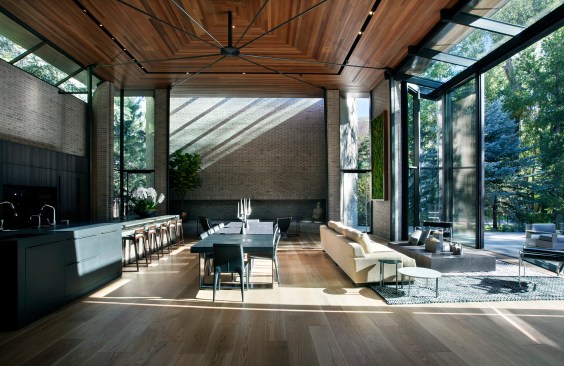
Derek Skalko
301 Lake Avenue Resdience – Remodel/ Reimaginaion, Existing Vitor Lundy Residence voluntarily designated for preservation and reworked to accomodate desires of Aspen Colorado 2018.
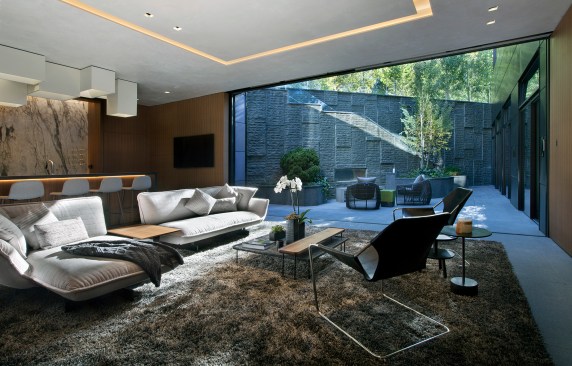
Derek Skalko
301 Lake Avenue Resdience – Remodel/ Reimaginaion, Existing Vitor Lundy Residence voluntarily designated for preservation and reworked to accomodate desires of Aspen Colorado 2018.
The lower level gains light not through a shaft, but from a good-sized courtyard that allows the downstairs bedrooms and family space to look out at what amounts to a secret garden all their own. The functions and the basic accoutrements are not much different from those of the house across the street, but here everything is simple, with large stretches of wood defining horizontal and vertical surfaces, brushed aluminum and steel accents, and planes that slide by each other to move you from one space into another.
The Lundy House, in other words, uses its luxurious budget and the constraints of both program and site—needing to fit that amount of luxury living in any lot is, strangely enough, a constraint—to play out the idiom of a reductive, minimalist, and yet sensuous form of Modernism that has its roots as much in the work of Adolf Loos as it does it that of Ludwig Mies van der Rohe.
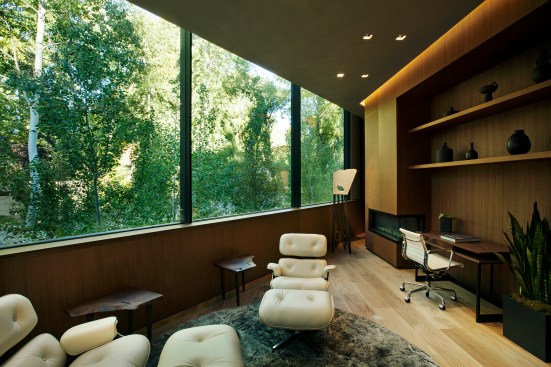
Derek Skalko
301 Lake Avenue Resdience – Remodel/ Reimaginaion, Existing Vitor Lundy Residence voluntarily designated for preservation and reworked to accomodate desires of Aspen Colorado 2018.
There is a danger to maximizing space according to the letter of the law and the dictates of the real estate market, especially if you have a little talent. Just don’t do it.
Would the world gain anything if all McMansions were built with the kind of thoughtfulness, materials, and spatial arrangements you can see in the Lundy House? Perhaps it would be only a marginal improvement. Both the relationship between building and neighborhood, and the development of private and semi-private spaces, would contribute to a shared understanding of where you are and what your relation to others and your environment is. What is more important, if the Lundy House could be a model that could also be developed at the scale of the kind of living environments most of us are allowed—and I believe that it could and should—then the world would be a significantly better place indeed.