
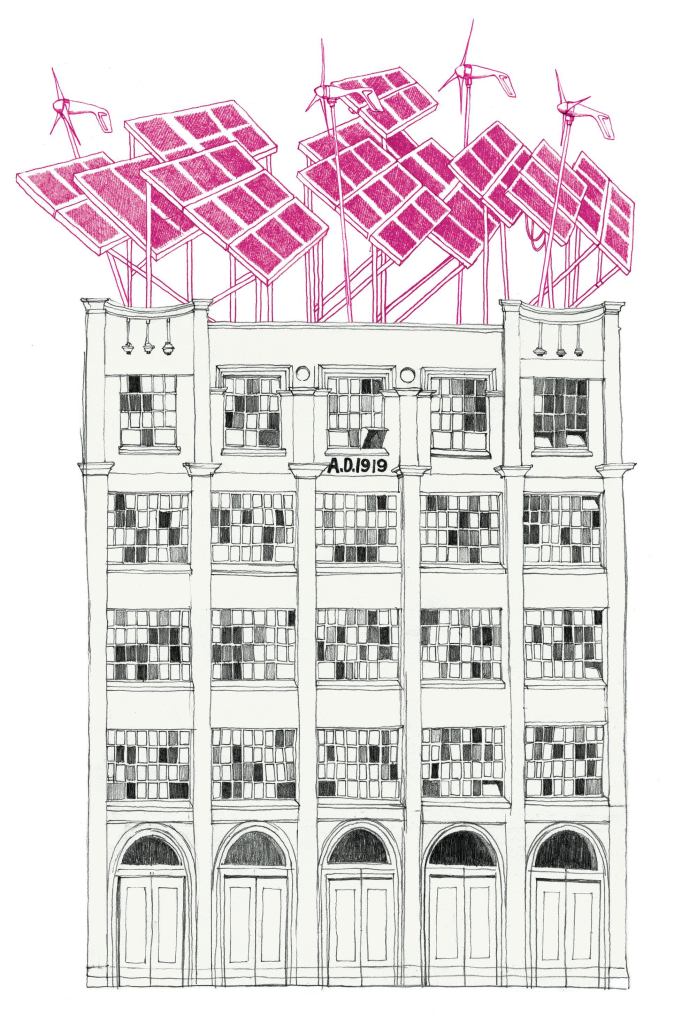
Conserving the recent past.
Nothing changes faster than notions of what’s old. The past 10 years have seen more agitating on behalf of modernist structures that are reaching the age of 50, which is the general eligibility age for the National Register of Historic Places. Not that the agitation is universal: As these structures start to show their age and outlive their intended uses, modern styles of architecture (Brutalism in particular) don’t always command the love of the public at large or of local governments. In Chicago, the city government is tearing down the work of Walter Gropius at the 37-acre Michael Reese Hospital complex on the South Side. The vacant campus was to be cleared for the Olympic Village if Chicago had won its (unsuccessful) bid for the 2016 games, but the city has gone ahead since last fall and begun demolishing all but two of the buildings—constructed from 1948 to 1958—anyway, despite scathing opposition and in hopes of attracting a developer to the site.“We cannot save all buildings. It costs a tremendous amount of money,” Mayor Richard M. Daley told the Chicago Tribune. “How are you going to reuse it? Who’s going to pay for it?”
The issue of 1960s architecture looms conspicuously in Los Angeles, where perennial development pressures put 1960s buildings at risk—both signature structures and more mundane architecture that contributes to the larger urban fabric. The Los Angeles Conservancy has been pushing its The Sixties Turn 50 campaign to get the public thinking about the importance of the period. “We don’t want to be saving what’s left of the ’60s,” says Linda Dishman, the conservancy’s executive director. “We want to start that awareness now.”
One of the trickier issues will be how 1960s ranch-house neighborhoods nationwide are treated by preservationists and planners, says Yeater. “The sprawl that started all of our frustrations is now becoming historic,” he says. “Some suburbs recognize that, but it goes back to the sustainability issue. They’re going to be very difficult to sustain.” But any efforts to fix extant suburban patterns “will run smack-dab into the fact that those neighborhoods are becoming historic,” Yeater says.
“By the 50-year threshold, we’re up to 1960 now,” he adds. “I hope I die before I get to the ’70s.”
Promoting diversity and localism.
Hector Abreu, a preservation consultant and educator based in San Juan, Puerto Rico, has noticed over the past 20 years how many more women and minorities have entered the preservation professions. “When I started, it wasn’t a very diverse field,” he says. By 1997, however, when he started teaching at the Savannah College of Art and Design, “We had a lot of women—over 60 percent of the student body at one point—and also African-Americans and Latinos.” Abreu also tried to make his students aware of the ways preservation projects can quickly transform the demographics of neighborhoods, especially in lower-income areas that are being revitalized, often at the expense of immigrant residents. Although preservation planners may set out to restore a single building, “we’ve almost become these advocates for social change,” which can have effects both good and ill.It is often said that all preservation is local, but now, with the saturation of the Internet in society, preservation has turned hyperlocal. Frederick Bland, an architect and the managing partner of Beyer Blinder Belle, has served since 2008 as a member of New York City’s Landmarks Preservation Commission. Much of the conversation about preservation is now occurring online. “Everything is shared instantly, and everybody knows everything all the time,” Bland observes. “You used to wait for the community meetings and so forth.”
Michael Allen runs the website Ecology of Absence in St. Louis, Mo., which has a huge following locally but also globally. It was Allen who last year revealed the identity of a secretive developer who has amassed 1,200 acres of real estate near downtown. When residents aren’t getting answers from elected officials about development issues, Allen says, “They can get it to the Net and get it blown wide open.”
Tim Whalen, the director of the Getty Conservation Trust, has been impressed at the way ordinary neighborhoods in Los Angeles have mobilized to gain designation as historic overlay zones, a system the city has had in place since 1979. So far, 24 neighborhoods have become historic zones, and more than a dozen proposed zones are awaiting approval.
“Neighborhoods came together and said, ‘We don’t want greater density and the changes we see around us,’” Whalen observes. “These aren’t wealthy neighborhoods. The demographic was diverse. These are people coming together to save places and community life.”
All of these forces that are reshaping preservation play well into Richard Moe’s strategy for decolonizing the movement away from the National Trust’s ornate mansion on Massachusetts Avenue in Washington, D.C. His successor would be wise to keep advancing preservation’s relevance in a similar fashion.
“It used to be that preservation appealed to a number of people who loved old buildings, and for the most part, they were individual buildings,” Moe says. “But now it appeals to a much broader range of people, and not just for aesthetic reasons.” He has seen the trust become a mainstay in areas he hadn’t thought possible, playing decisive parts in social and economic issues, he says. “I hope my successor will continue to look for those possibilities.”