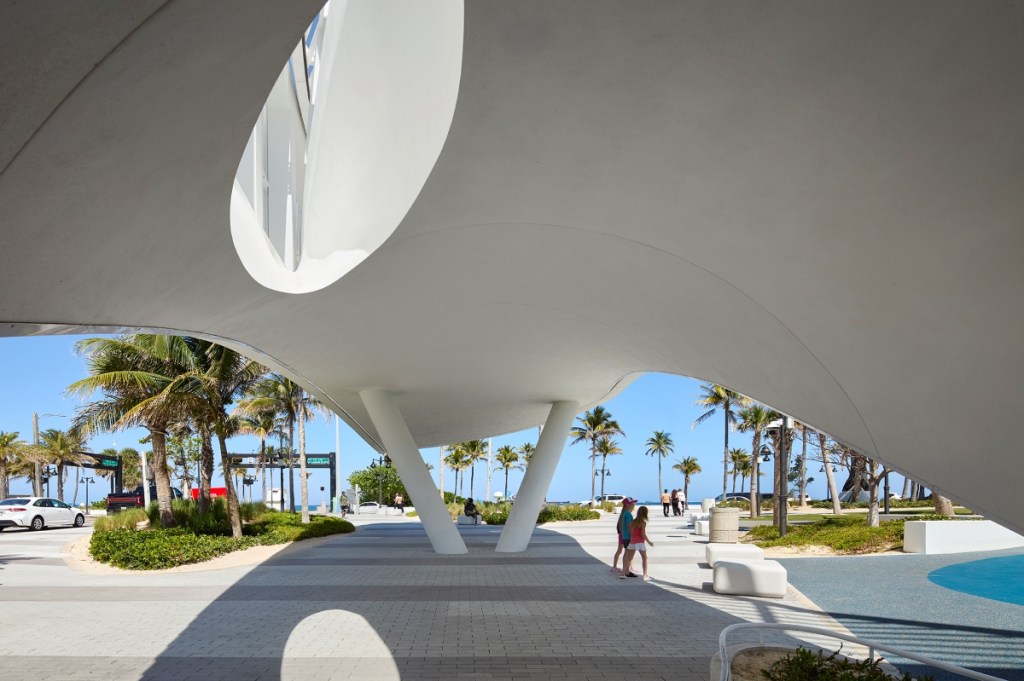
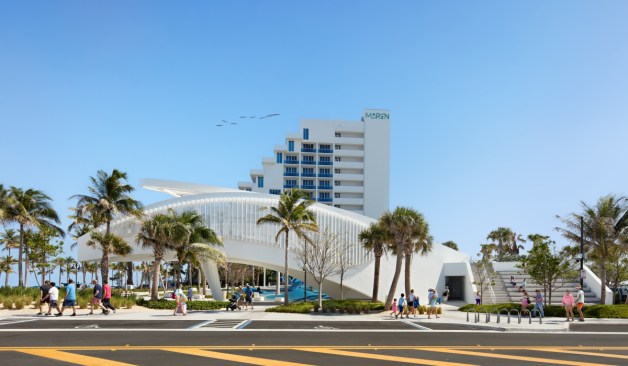
On Fort Lauderdale, Florida’s busy oceanfront, DC Alexander Park replaces a surface parking lot with a compact, 52,300-square-foot landscape that works as infrastructure, habitat, and public space all at once. Designed by Brooks + Scarpa with landscape architecture and civil engineering by PLAN(t) and Keith Engineering, for the City of Fort Lauderdale, the $5 million project is part of a broader effort to harden the city against coastal flooding and sea-level rise without resorting to more concrete walls along the shoreline.
Credit: Brooks + Scarpa
From Parking Lot to Living System
The site is subject to constant salt spray, heavy rains, and storm surge. It also faced a familiar tangle of permitting and flood-control requirements. Rather than treat resilience as an engineering problem alone, the design team used landscape as the primary tool.
DC Alexander Park “botanizes” the former asphalt lot, replacing it with a layered coastal ecosystem. The project interprets two native Florida systems—the coastal dune and the tropical maritime hardwood hammock—into a series of planted zones, paths, and overlooks. The goal is to protect landward investments, absorb water, and create a comfortable, legible public space for both residents and tourists.
Credit: Brooks + Scarpa
Dunes as Barrier and Playscape
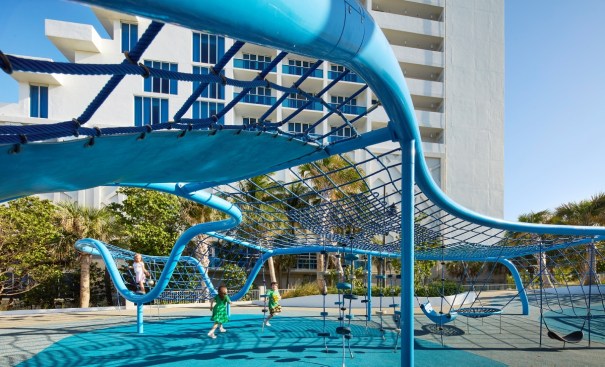
Along the upland edge, the park introduces vegetated “root” dunes that act as a soft buffer against storm surge. Between and around these planted forms, rubberized surfaces create a boundless playscape. Rather than relying on standard playground equipment, the topography itself invites climbing, running, and informal play.
Credit: Brooks + Scarpa
A Ramp to the Ocean
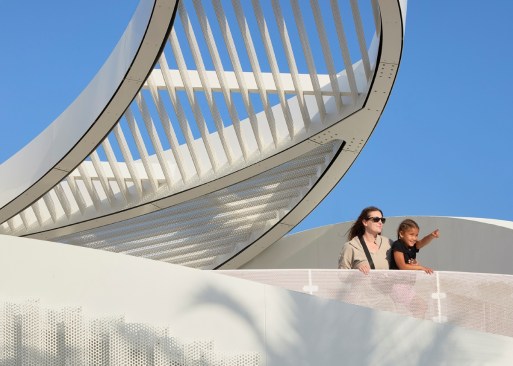
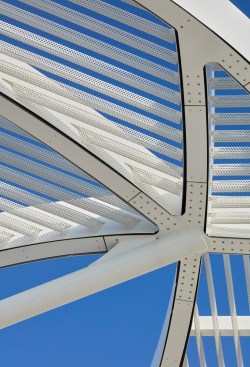
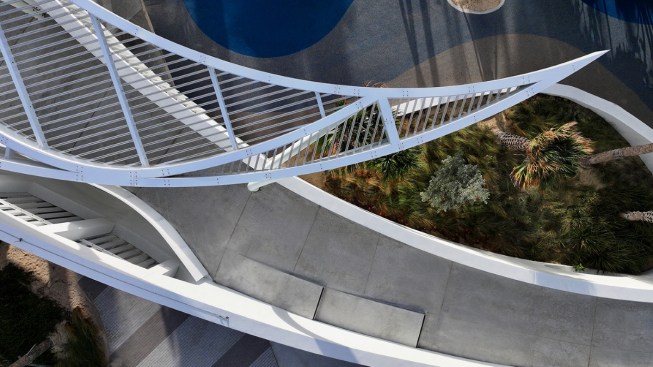
One of the project’s defining elements is a ramping dune that rises to a 25-foot cantilevered overlook offering panoramic views of the beach and Atlantic Ocean while doubling as part of the resilient infrastructure.
The ramp and overlook are designed for universal accessibility, allowing users of all ages and abilities to experience the elevation change and long views. The structure reads as both public art and lookout, turning a functional flood-resilience element into a memorable civic gesture.
A Hammock That Holds Water
At the perimeter of the park, a reestablished maritime hammock functions as a sponge for rainfall and saltwater flooding. This planted zone slows, stores, and filters water during storms and high tides while providing shade and habitat.
The hammock supports passive recreation—walking, sitting, and informal gathering—within a more enclosed, shaded environment. It also creates opportunities for habitat development for native fauna, strengthening biodiversity along a heavily developed stretch of coastline.
Credit: Brooks + Scarpa
Shade, Comfort, and Shared Street
On the park’s northern edge, a coastal plaza acts as a shared space that calms traffic and frames the park’s entry. Here, a “shade hammock” of trees filters the intense Florida sun, creating dappled light over the plaza and walkways.
The planting palette emphasizes native and indigenous species such as Green Buttonwood, Gumbo Limbo, and Seagrape. These trees and shrubs are adapted to salt, wind, and heat; they require less maintenance and reinforce the project’s ecological narrative. Their branching structures and leaf canopies create a distinct visual character while improving comfort for pedestrians and cyclists.
Credit: Brooks + Scarpa
Infrastructure as Public Art
Throughout the park, resilient systems are treated as expressive design elements. Flood protection, stormwater management, and circulation aren’t hidden—they shape the experience of the space.
This approach contrasts with the “hardened” infrastructure seen elsewhere along the Fort Lauderdale shoreline, where seawalls and revetments can be visually harsh and disconnected from public life. At DC Alexander Park, dunes, ramps, overlooks, and hammocks are all doing work: absorbing water, protecting adjacent properties, and inviting people in.
By integrating performance, accessibility, and aesthetics, the park positions resilient design as an asset rather than a constraint. It demonstrates that coastal adaptation can be fiscally responsible and visually compelling.