The conventional line between architecture and construction gets blurry in the work of Los Angeles–based Besler & Sons. Although Erin and Ian Besler officially co-founded the firm in 2014, the couple has been working together for years. “It’s less of a collaboration and more that we work on each other’s projects equally,” Erin says. Ian agrees: “At times it’s discrete, and at times it’s really passing [a project] back and forth.”

Courtesy Besler & Sons
"The Entire Situation"
The practice—whose name stems from Ian’s graduate program director’s frequent greeting: “How’s ‘Besler & Sons?’ ”—has accumulated several accolades in its short history. In 2015 alone, it won the Architectural League Prize and was a finalist for the MoMA PS1 Young Architects Program. The firm was also invited to participate in both the inaugural Chicago Architecture Biennial (CAB) and the Shenzhen and Hong Kong Bi-City Biennial of Architecture/Urbanism (UABB), where it was part of the “Now, There: Scenes from the Post-Geographic City” pavilion, which nabbed the UABB Bronze Dragon.
Besler & Sons approaches each project with the goal of sparking discourse among different types of people, perhaps because their own backgrounds vary so—Erin is a trained architect with a B.A. in architecture from Yale University and an M.Arch. from SCI-Arc; Ian is a graphic designer and arts writer with a B.S. in journalism from the University of Illinois at Urbana-Champaign and an M.F.A. from the ArtCenter College of Design, in Pasadena, Calif. Not surprisingly, then, their design processes don’t always align. “We spend a lot of time talking about process and trying to critique it,” Ian says. “We think about the procurement of materials as well as the installation, exhibition, and de-installation periods,” Erin adds.
Courtesy Besler & Sons
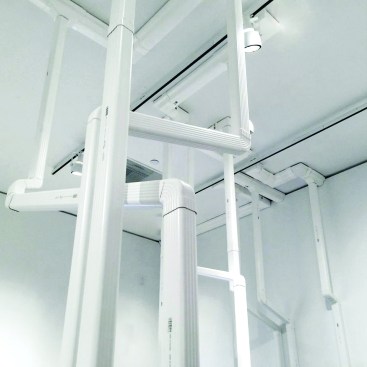
For its 2015 Architectural League Prize installation, the Beslers developed a network of gutters that bent around existing gallery track lighting to showcase the potential of commonly available building materials.
The result is projects that are driven by investigations into fabrication and made from off-the-shelf building materials: drywall, molding, steel studs, 2×4s, and even gutters. “We rely on the standardization of big-box retail store inventories,” Ian says. For example, as part of their Architectural League Prize exhibition, Authenticity, the designers refitted rain-gutter components to form a network that bent around existing lighting within the gallery space.
Joshua White
"The Entire Situation"
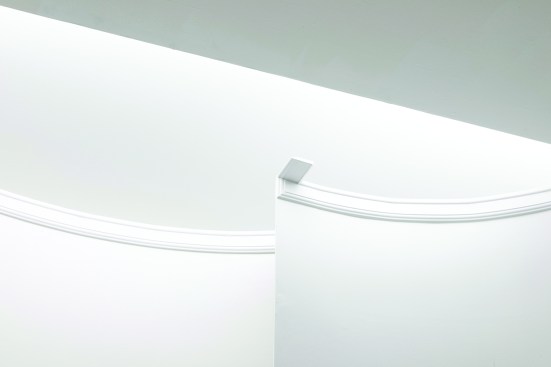
“The Entire Situation,” an installation at Los Angeles’ MAK Center for Art and Architecture, featured full-scale mock-ups of interior walls with unexpected treatments like baseboards that appear to fold over themselves. The Beslers continued this research in their CAB project by developing the software Studfindr in collaboration with Satoru Sugihara, founder of Los Angeles–based firm ATLV. The program generates and catalogs 3D digital models, complete with time-and-material estimates, based on input from visitors to the installation.

Courtesy Besler & Sons
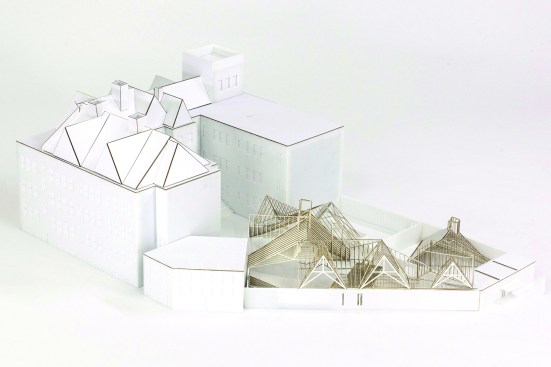
For their MoMA PS1 proposal, “Roof Deck,” the pair focuses on the roof, both for its architectural properties and for its history as a social space, to provide the requisite shade, seating, and water in the museum courtyard. Inspired by conversations with architectural critic and historian Sylvia Lavin—who directs the Ph.D. program at the University of California, Los Angeles’ Department of Architecture and Urban Design (UCLA.AUD), where Erin also teaches—the Beslers proposed replicating MoMA PS1’s roofing framework at full-scale above the courtyard, attaching gutters to divert runoff into a water retention system. Any roof portions that couldn’t fit would be inverted and used as stages. The concept cleverly integrates a form of reuse and recycling by alluding to MoMA PS1’s 1976 inaugural exhibition, “Rooms,” where artists used the museum building itself as a medium.
Courtesy Besler & Sons
Besler & Sons’ proposal for the 2015 MoMA PS1 Young Architects Program replicated the museum’s existing roof framing to create a sunshading system for the PS1 courtyard.
By using standard construction materials in nonstandard applications, Erin says that Besler & Sons continually pushes the line between design and making while “thinking about the life span of a project” and exploring how to assemble meaningful designs within practical constraints.
This article has been updated to reflect Besler & Sons involvement in the “Now, There: Scenes from the Post-Geographic City” pavilion at the Shenzhen Biennale. Erin Besler earned a B.A. in Architecture from Yale University. Ian Besler attended the University of Illinois at Urbana-Champaign.