




Charlie Brown
A Brief History
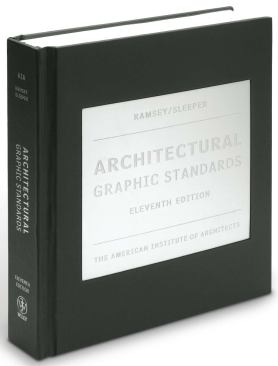
Although “Graphic Standards” suffices as the tome’s shorthand for architects today, earlier generations invariably referred to their trusty desktop reference as “Ramsey/ Sleeper” for the authors who oversaw the first five editions. An introductory essay in the latest edition introduces the pair and the social concerns within the profession during the decade prior to the book’s introduction—“situating” them with au courant academic phrasing. But what’s most notable is the fact that Charles George Ramsey and Harold Reeve Sleeper’s initial book proposal to publisher John Wiley & Sons was dated Oct. 29, 1930—exactly one year after the stock market crash that initiated the Great Depression. Work at the New York–based firm of Frederick L. Ackerman, where they were associates, had apparently dried up, and the need for some gainful activity provided the stimulus for architecture’s best-seller.
Cornell-educated Sleeper (1893–1960) met immigrant draftsman Ramsey (1884–1963) when he joined the firm in 1919. While their employers split the following year, Ramsey and Sleeper remained with Ackerman. The most notable of the firm’s projects during the following decade was the 1924 collaboration with Henry Wright and Clarence Stein on Queens’ Sunnyside Gardens development. That same year, Ramsey co-authored a book intended for the training of draftsmen called Architectural Details. In a blatant act of self-plagiarism, certain drawings were reused in the initial editions of Architectural Graphic Standards. By all accounts, the two workers’ interests and skills were complementary: Ramsey was the office’s chief draftsman, Sleeper the specifications writer. Sleeper acknowledged that he initiated the research and organization of the book; the more graphically oriented Ramsey was responsible for the final presentation. Sleeper published several other specialized tomes, including Architectural Specifications in 1940, reflecting his early involvement in the Construction Specifications Institute.
Initial sales of Architectural Graphic Standards were impressive, given the economic climate that accompanied the years of its production and the first printing in 1932. In 1947, not long after the end of the World War II, Wiley sold the 100,000th copy. By 1970, the book was such an entrenched part of professional practice that the American Institute of Architects joined Wiley as the co-publisher of the sixth edition—a role that the AIA has continued to this day. Sales soared to reach a tally of 1 million copies by 1999.
It’s been over half a century since the resourceful Ramsey and Sleeper worked on the book. Today, it’s a team effort involving dozens of contributors and advisers—but Wiley and the AIA honor their legacy by placing the original authors’ names on the book’s front cover and spine.