
Aaron Betsky
"Untitled" by Pierre Huyghe
The strangest thing I saw at Documenta 13 in Kassel, Germany, was what I guess you would call a garden, hidden away in the far reaches of the municipal park, the Augarten. It was about as far away from the baroque splendors of the swath of green that spreads out along radiating lanes from the old garden palace along the Fulda River as you could get. If there was a hint of what was to come, it was the irregular mounds that Song Dong deposited at the end of the palace’s front lawn, their cones hinting at abstract versions of the surrounding hills.
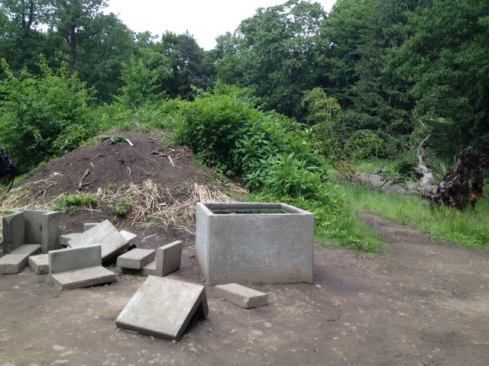
But if you hike past the lines of trees and hedges and turned into the poche between those lines you can find much more irregular nature yet. A muddy track and some dirt mounds leads into what appears to be a work yard from which the maintenance crew stage their assaults on nature to keep the garden disciplined. Instead, it is “Untitled” by Pierre Huyghe, a French artist who knows how to shock.
Huyghe recently created an installation in which, or so I am told, one of the things you might find actors doing as you visited the art was copulating. He also bought the rights to a Japanese anime character and had artists create animations that turned her into something very different than her fairytale roots might suggest.
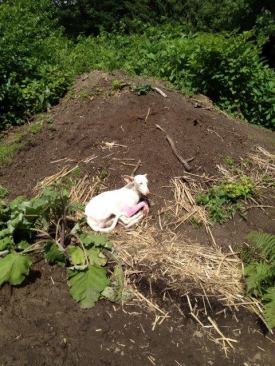
Here, he was in a tamer mood, or perhaps in a mood not too tame. The piece’s official description is: “Alive entities and inanimate things, made and not made/Dimensions variable.” It consists of mounds, some of dirt, some of them of fragments of asphalt or concrete. Each has its own place and order, and, after you realize that they are not happenstance accumulations of trash, begin to fascinate because of the variety of materials and forms they exhibit.
The largest mounds are covered with weeds and with flowers that, one visitor told me, are native to Afghanistan—a country that is a special focus of this year’s Documenta art exhibit. A caretaker wanders around continually, filling a can from concrete cisterns and watering this mess of growth. Part of his hair is shaven, and a semicircle of what remains dyed lavender. His two dogs, each thin, but attentive, friendly, and altogether doglike, also sport one lavender-dyed leg.
The closest that this installation comes to appearing to be art is in the central zone, where both mud and a sign discourages you from entering. This is the realm of a female nude statue, reclining on small plinth, her head covered with a beehive around which the apian creatures do whatever it is they do in Germany in the summer.
What it means, I really have no idea, though when I visited, a young man was holding forth on what appeared to be theories of aesthetics, perched on some of the concrete blocks while an audience tried to follow words that seemed as messy and weedy as the surroundings. I do know that this installation, together with several of the other pieces spread throughout Kassel until November, make you think about what is human-made and what is natural, how we make order and sense of things, and what our landscapes tell us about ourselves. More than anything else, these are art works that the makers assembled as much as they invented them, creating moments and places, rather than permanent things, of art.