
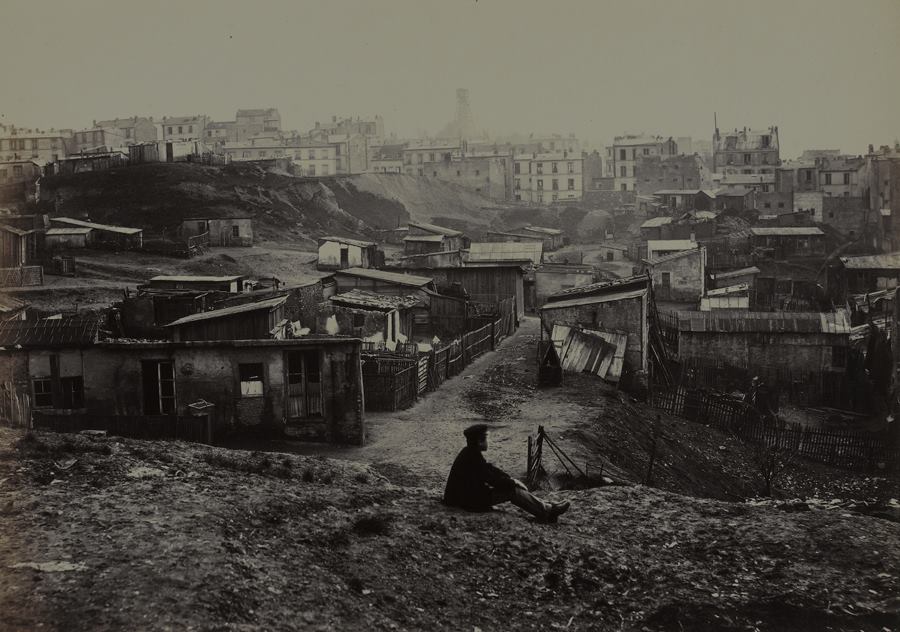
Photographer Charles Marville (1813-1879) spent many years in Paris documenting the city as it underwent extensive renovation and development. A placard in a new exhibit of his work reads:
“On occasion Marville deliberately posed one of his assistants in the otherwise lonely stretches of abandoned structures, recalling the theme of the romantic wanderer contemplating the remnants of earlier civilizations, but also the modern notion of the flâneur, the disengaged observer of the rapidly transforming city.”
The new exhibition, “Charles Marville: Photographer of Paris,” at the National Gallery of Art in Washington, D.C., opened Sunday, and provides a journalistic glimpse of the city from the perspective of a photographer that could himself be called a bit of a flâneur. These photographs are fascinating on several counts. One, they satisfy our fetish for “ruin porn.” But perhaps more importantly, they are a rare glimpse of what was, as today’s ruin porn becomes tomorrow’s historical record.
Marville was hired by the city on numerous occasions to document changes during the Second Empire under Emperor Napoleon III and urban planner Baron Georges-Eugène Haussmann. This period saw the birth and death of many Parisian architectural structures and infrastructure (including public urinals, pictured below).
He also was a pioneer in the collodion process, a photographic technique introduced in the 1850s, which was more ideal than previous methods for capturing the sharp lines and detail of buildings. As Sarah Kennel, the exhibit curator and museum’s associate curator in the department of photographs, said last week at a press preview, “Marville excelled at photographing architecture.”
“Charles Marville: Photographer of Paris” runs from Sept. 29-Jan. 5 at the National Gallery of Art’s West Building in Washington, D.C. The exhibition was organized by the National Gallery with New York’s Metropolitan Museum of Art.
