
The future arrives in two years. At least it is according to Blade Runner, the 1982 thriller directed by Ridley Scott. The movie takes place in Los Angeles, November 2019, in what is unquestionably the greatest of all cinematic cities of the future. A sequel, Blade Runner 2049, opened on Oct. 6, and to maintain continuity, director Denis Villeneuve brought back actor Harrison Ford, screenwriter Hampton Fancher, and concept artist Syd Mead. What he left behind was the original’s richness of detail, verisimilitude, and conceptual rigor.
Scott’s movie was a glorious swan song for analog special effects: He reworked sci-fi conventions that first appeared in 1927, in Austrian director Fritz Lang’s Metropolis, a silent parable of progress and personhood set in 2026. In all three films, there are flying cars, impossibly tall buildings, villainous technocrats, a downtrodden populace, and robots masquerading as real people. In the Blade Runner universe, robots are called replicants. Not mechanical but bioengineered, and indistinguishable from humans, they’re made to work “Off-world” (i.e., in outer space) and forbidden on pain of death to set foot on Earth. Not that Earth is so appealing: Environmental mismanagement has left L.A. denuded of sunshine and palm trees. Ford’s character, a policeman bounty hunter, chases down
the strays through crowded, dark, and stormy streets.
Warner Bros.
The city appears as kind of a parasitic life-form, a character in itself, with a richly layered backstory. Its urban evolution becomes evident in a palimpsest of western and eastern iconography, decrepit masonry apartment buildings and pyramidal corporate headquarters, humble neon street signs and enormous animated billboards, and a haywire network of building systems and mechanicals. Filming took place in Burbank, on a Warner Bros. backlot, and at select locations around town, such as Union Station, the Bradbury Building, and Frank Lloyd Wright’s Ennis House, linking the L.A. of Blade Runner with the true place and its past.
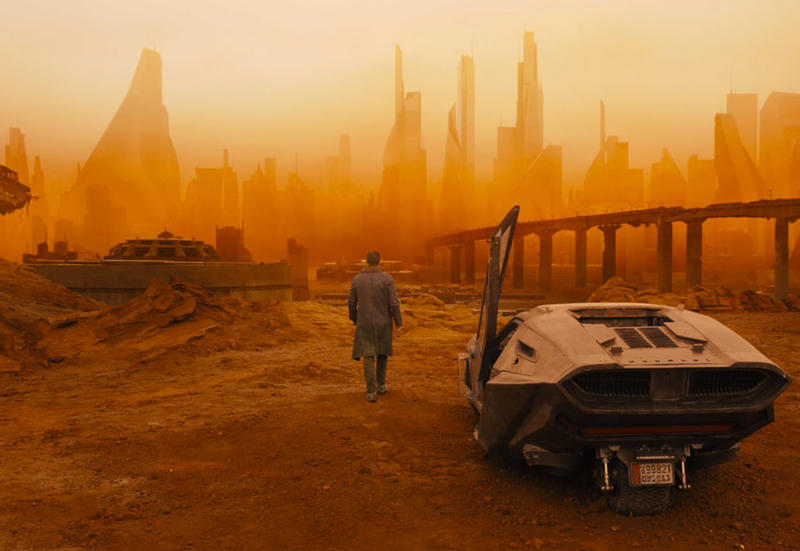
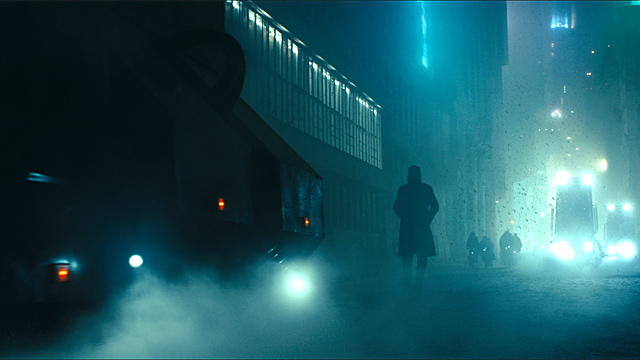
Villeneuve, to his credit, doesn’t mimic Scott’s aesthetic (though there are nods throughout) and uses digital effects sparingly. He cites Brutalist architecture as an influence, and exhibits a penchant for reductivism, copying a powerfully spare rendering by Spanish modernists Barozzi / Veiga for one interior set. Fancher’s story moves the plot and themes in smart directions. Regrettably, the production design, by Dennis Gassner, doesn’t follow. In L.A., 2049, the environment has degenerated to the point of sterility, helped along by a nuclear war. Perpetual winter has supposedly set in, but the condition isn’t self-evident: Coats go unbuttoned, snow resembles ash, and yellow is the symbolically dominant color. The planet may be dying, but it doesn’t seem cold.
In some scenes, L.A. looks deserted, the residents dead or gone Off-world; in others, streets and buildings are crowded, the dim skyline punctuated with innumerable lit windows. Villeneuve shot in Budapest, Hungary, which no one could mistake for L.A.—or even for Las Vegas, where the action moves for a spell. An atmospheric blur of fog, smog, snow, ash, dust, sand, or rain reduces many shots to hazy monochrome, like a succession of horizontal-format Rothko paintings. Blade Runner 2049 delivers abstraction at the expense of meaning. There are moments of great beauty, but the film feels soulless, like a replicant, desperately searching for an identity of its own in the long shadow of its progenitor.
