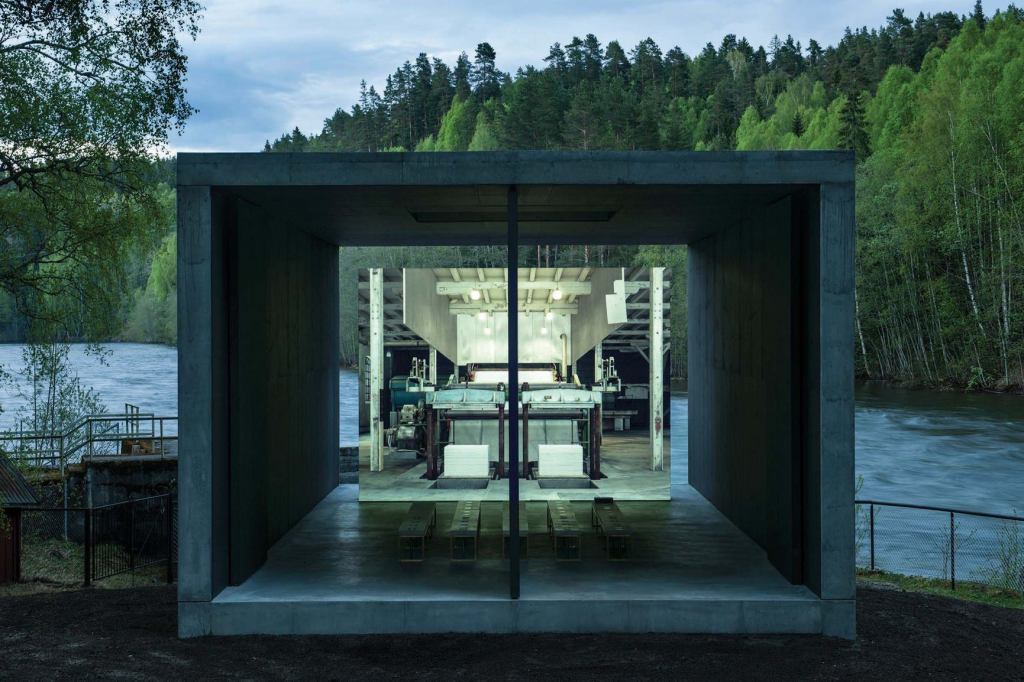
Constructed at the grounds of a former riverside paper mill, Pulp Press, a pavilion collaboratively designed by A2 Architects and Irish artist John Gerrard, pays tribute to its 19th century predecessor by projecting 30 years of footage of its original, mechanical function onto its interior walls.
“Pipes have been replaced, valves sourced, missing components researched by the production team for over a year and all recreated in simulacra,” the architects explain in a press release.
The cast-concrete structure, located one hour north of Oslo in Jevnaker, is a permanent installation for Kistefos Museum, a prominent contemporary sculpture garden. The pavilion sits alongside the edge of the same River Rands that powered the original paper mill, which dates back to 1889 and was decommissioned in 1950.
Pulp Press stands at a height of five meters (16 feet), with its base measuring 13 meters (43 feet) long and 6.5 meters (21 feet) wide. The pavilion sits at an angle that forms a cluster with an existing boathouse and adjacent concrete pier. Three pivoting pre-stressed plywood doors are recessed into the structure.
One open façade faces the former paper mill, and the other overlooks the river, which powers the building through hydro-electrics. Its interior walls, painted black to allow for the projection, simulate a painstakingly accurate digital replica of the industrial paper mill.
The project was recently nominated for a European Union Prize for Contemporary Architecture (Mies van der Rohe Award 2015).
“While we may live in a ‘paperless’ world, the work is keen to remind us that even digital data is stored in a physical world. The projected work’s physical presence is also inherent in the daily increasing ‘stock’ of digital sheets of paper pulp it produces – digital files that are inspired by historic images. They accumulate in metal hard-disk units on a nest of precast concrete and brass shelves inside the pavilion, emulating the piles of wood pulp bales that the mill once produced. As each hard disk is filled, another is required, and so the project expands forever more.”-A2 Architects