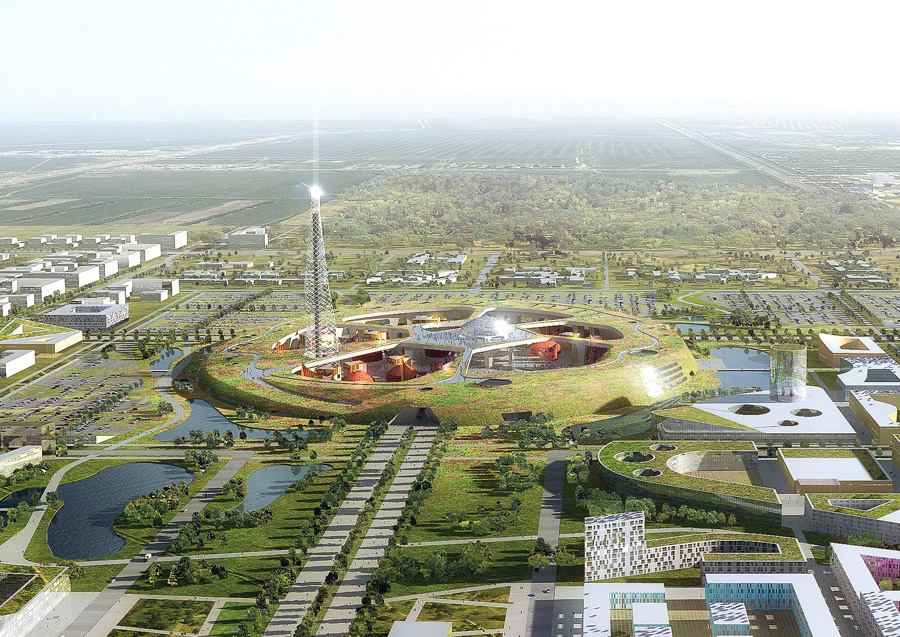
A spectacular world expo is slated for 2017 in Astana, Kazakhstan. Dedicated to the “future of energy,” the expo could be designed by Zaha Hadid, FAIA, Moshe Safdie, FAIA, Gordon Smith, Snøhetta, Coop Himmelb(l)au, Mecanoo, or Jürgen Mayer H., depending on who wins the competition between these firms and others. Based on recently released images, it looks as if whoever wins, the result will be not the usual collection of disconnected pavilions, but a structure of an enormous scale and (in many ideas) a daring design.
The city of Astana—which Kazakhstan’s strongman, President Nursultan Nazarbayev, turned into the gas-rich country’s capital in 1997—has already been the site for eye-catching designs by Norman Foster and the like, but from photographs also appears to be a mind-numbing array of the kind of soulless blocks that now constitute the meat-and-potatoes mass of most Asian cities. Situated on the barren steps of the country’s northern reaches, Astana is meant as the incubus of a completely controlled (and non-Russian) environment. The expo will both celebrate its achievements and attempt to launch it into the orbit of world capitals.
If architecture can do that, these designs certainly will succeed. I am especially fond of the designs, such as those by Snøhetta and Mecanoo, that seem to grow out of the ground and turn that landscape itself into a monument to the new. Yet Hadid’s and Coop Himmel(b)lau’s efforts also seduce with their dramatic explosion of forms.
The question is whether it is right for a country to spend this amount of money on what amounts to a giant folly—all expos loose money, and often a staggering amount—that will celebrate a dictatorship. And should architects participate in this effort? Even though I am tempted to say that at least with these finalists, the result will be better than if some mediocre firm were to design it, I would say not.
Contrast these efforts to the work of Yehuda Greenfield-Gilat and Karen Lee Bar-Sinai about Jerusalem. Assuming that at some point peace will come to the area, they have created a visualization of a dual-capital Jerusalem based on what territories each state would most logically control. They have drawn a border that is complex and sensitive to both population patterns and the landscape. They have even designed border crossings that attempt to ameliorate the harsh reality of what will, in their view, be a divided city.
Not content to make big plans, nor are they, from the evidence I have seen, the most original or accomplished (though quite good) designers, the duo built a map in a Tel Aviv gallery, encouraging visitors to move pieces of the area around according to how different Jewish and Palestinian territories might fit together. The sad thing is that it turns out to be an impossible puzzle to solve, and that is exactly why it deserves the attention of serious architects and planners from around the world.
Perhaps if the same imagination that can envision such a spectacular artifice celebrating an artificial capital like Astana under the rule of an authoritarian regime could come up with as-convincing images and forms for one of the world’s oldest and most troubled seats of government, it could contribute something real.
Aaron Betsky is a regularly featured columnist whose stories appear on this website each week. His views and conclusions are not necessarily those of ARCHITECT magazine nor of the American Institute of Architects.