

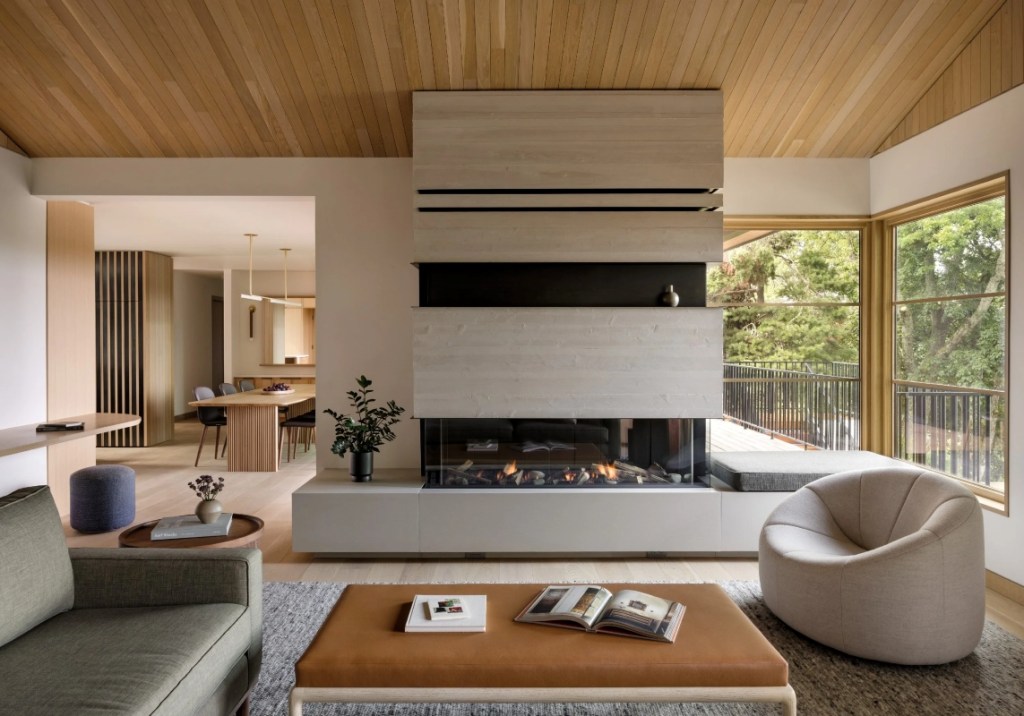
Global design influences can transport us in an instant—from admiring the cloister at Coco Chanel’s coastal house in France to peeking into a tiny powder room in Sicily, where the sink and walls are carved entirely from Libeccio Antico marble.
These are the kinds of touchpoints—encountered in person or from the comfort of an armchair—that fill Pinterest boards and magazine spreads with inspiration. Clients often arrive at meetings with architects clutching dog-eared pages showcasing design details from around the world.
The appetite for cross-cultural references is only growing. International tourism rebounded to pre-pandemic levels last year, with Spain, Japan, and Morocco each breaking visitor records, according to a New York Times story.
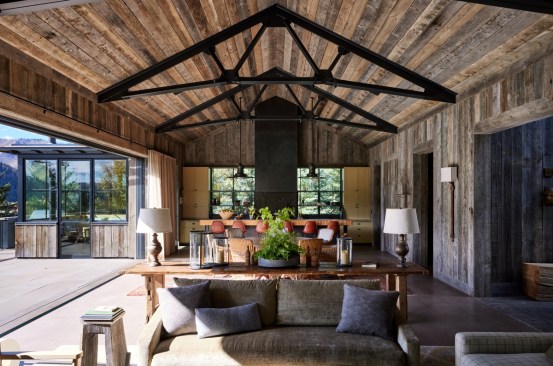
Sun Valley Residence in Ketchum, Idaho, by Backen & Backen Architecture. Photo by John Merkl Photography.
That exposure often shows up back home in the form of design requests. “Our client base is one that definitely travels—they’re going to different places around the country, around the world, and seeing a lot of different things,” says architect Pamela Lamaster-Millett, principal of Searl Lamaster Howe Architects. “And it’s always interesting when they bring ideas back to us in Chicago.”
Climate Adaptation and Glass
While connecting to the outdoors remains a top consideration for homeowners, blurring the boundaries between inside and out requires ingenuity. An open-air living room in Spain, for example, doesn’t carry the same appeal in the woods of Wisconsin. “While we love to bring the outside in, it’s about finding a way within product lines to keep that visual sense of openness and also be able to manage people’s lives to maintain a comfortable space,” Lamaster-Millett says.
Architects, too, are looking to far-flung projects and travels that translate stateside, and glass is often central to that exchange. “We’ve always used a lot of glass in our projects,” says Minneapolis-based architect Charles Stinson. “The indoor-outdoor relationship that we need as human beings, that’s been part of what we’ve done forever.”

Cayman Islands Beach House by Charles R. Stinson Architecture + Design. Photo by Paul Crosby.
For Stinson, travel has reinforced a design philosophy centered on glass and expansive views. His projects span the hills of Germany, the Costa Rican coast, and the dramatic urban fabric of Dubai, and the design strategies he’s employed abroad—wide banks of windows, deep overhangs to shield the sun, outdoor grilles that provide privacy, for example—have also informed his U.S. work. In a desert bluff house he designed in Arizona, the structure appears to rise organically from the mountainside, its cantilevered wings hovering above the valley below. Floor-to-ceiling windows meet without corner posts and disappear into rugged stone walls, dissolving the boundary between landscape and home.
Merging Design Details
Global influences that inspire American architecture often do so in ways that transcend specific styles. “It’s less about ‘this is traditional’ or ‘this is modern,’” Lamaster-Millett says. “It’s much more fluid. You see modern additions on old buildings.”
Her firm is currently designing an addition for a family in Evanston, Illinois, who once lived in London and wanted to replicate the sleek glass-enclosed kitchen additions common on century-old townhomes there.
“Bringing that sense of ease with modern living across decades of time is something that our clients have embraced,” she says. “You don’t have to be a die-hard modernist to make a nod to something else that has inspired you from some other period.”
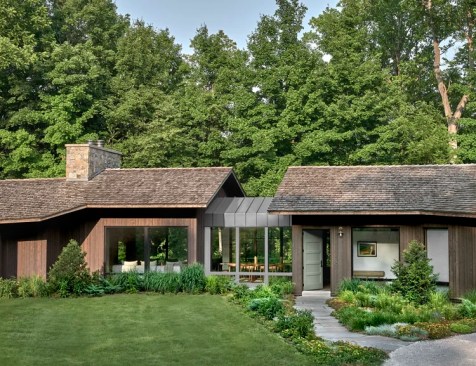
Buchanan Riverhouse in Buchanan, Mich., by Searl Lamaster Howe Architects. Photo by Tony Soluri.
Another client commissioned Lamaster-Millett’s firm to create a glass-enclosed dining space for multiple generations to gather at their second home. The design forms a “knuckle” dining room that bridges the structure’s two wings. Covered by a standing-seam metal roof, the room overlooks an orchard of fruit trees on one side and opens to river views on the bluff-facing side.
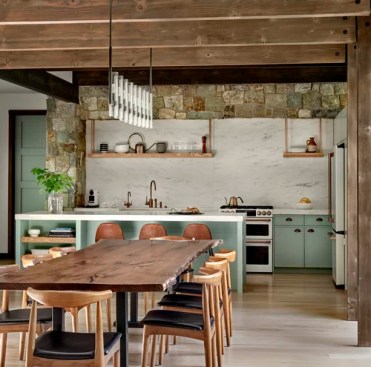
Buchanan Riverhouse in Buchanan, Mich., by Searl Lamaster Howe Architects. Photo by Tony Soluri.
Similarly, Dusan Motolik, principal of St. Helena, Calif.-based Backen & Backen Architecture / Lifestyle / Wellbeing, notes that the firm’s signature use of steel-sash windows integrated with agrarian forms traces back to England during the 19th century.
“We’ve created a high-end look that is elevating the architectural aspect of residences wherever it’s used,” Motolik says. “It’s quite timeless in its look and in its execution. It’s the strongest, most durable product you can get that can embellish the building itself.”
Motolik points to a Sun Valley, Idaho, residence—a project he designed in collaboration with the firm’s founder, the renowned late architect Howard Backen, and partner Tony Selko—as an example of how these ideas come together.
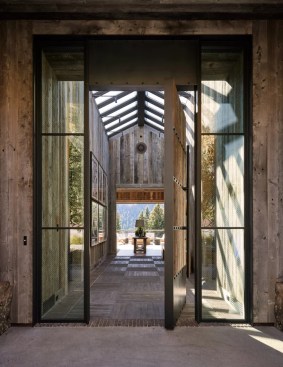
Sun Valley Residence in Ketchum, Idaho, by Backen & Backen Architecture. Photo by John Merkl Photography.
The home’s entry gallery is defined by a ridge skylight, fulfilling the client’s desire for an internal courtyard in a cold-climate location. “By introducing a 9-foot-wide gallery topped with a ridge skylight, we were able to provide ever-changing natural light and views of the sky—including stars at night—transforming what could otherwise be a dark, unremarkable internal spine of the house,” Motolik says.
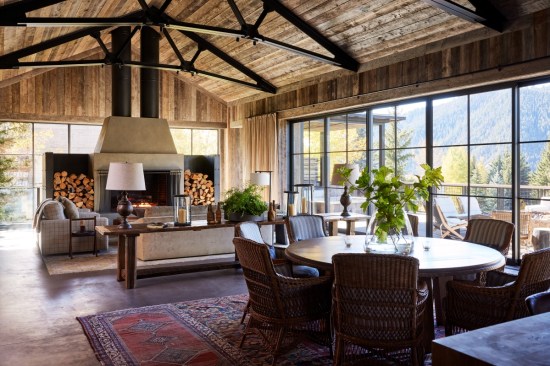
Sun Valley Residence in Ketchum, Idaho, by Backen & Backen Architecture. Photo by John Merkl Photography.
The team combined reclaimed barnwood with steel trusses and 33½ -foot-wide steel-and-glass pocket doors opening onto a terrace with sweeping views of Bald Mountain. Inspired by an Italian resort, the architects designed a monolithic wood-burning fireplace in the great room, its presence amplified by a wall of windows behind it. “The house is about 60 feet wide, and we made sure we could have windows on both sides to bring in more natural light,” Motolik says.
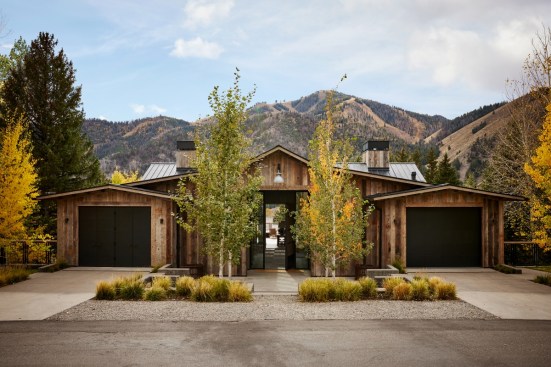
Sun Valley Residence in Ketchum, Idaho, by Backen & Backen Architecture. Photo by John Merkl Photography.
For other architects, restraint means letting the building nearly disappear. Such is the case with a coastal house Stinson designed in the Cayman Islands. “Keeping the architecture out of the way was imperative,” he says. Uninterrupted glass and clerestory windows create a sense of weightlessness, with the home’s horizontal white wings “outstretched like a seabird alighting on the sand.”
Essentialism
Minimalism, or what Portland, Ore.-based architect Jeff Guggenheim of Guggenheim Studio prefers to call essentialism, helps design transcend borders, he says. “Japan has its own set of details and craftsmanship and joinery, but it’s underlaid with minimalism—uncovering the essence of a piece of furniture, an object, or a home.”
The concept also connects to Scandinavian design, where the desire is to get to the essence of a design instead of obscuring it. “It’s easy to cover something with ornamentation and pass it off as good, but it takes a lot of effort to make something essential look really good,” Guggenheim says.
Local Materials and Craft
Authentic architecture often begins by leaning into the land—drawing on clay in the Mediterranean, timber in Japan, or whatever materials a place offers most naturally. “We are trying to look for materials such as stone that we can source locally, whether it’s literally on the site itself or within the shortest radius where we can get it from,” Motolik says.
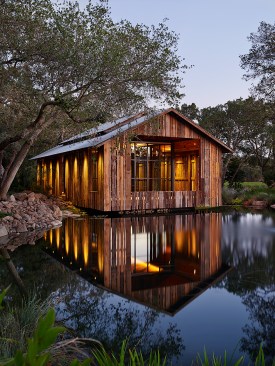
Rudd Estate Winery in Oakville, Calif., by Backen & Backen Architecture. Photo by Adrian Gregorutti Photography.
One of the firm’s Napa Valley projects features barnwood-clad buildings that accentuate the natural landscape tucked under leafy oak trees on the shores of a shady pond. A glass box tasting room nestles inside one of the buildings. “At night, the building is illuminated, and it creates this beautiful feel surrounded by natural materials. The doors open up and fold toward the sides to face the water,” Motolik says.

Lawless Cottage in Jones, Michigan, by Searl Lamaster Howe. Photo by Tony Soluri.
Bringing exterior materials inside further anchors a structure to its site. At a wooded retreat on the edge of a state park in Michigan, Lamaster-Millett’s firm used Japanese-inspired Shou Sugi Ban cedar and obsidian lap siding that flow seamlessly from the exterior into interior walls. Black slate floors, ash steps, and ebonized oak screens add cozy cabin character. “We use a lot of natural materials to play with textures and bring a tactile kind of experience to our projects,” she says.

Lawless Cottage in Jones, Michigan, by Searl Lamaster Howe. Photo by Tony Soluri.
Guggenheim also looks to materials—often in place of labels. “People like to put out these labels, like Scandinavian or Japandi, to describe a certain aesthetic, but what’s most interesting is when you get below the surface,” he says. “What I think people are really responding to, and what I personally respond to, is how design is influenced by the natural environment and the materials that are readily available. Wood, stone—materials that really root the design in a certain place.”
For Guggenheim, those ideas resonate across cultures. He points to the parallels between Japan and the Pacific Northwest: Much of both regions share a temperate climate, abundant forests, and a strong culture of craftsmanship. “We have Western red cedar here, and they have cypress there. They’re very similar woods that can be used in similar ways,” he says.
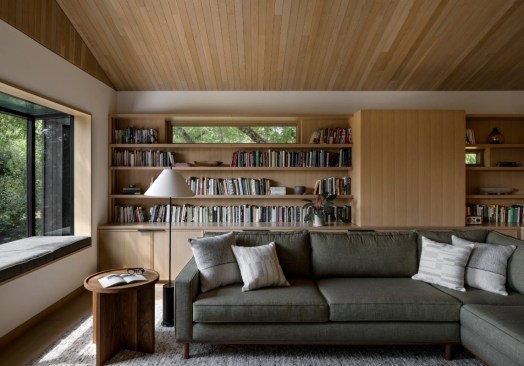
The Hillsdale project in Portland, Ore., by Guggenheim Studio. Photo by Miranda Estes.
“Japan also has a culture of craftsmanship that’s in line with what our woodworkers and carpenters do here. So you can take something that is culturally Japanese, bring it here, and it still feels of the place. Then you can add a Northwest spin to it and arrive at an aesthetic that feels very regional.”
Travel, he says, sharpens this kind of sensitivity. “That’s the great thing about travel. You can go to other places and see how craftspeople and designers are using a similar palette of materials but interpreting it in a different way.”
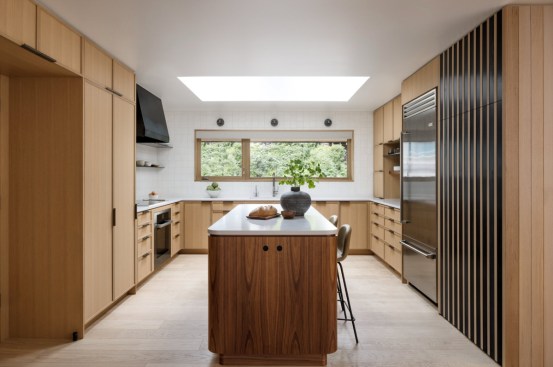
The Hillsdale project in Portland, Ore., by Guggenheim Studio. Photo by Miranda Estes.
That appreciation for restraint dovetails with his respect for craft. His firm’s Hillsdale project, he notes, revealed how deeply skilled woodworkers and furniture makers are in the region. “For them, making something isn’t just a job—it’s an extension of themselves. That’s the mark of a good craftsperson. As designers we have a responsibility to respect what they can do, listen to them, and collaborate. It’s not a top-down process. It’s working with people who know the materials best and what details will work in certain places.”
Like Guggenheim, Stinson often grounds global ideas in local context. The exterior color palette of the southwest desert house came from a handful of stones he scooped up from the site during his first visit and took back to his studio in Minnesota. The gesture illustrates that even though architect’s experiences span geographies and cultures, his approach integrates a deep understanding of the local context for each location. In other words, taking in a worldly view helps to better focus what might be right at your fingertips.
“Anytime you work internationally, it opens up your philosophy about architecture,” he says, “to see if it transcends different cultures, about how you abstract from that culture and what you bring back to your designs that celebrates that particular location or culture.”