
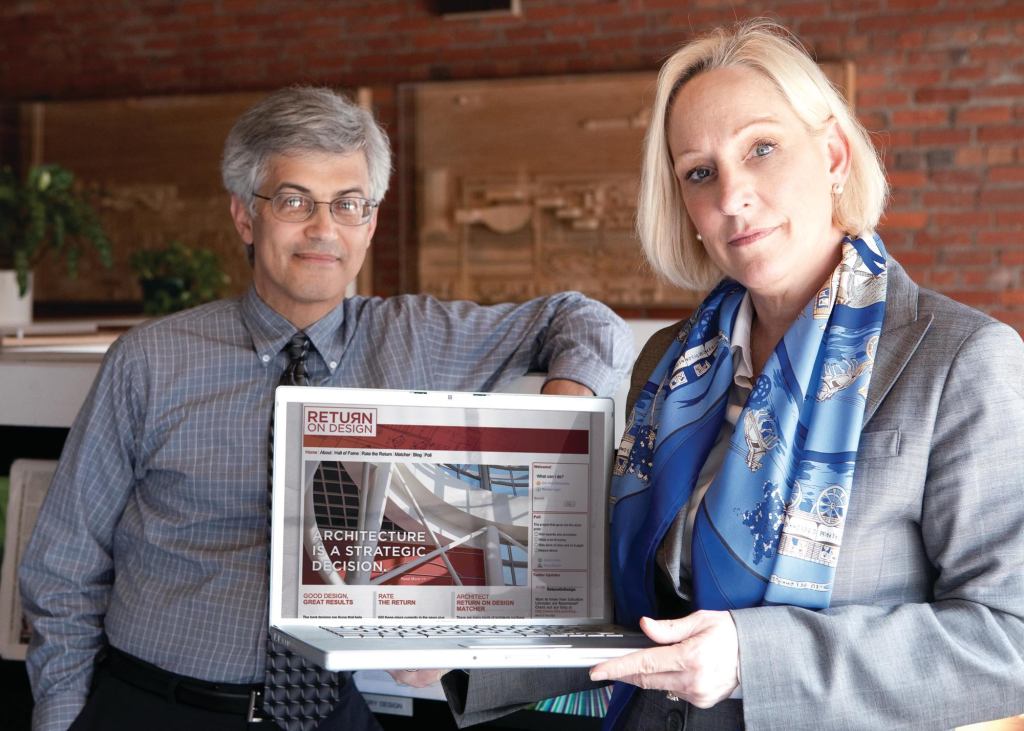
Readers of this magazine will probably unanimously agree: design adds value. But just what that value is—and whether it can be quantified at all—is a more nuanced proposition. For clients hewing to a bottom line, taking on architectural projects may seem daunting, even irresponsible. Thus, for architects, it becomes imperative to make a compelling case about the value of design not just as an aesthetic proposition, but as a way to address a client’s business objectives.
Return on Design hopes to tackle the question of architecture’s business value. Created and given a soft launch in March by the Philadelphia firm BLT Architects, the social networking site asks members to post projects whose design demonstrates a certain value beyond the aesthetic. Members can then discuss the merits of each case study. To stimulate an initial conversation, the site has a prestocked Hall of Fame, which includes New York’s Fifth Avenue Apple store, designed by Bohlin Cywinski Jackson—surely among the best-known, and most-visited, retail spaces in the nation. “We designed [the site] to be malleable. It’s going to move where its participants want to take it,” explains Michael Prifti, BLT’s managing principal.
Prifti has been wrangling with the issue of architecture’s value throughout his career. “Philadelphia is very much a value-driven market,” he says. “The city has near-Manhattan building costs, but developers get Philadelphia rent.” Thus, in a process familiar to most architects, he and his fellow principals at BLT have to go into projects making the case for the firm’s services. “This has been an interesting discussion for us for a long time, since we straddle different markets,” Prifti notes. In this way, Return on Design is very much borne from years of experience.
To encourage participation, at press time, BLT planned on a series of targeted pushes to its clients and to fellow architecture firms. “There’s always something to learn,” says Prifti. “We are just hoping to support the conversation.”
Links
dlib.indiana.edu
“Charles Cushman’s Journey Through the American Landscape, 1938–1969,” an essay by Indiana University history professor Eric Sandweiss, is part of the school’s online archive of Cushman’s 14,000-plus Kodachrome color slides. Sandweiss discusses how the amateur photographer captured a nation undergoing tremendous changes—economic, social, urban, and otherwise—over the course of three decades. “Any single place in the mid-twentieth-century American landscape can be found documented in greater detail elsewhere,” he writes. “But in no other single place that I know of does the sheer range of those places—across space, across time, across the intermeshed functional elements of city, suburb, and countryside—receive a fuller treatment than it does in these pictures.”
recoletacemetery.com
Buenos Aires’ Recoleta Cemetery is a must-see for any visitor to the Argentinian capital. The city-within-a-city is the final resting place for many of the country’s most famous people and—like the better-known Père Lachaise Cemetery in Paris—features remarkable mausoleum designs. This blog, written and photographed by Robert Wright, an American guidebook researcher and writer, and Argentinian cultural journalist Marcelo Metayer, explores the cemetery and the histories of many notable names. Although Wright stopped adding new posts in March because of other commitments, he plans to keep the blog online as long as possible because of the paucity of information about Recoleta available in English.
translab.burundi.sk
Artists love to investigate the creative aspects of new technologies. This archive of computer-generated and -aided art from the 1950s to the late 1970s shows what 19 people—some working in collaboration—accomplished with punch cards, programming languages such as FORTRAN, and other computer tools available at the time. The archive was compiled by Translab, a cross-disciplinary research project based in Slovakia.