
Greg Premru Photography Inc.
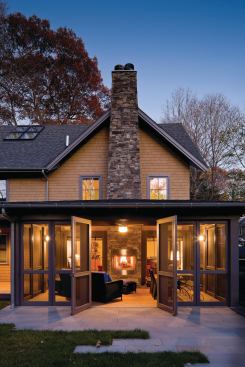
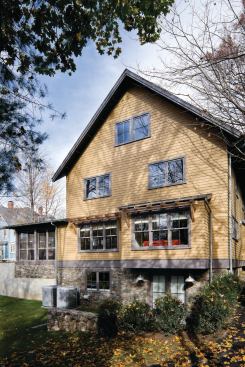
The owners of this private residence in Newton, Mass., were able… The owners of this private residence in Newton, Mass., were able to build a home from scratch that allowed for accessibility and sustainability.
Greg Premru Photography Inc.
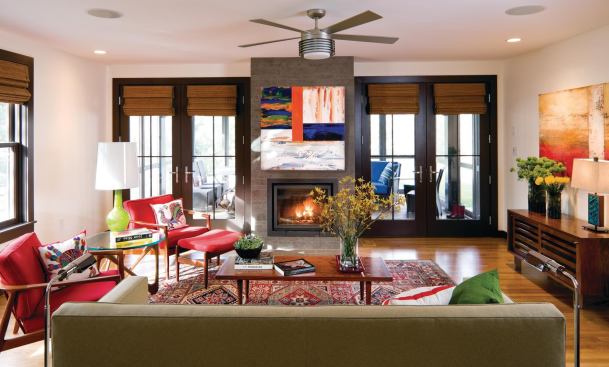
Two sets of Lepage French doors with low-E argon-filled glass co… Two sets of Lepage French doors with low-E argon-filled glass connect the living room to the screened porch and facilitate natural ventilation. For easy wheelchair access, the living room floor is at the same level as the screened porch and the doors were customized for a flush threshold. 877.289.0191. www.lepagemillwork.com.
Greg Premru Photography Inc.
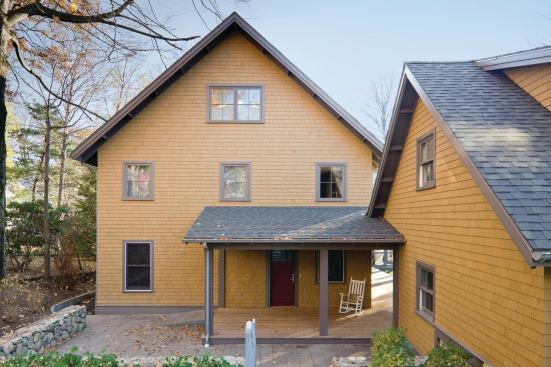
A wraparound porch connects the courtyard to the main entry, whi… A wraparound porch connects the courtyard to the main entry, while the garage, at right, is detached but accessible by a covered walkway. Because the family’s minivan often runs for long periods while the wheelchair lift system is operating, the owners wanted to ensure that pollutants from the car would not enter the home. A bluestone ramp and sloped path, at left, lead to the lower backyard.
Greg Premru Photography Inc.
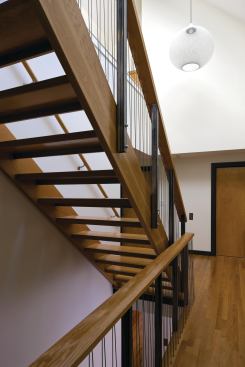
A three-level open riser stair crowned with remote-controlled En… A three-level open riser stair crowned with remote-controlled Energy Star skylights from Velux brings daylighting and fresh air to the core of the home while exhausting unwanted heat. Thanks to ventilation from the skylight and an array of low-E argon-filled Lepage windows (U-factor: 0.29/SHGC: 0.22) , the owners rarely need to use air conditioning, according to architect Douglas Dick. Velux: 800.888.3589. www.veluxusa.com. Lepage: 877.289.0191. www.lepagemillwork.com.
Greg Premru Photography Inc.
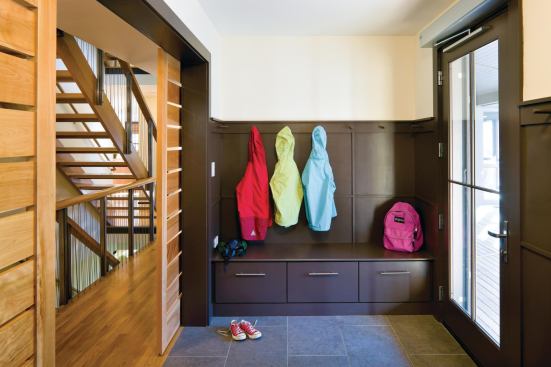
Equipped with an automatic door opener, a wheelchair charging st… Equipped with an automatic door opener, a wheelchair charging station, and a durable ceramic floor, the mudroom is the main point of entry for all family members. Residents and visitors store shoes here to avoid tracking mud inside as a way to reduce indoor contaminants. In addition, a nearby outdoor faucet allows for easy cleaning of wheelchair tires.
Greg Premru Photography Inc.
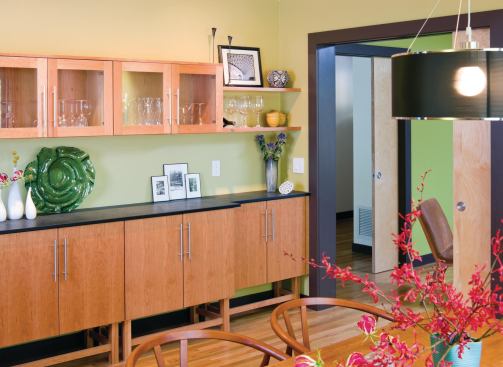
The custom-designed sideboard is topped with EcoTop surfacing, m… The custom-designed sideboard is topped with EcoTop surfacing, made of an FSC-certified 50/50 blend of bamboo fiber and recycled wood fiber salvaged from demolition sites, bound together by a water-based resin that is free of petroleum and VOCs. 253.904.8608. www.kliptech.com.
Greg Premru Photography Inc.
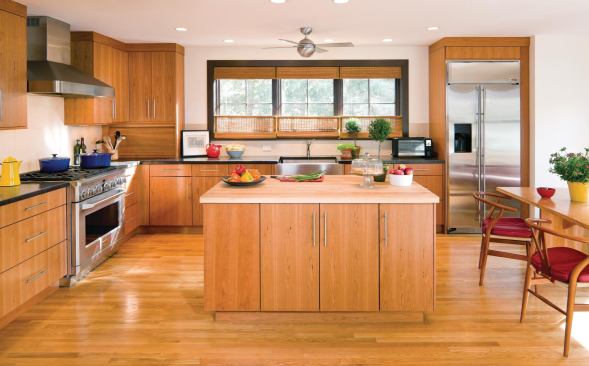
The large, open kitchen, the central hub of the home, reflects t… The large, open kitchen, the central hub of the home, reflects the project’s focus on modern but warm interior design. The family-friendly space offers sustainable touches: locally manufactured concrete countertops and GE Energy Star appliances. 800.626.2005. www.geappliances.com.
Greg Premru Photography Inc.
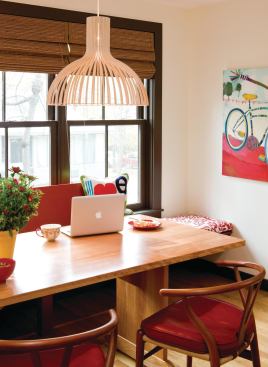
The kitchen also features universal touches, such as the custom-… The kitchen also features universal touches, such as the custom-made table for wheelchair seating in the breakfast nook.
Greg Premru Photography Inc.
Locally sourced FSC-certified eastern white cedar shingles from … Locally sourced FSC-certified eastern white cedar shingles from Maibec, broad covered porches, and deep roof overhangs add to the home’s farmhouse look. DuPont Tyvek HomeWrap protects against wind and rain while sealing the home to help it stay dry, cool in the summer, and warm in the winter. Maibec: 800.363.1930. www.maibec.com/en. DuPont: 800.448.9835. www.dupont.com.
Greg Premru Photography Inc
Carter Williams, LEED AP, LDa Architecture and Interiors.