
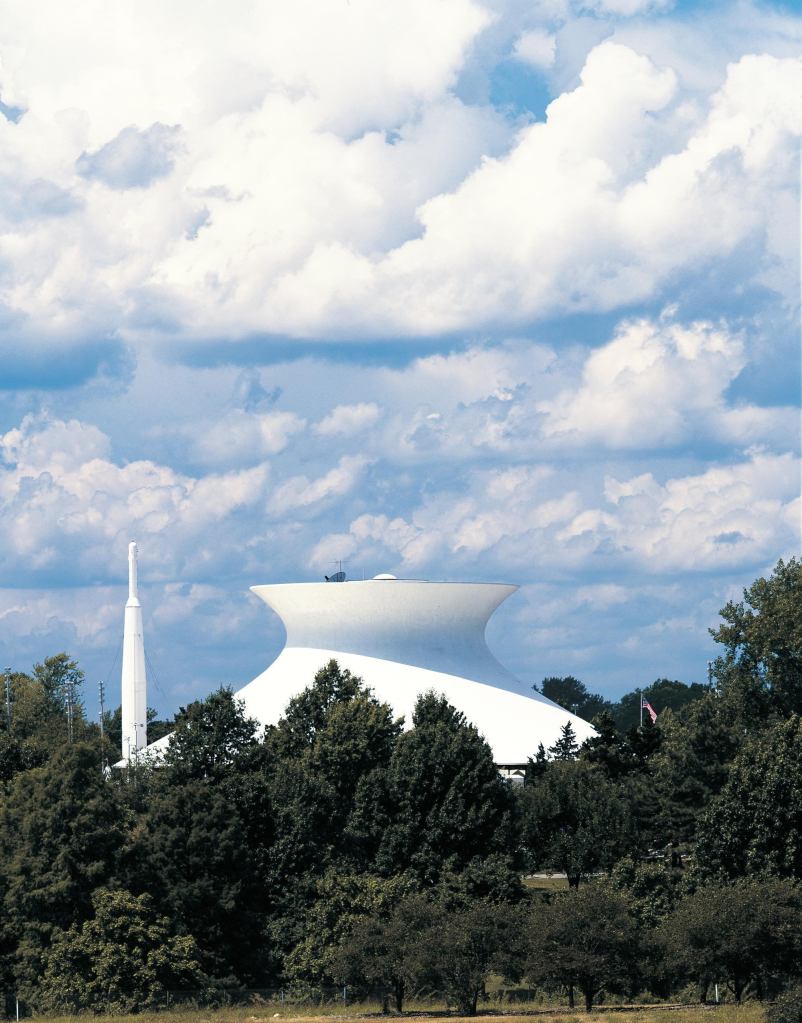
The current fascination in architecture with complex geometries and expressive forms had a precedent in the HOK-designed St. Louis Planetarium, a citation winner in the 1960 P/A Awards program. Its hyperbolic, thin-shell concrete roof, consisting of straight lines rotated around a central vertical axis, created a circular shape that flared out at its base to cover a perimeter porch and glass-enclosed exhibition area and that opened up at its top to encircle a platform initially used for star-gazing. A 60-foot-diameter aluminum planetarium dome originally stood inside the structure, with a suspended spiral ramp leading up to the observation deck. Classrooms, offices, and support spaces occupied the lower level.Time has proved the 1960 jury correct. While the jurors liked the “sculptured form of the exterior,” they found the shape “totally unrelated to the concealed dome” and “the resulting space between the two surfaces … awkward.” In the intervening years, an 80-foot-diameter dome replaced the original, which forced the removal of the ramp and the closing of the observation deck. Exhibition standards also changed, and the once-tall, glass-enclosed display space around the dome acquired hung ceilings, with walls covering the glass. And the growth of the institution, with a large science center attached underground to the planetarium, has led to the removal of the lower-level classrooms and the transformation of that space into a reception area. The elegant hyperbolic roof remains, however, as a testament to the flexibility of complex forms that have a loose-fit relationship with their functions.
1960 P/A Awards Jury
William Caudill
Louis Kahn
Ralph Rapson
Jose Luis Sert
Lyndon Welch
