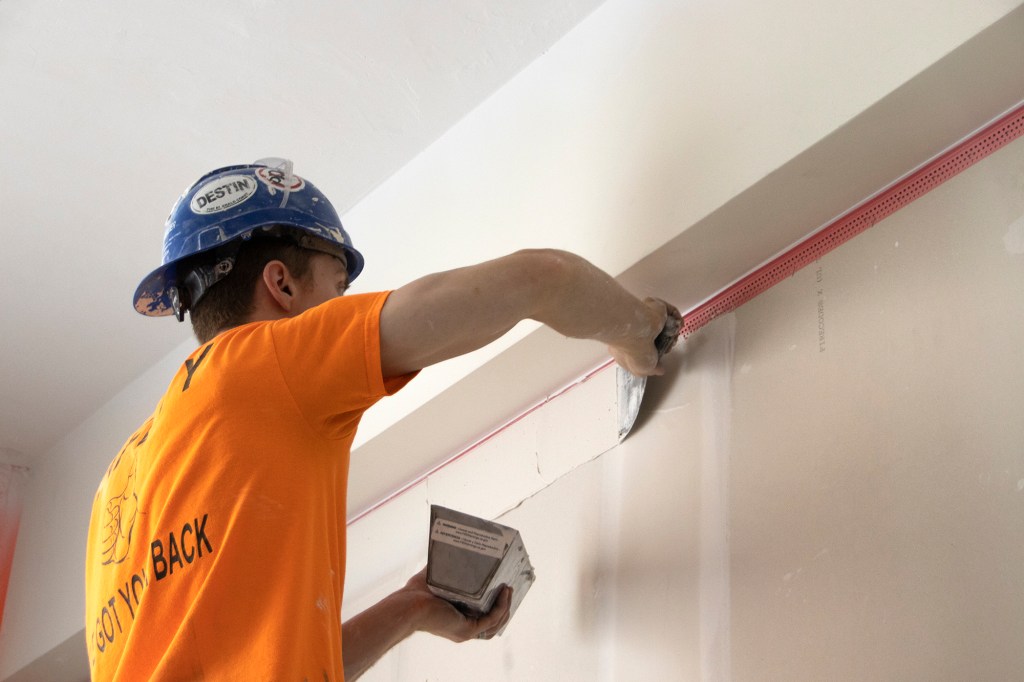
It’s no secret that innovation in construction hasn’t kept pace with that of many other industries, including information technology and communications.
Take something as basic as drywall installation.
Drywall hanging and finishing hasn’t changed much since the 1950s, when drywall gained acceptance as a faster, lower-cost alternative to plaster applications. Up to 75% of drywall installation cost is labor, a frustrating reminder of the challenges ahead for a $25 billion segment of the construction industry.
Accelerating Innovation
The good news is, signs of innovation abound. For example, there are at least 14 different categories of drywall products available today, ranging from standard-issue regular white board and Type X and C fire-rated formats to compositions that address acoustics, mold, and environmental concerns.
In fact, the pace of innovation may be picking up. Some recent evidence:
- Manufacturing advances in drywall composition allow panels to snap more crisply and cleanly, speeding contractor workflow by up to 10%.
- Robots are now being tested at several California jobsites, including the new Harvey Milk Terminal at San Francisco International Airport. The robots are engineered to complete drywall finishing by repeatedly applying, drying, and sanding mudcoat seams to a seamless level. Early results show a robot can reduce a seven-day finishing job down to two while minimizing worker health and safety issues.
- Next generation firestopping accessories have reinvented how to seal deflection joints from fire, smoke, and fumes, a task once reserved for firestopping sprays and caulk. The accessories, called devices, represent an advance that architects should take note of, says long-time drywall industry veteran Daniel Kernan of Trim-Tex, a leading drywall accessories manufacturer.
“We know from time studies that a skilled installer can seal about 350 to 400 feet of deflection joint seams a day. We also know working with firestopping caulk is tricky; there are many variables. You have to caulk the sealant in, smooth it out, and in some cases flat tape it,” explains Kernan. “Plus, it all depends on installer experience and skill.”
Rotary Phone vs. Smartphone
Next generation firestopping beads help automate that process. Contractors can seal-up deflection joints at an installation rate of about 1,600 feet a day, up to a 400% increase.
“It’s the drywall equivalent of comparing a rotary phone to a smartphone,” says Kernan. He cites a large drywall-hanging project in Ithaca, N.Y., that is expected to finish two months ahead of schedule due to the technology.
Special Inspections
Devices also end sealing uncertainty caused by the special inspections required for high-rise buildings and Risk Categories III and IV structures (Chapter 17, section 1705.16 of the 2012 IBC requires all firestopping to be inspected in accordance with ASTM E 2174 and E 2393) “There’s no need for destructive testing. A visual inspection confirms fail-safe installation of a metered dosage device,” reports Kernan.
Architects looking to speed project completion and minimize liability risk should consider writing performance specs that conform to next generation firestopping drywall accessories.
To learn more, check out the AIA-accredited CEU, “Fire and Sound Rated Building Joints & the Effects of Structural Movement.” Or request a complimentary sample pack here.