
It’s been fascinating for me seeing how your work has changed over the years. It strikes me that these three projects [shown on the following pages] are much more landscape-driven than your earlier work. What is the evolution in thinking that has led you in this direction?
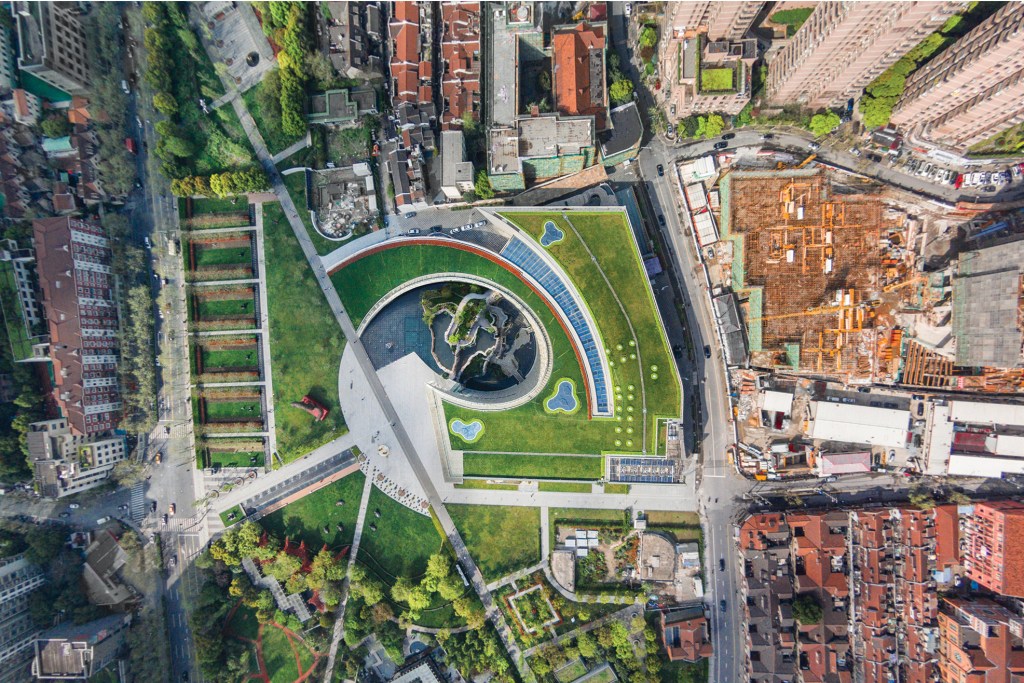
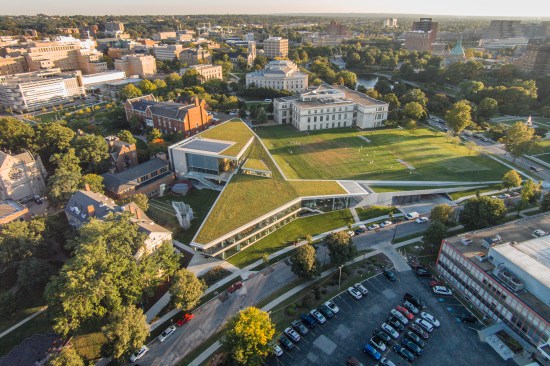
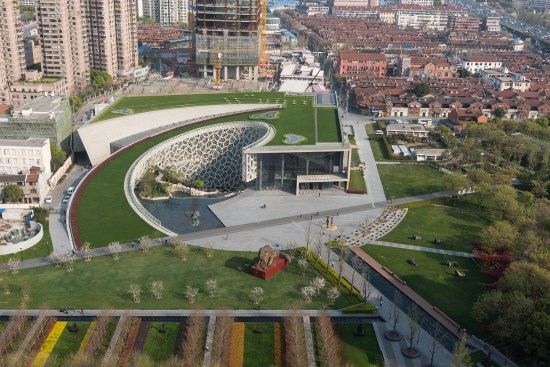
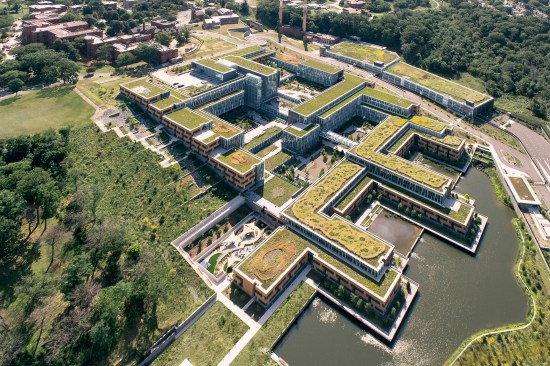
Ralph Johnson, FAIA: When I remember back to my work in the ’80s, I think of Midwestern-oriented work. And since then Perkins+Will has grown tremendously. We have 25 offices now, and I’m working around the world and in different contexts. All of these buildings are contextual somehow, but it’s an evolving view and I’m open to other interpretations of context than simply the literal ones. With the Coast Guard project, it was about making the building and the land into one—melting the structure into the hillside like a hill town. In the case of the Shanghai Natural History Museum, it was about scaling a very large, almost half-million-square-foot building to an existing sculpture park. And at Case Western, the building stretches out horizontally to grab three axes connecting back to different areas of campus. It was the opposite of the Shanghai project—more about increasing the scale and impact of the building.
I have always thought that a characteristic of great architects is to not only have clear ideas but to be able to follow them through. In the Shanghai project, your idea starts with a nautilus. It’s fascinating, but I can see how it could get watered down in the design process.
Hopefully the idea gets better, too. But I think holding onto it is the key. You have a lot of people involved in the process when you’re doing big or public buildings. But in Shanghai, the idea of the nautilus was reinforced as we developed the circulation patterns inside the building. It became an organizing device, similar to the Guggenheim, where you go to the top and then spiral down. It continued into the evolution of the interior.
Has the composition of your teams or your process changed while doing buildings like this?
In Shanghai and at the Coast Guard, especially, we were working with really excellent landscape architects, so it was very much an integrated process—not just an appliqué at the end. And we’re developing a really good landscape practice at Perkins+Will. Working in an interdisciplinary way allows the form-making to evolve out of the landscape or sustainable ideas.
This integration of landscape and built forms goes back to early Modernism. There’s a passage in one of Le Corbusier’s early books where he fantasizes about flying over the modern city and not seeing the built structures—that it would just be green. In a way, you realize that in these works. How are your current projects continuing these ideas?
We’re doing a master plan for 4,000 units of housing around River City in Chicago, and we worked with Hoerr Schaudt Landscape Architects on integrating public open space along the river. It’s like Corb says—there is a garden level connected with bridges so that you can have a connective park in the sky. And it’s not just a private gated community; it’s trying to create connections. I’m interested in that, and in looking for other opportunities to continue exploring that idea.
Projects
Tinkham Veale University Center, Case Western Reserve University
Cleveland
James Steinkamp Photography
Shanghai Natural History Museum
Shanghai
James and Connor Steinkamp
United States Coast Guard Headquarters
Washington, D.C.
James and Connor Steinkamp