
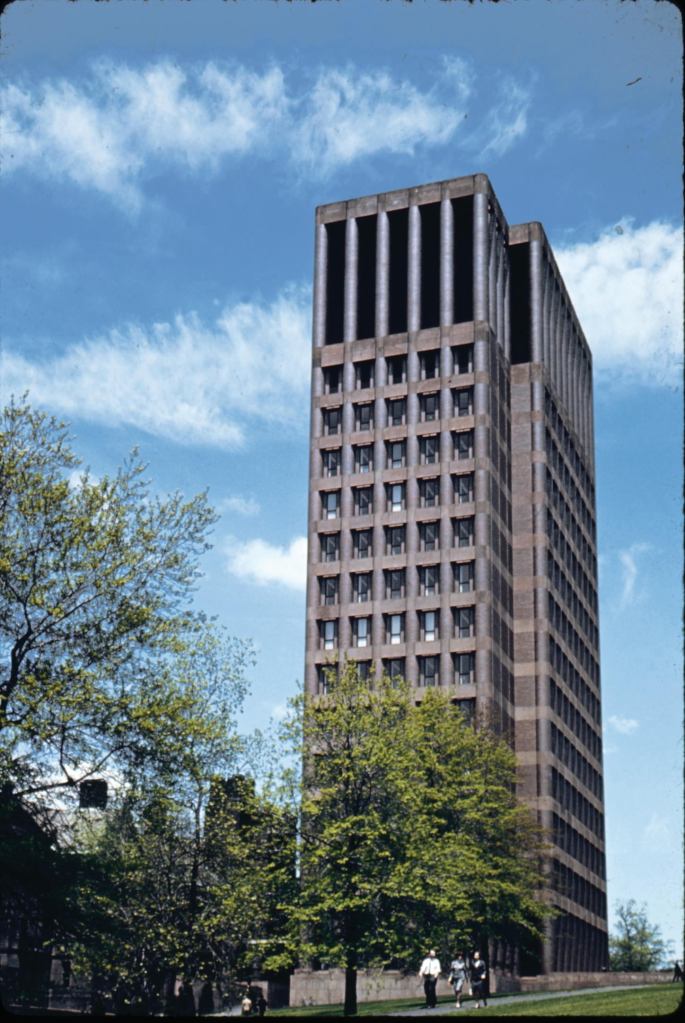
The Kline Biology Tower is the signature component of a science center planned by Philip Johnson & Associates for a hilltop site in Yale University’s science precinct. The structure’s cylindrical ground-floor columns become half-cylinder exhaust ducts as they rise toward its crown, which houses a chiller plant sized to serve several buildings. Johnson’s respect for classical precedent is reflected in both the emphatic columns (thought by one juror to be “obsessive”) and the tower’s rigorous symmetry. His meticulously crafted surfaces of iron-spot brick and sandstone echo the varied masonry of nearby Gothic Revival structures, though not their picturesque massing.
The 1964 P/A Award honored Johnson’s entire multibuilding proposal (which included the geology building he had completed in 1963), but the focus of the jury was the tower that remains a prominent feature of New Haven’s skyline. The jurors praised the project’s respect for existing context, a concern that had emerged among Modernists by the early 1960s. Further construction of science facilities didn’t quite adhere to Johnson’s plan, but subsequent buildings have deferred visibly to his commanding tower.
The housing of academic functions in towers is now frowned upon, believed to discourage the socializing that’s thought to promote scholarship. So Yale has recently installed a café and lounge on the generously scaled first floor. Reporting on this development, the Yale student newspaper characterized the tower as “overbearing” and “menacing”—a starkly different view of a building that the P/A jurors considered an “elegant” good neighbor.
1964 P/A Awards Jury
Peter Collins, AIA
Vincent G. Kling, FAIA
Ernest J. Kump
William J. LeMessurier
Harry Weese