
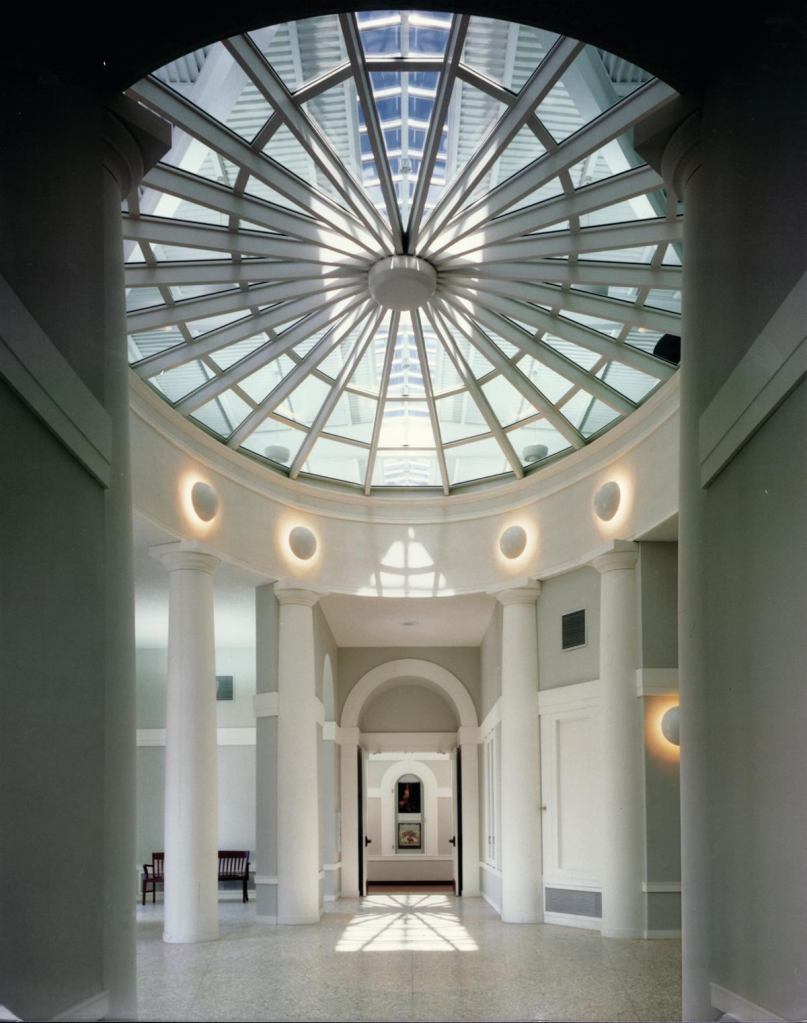
1983 P/A Awards Citation
To design one of Chicago’s branch public libraries, city architect Joseph W. Casserly engaged consulting architects Hammond Beeby & Babka, a firm then becoming known for the mix of Modernism and historical allusion that constitutes Postmodernism. The resulting Sulzer Regional Library—still a neighborhood anchor—exemplifies Postmodernism’s principles and their thoughtful application.
While “PoMo” has since been widely derided, it was based on the premise that buildings should communicate their purposes through recognizable design conventions. This library design was intended to express the stability of a public institution and reinforce the street wall of the major avenue where it stands. And it represents its building type, the public library, with classical massing, regularly spaced windows, and a prominent central entrance.
The whole design concept—with its masonry enclosure and a metal-framed, skylit reading room above a low-ceilinged street floor—recalls Henri Labrouste’s 19th-century Bibliothèque Ste. Geneviève in Paris, widely admired as a precursor of Modernism. But as a true Postmodernist work, the building doesn’t simply replicate a historical model, but juxtaposes traditional features with others that are conspicuously modern. Here, exterior window surrounds and pilasters are composed of steel sections, and the reading room is spanned by exposed steel framing.
Postmodernism predominated among the 14 architectural design projects honored in 1983. But the jurors were so clearly divided on matters of design that no project earned more than a citation. The period of PoMo P/A Awards winners, which peaked around 1980, was drawing to a close.
1983 P/A Awards Jury
George Baird, Intl. Assoc. AIAA
lan Chimacoff, AIA
Stanton Eckstut, FAIA
Sandra Howell
Mark Mack
Marietta Millet
James Frazer Stirling
John M. Woodbridge, FAIA