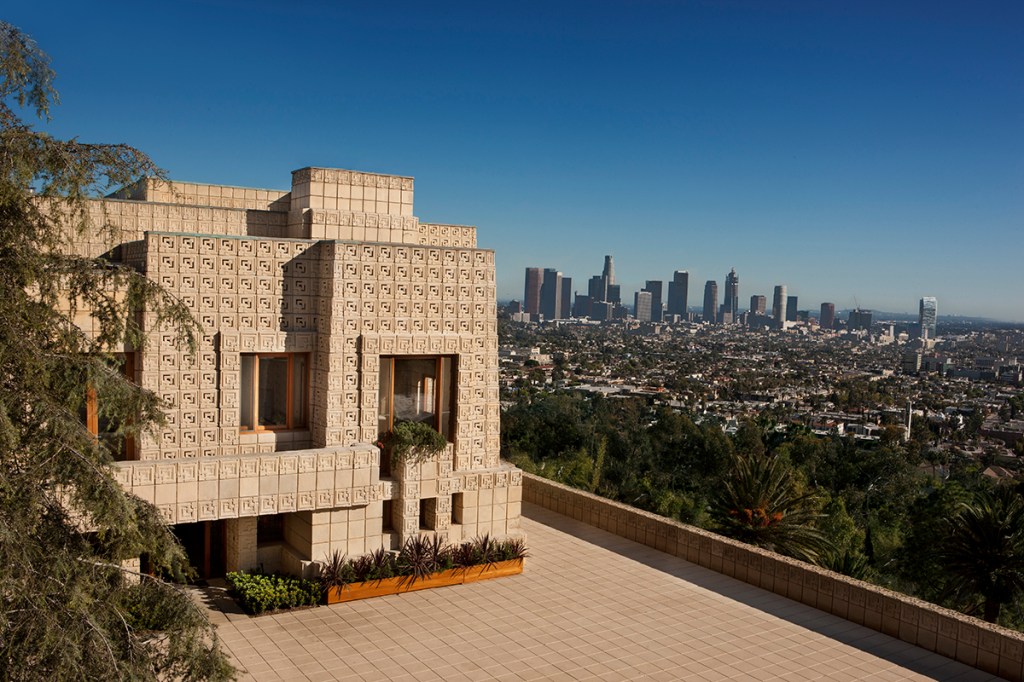
Designed by Frank Lloyd Wright in 1923, the Ennis House, also known as the Ennis-Brown House, in the Los Feliz neighborhood of Los Angeles was built a year later by Wright’s son, late architect Frank Lloyd Wright, Jr. Considered one of the best examples of Mayan revival architecture in the United States, the four-bedroom, three-and-a-half-bathroom single family house is now jointly listed for sale by Beverly Hills–based real estate agencies Hilton & Hyland and Coldwell Banker for $23 million. The residence is offered furnished and includes some of Wright’s leaded-glass windows.


Named after Charles and Mabel Ennis—owners of a men’s clothing retail store who commissioned Wright to design the structure—the 6,200-square-foot single family house has been the backdrop of many Hollywood films, including David Lynch’s 2001 thriller Mulholland Drive and Denis Villeneuve’s 2017 sci-fi film Blade Runner 2049. Charles died in 1928, and Mabel sold the property eight years later in 1936. Since then, the residence has had several owners, including late actor John Nesbitt, who commissioned Wright to renovate the house in 1940; the Brown family, who purchased the property in 1968 and formed the Trust for Preservation of Cultural Heritage (now the Ennis House Foundation) to finance associated maintenance costs; and the current owner Ronald Burkle, who purchased the house in 2011 for $4.5 million and spent nearly $17 million to restore the property.

Set on a half-acre lot on a hilltop overlooking downtown Los Angeles and the Pacific Ocean, the house is believed to be the largest of the four experimental textile-block houses Wright designed in the Los Angeles area. “The phrase ‘textile block’ came from the way vertical and horizontal steel rods were woven through channels in the concrete, a technique that was supposed to keep the blocks knitted together and held in position,” wrote author Jeffrey Head in a 2011 article in the Los Angeles Times. The Ennis House was constructed with more than 27,000 of these concrete blocks arranged on a concrete platform and reinforced by a retaining wall. Measuring 16 inches wide by 16 inches long, and 3.5 inches thick, each block was hand-cast in an aluminum mold.
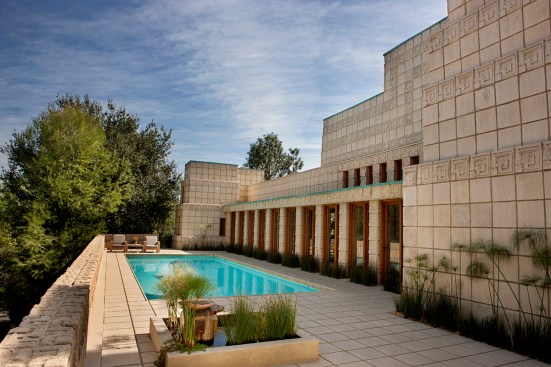
The Ennis House was listed on the National Register of Historic Places in 1971, but for years prior to the recent $17-million restoration, the house sat in deteriorating conditions. “By 2005, deferred maintenance, earthquakes, and heavy rains had taken a toll on the Ennis House,” according to nonprofit Los Angeles Conservancy. “Foundations and walls had begun to fail, and the situation grew so dire that the National Trust for Historic Preservation included the home on its 2005 list of America’s 11 Most Endangered Places. Work to stabilize and restore the house began in 2006, earning a Conservancy Preservation Award in 2008.”


The listing agents are currently showing the house by appointments to pre-qualified buyers.