
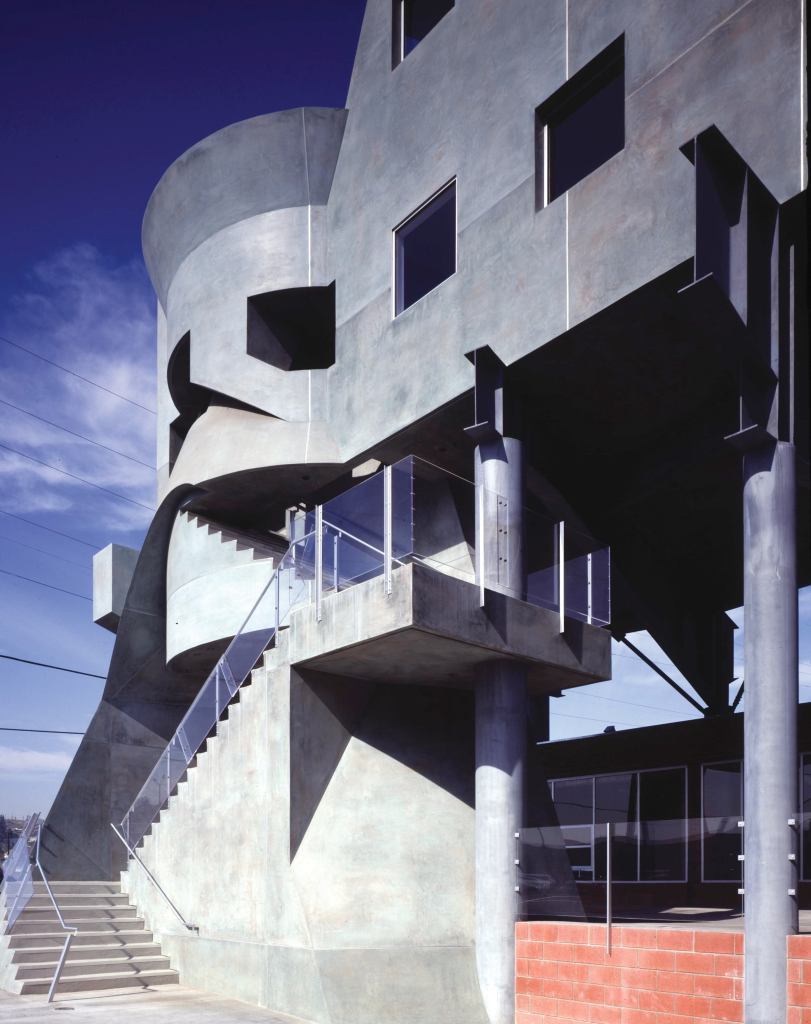
Eric Owen Moss’ Samitaur Offices project embodies unconventional ideas that resonated with the 1992 P/A Awards jurors—and remain timely today. It initiated the revitalization of a low-density, urban-fringe area of Culver City, Calif., through the careful insertion of a new and prominent element. Essentially a box of offices lifted above a roadway that serves the one-story loft structures along it, the new airborne structure and much of the space below are linked for use by the same tenant. Samitaur is an early example of a design approach Moss has evolved that juxtaposes volumes of rather ordinary, repetitive design with boldly sculptural incidents. This strategy was appraised by juror Steven Holl as “a question of order and disorder; where the order is extreme, the disorder is a real joy.”
The project was one of two 1992 P/A Award wins for Moss, whose work was already known to most readers. He had won an award in 1978 (with James Stafford) and has won two more since Samitaur.This was the first of Moss’ collaborations with the developers Frederick and Laurie Smith. Winning the award encouraged this architect-client team to undertake numerous other notable projects in the same vicinity, a collaboration that continues to the present—and may soon yield a high-rise building adjoining this one. A light-rail station soon to open nearby is in part a response to the revitalization accomplished by Moss and the Smiths. Together they have made this formerly low-rent, low-visibility area an economic and architectural object lesson.