
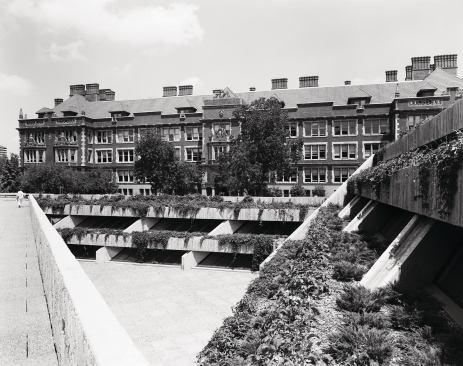
Courtesy Flansburgh Architects
The Cornell University bookstore, designed by Earl R. Flansburgh…
Cornell University and the University of Minnesota, both major land-grant research institutions, faced the same dilemma some 40 years ago of how to fit their bookstores into the hearts of their already crowded campuses without disrupting the surrounding historic buildings. And both arrived at the same solution: Put the structures below ground.
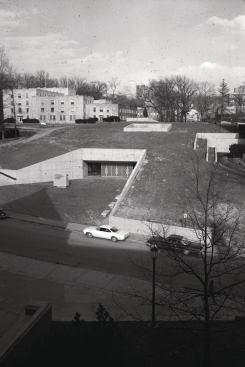
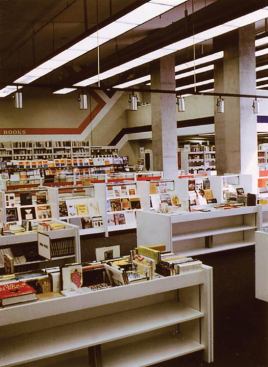
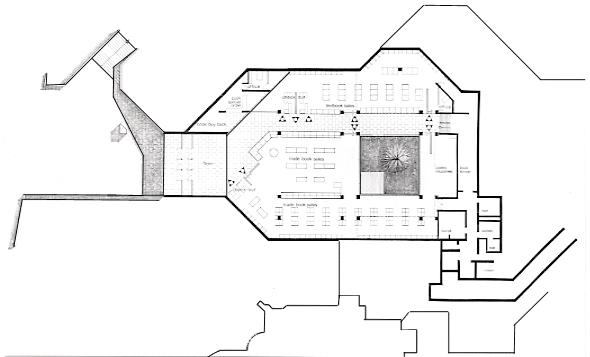
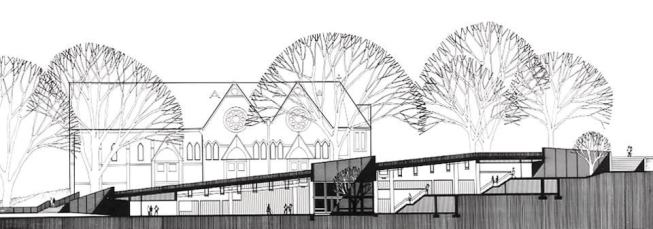
The Cornell Store, designed by Earl R. Flansburgh & Associates and cited in the 1969 awards program, burrows into a hill across from the student union, with concrete retaining walls funneling people to the entrance or up steps and over the grass-covered roof. An open courtyard brings light to the center of the store and marks the place where stairs lead up to a mezzanine and a back entrance.
Minnesota’s East Bank Bookstore and Admissions and Records offices, awarded in 1975 and designed by Myers and Bennett Architects/BRW, occupies a flat urban site, which forced more of the building—clerestories and the loading dock—above grade, with a triangular stepped-down courtyard bringing daylight to the two below-ground levels.
While both buildings got built and served their stated purposes well, they also revealed the limits of subterranean structures. They proved difficult to expand, with Cornell’s store feeling cramped and overcrowded as a result. And they met unexpected subsurface problems, such as an aquifer at Minnesota that led to a lot of water infiltration. Add to that changes in how students buy books and purchase supplies, and these two below-ground buildings now seem as outdated as they once were innovative.
1969 P/A Awards Jury (Cornell University)
Henry Cobb, FAIA
Lewis Davis
Richard M. Gensert
Roger Montgomery
Cesar Pelli, FAIA
1975 P/A Awards Jury (University of Minnesota)
Michael Brill
Peter Chermayeff, FAIA
Lee Copeland, FAIA
Peter Eisenman, FAIA
Clare Cooper Marcus
Paul Rudolph
Joyce Whitley
Eberhard Zeidler, Hon. FAIA