
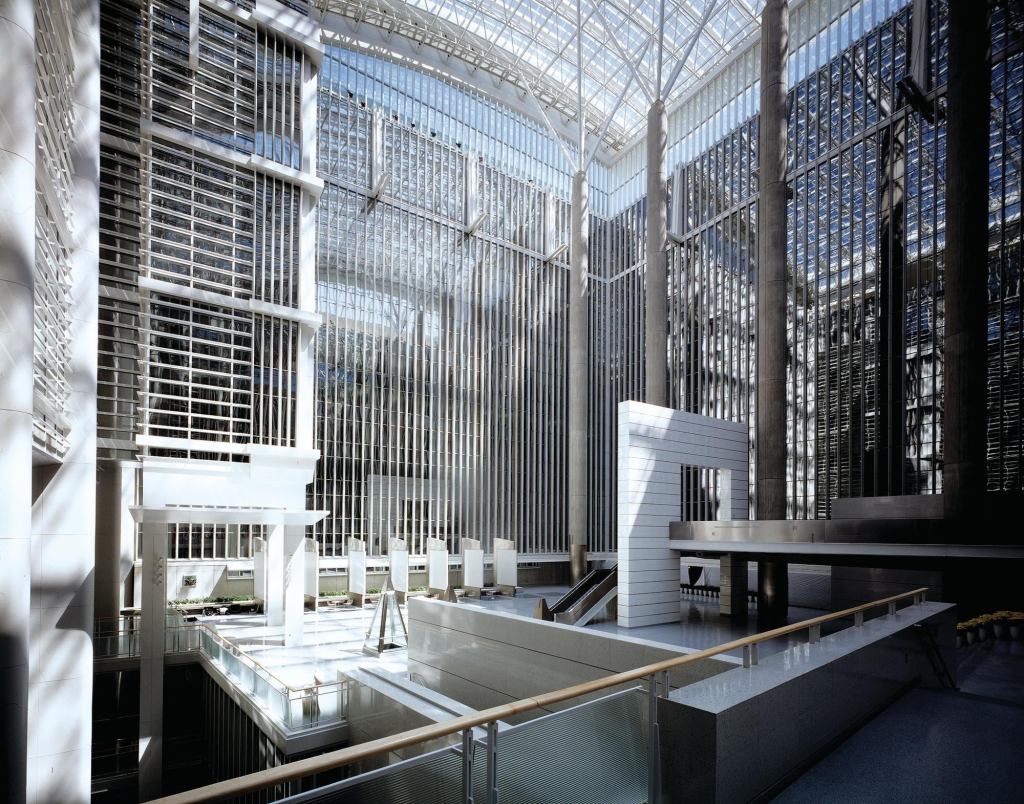
The World Bank headquarters, which fills an entire city block near the White House in Washington, D.C., is a rare combination of new and old structures. Designed by Kohn Pedersen Fox Associates (KPF) of New York with D.C.-based KressCox Associates, the complex incorporates two earlier increments of the World Bank’s expansion, one by Gordon Bunshaft of Skidmore, Owings & Merrill and one by the office of Vincent G. Kling, FAIA, which together covered about half the block. The KPF-designed construction (completed in 1997) was calculated, in both its volumes and its surfaces, to look like two more increments roughly comparable to the existing ones. The result, though subtly varied, looks as if it was all built at one time. The blurring of the distinction between old and new dominated the awards jury’s discussion. Juror Rem Koolhaas found it “both very intriguing and at the same time vaguely sinister.”
The architects had won this commission through an international design competition between eight finalist teams. Major factors in the competition jury’s choice were the retention of the existing buildings and the creation of a 150-foot-square skylit atrium at the center of the block. An exhilarating space, the atrium became a favored setting for Washington gatherings. Sedya Kocer, AIA, the bank’s senior project manager since its construction, reports that “minor interior adjustments” have been required to keep pace with technology and that building security has had to be enhanced. But, she says, “the integrity of timeless architecture” has been maintained.
1991 P/A Awards Jury
Dana Cuff
Ralph Johnson, FAIA
Rem Koolhaas
Eric Kuhne
Dean Macris
Samuel Mockbee
Adele Santos, FAIA
Donald Watson, FAIA