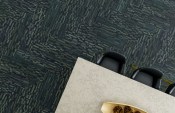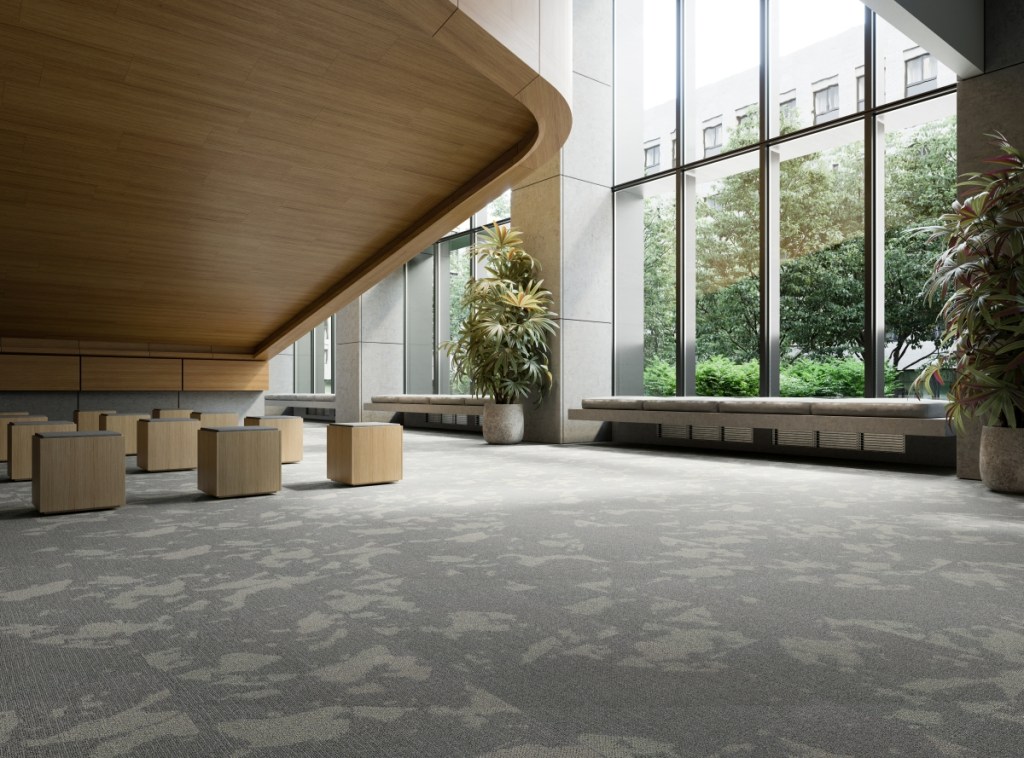
The principles of biophilic design—the innate human desire to connect with nature—have become mainstream, but few know the precise origin of one of its most powerful commercial applications: the Fractals Movement in commercial interior design.
Following the success of the company’s first Living Product, Lichen, Mohawk Group collaborated with designers Martin and Dr. Anastasija Lesjak of 13&9 Design. It was Martin who posed the pivotal question: “What if instead of copying nature, we learn how nature makes patterns?” That query set Mohawk Group on an entirely new path. The search led directly to physicist Dr. Richard Taylor of Fractals Research, whose work demonstrated that fractals—the self-repeating patterns found everywhere from tree branches to coastlines—can scientifically reduce human stress.
This unique collaboration—the ScienceDesignLab—immediately focused on translating pure science into carpet tile designs. After connecting with Dr. Taylor, the teams began holding in-person meetings to explore how his fractal dimension research could be applied to flooring. Their early work involved recreating patterns using software, referencing concepts like the Lévy flight pattern found in nature. They had to overcome the technical challenge of translating these complex patterns into carpet tile while ensuring the crucial fractal dimension was maintained even after cutting and installation.
As the work evolved, Mohawk Group collections like Relaxing Floors and Fractal Fluency expanded the application of fractals, with subsequent lines offering wider budget options. The third collection, Fractal Findings, showcased the next evolution by being specifically curated for K-12 education. Driven by firms such as PBK that were seeking stress-reductive spaces for students, the research revealed that specific mid-level fractal D-values are optimal for collaborative areas, while other, lower D-values are better for focused learning environments. This detailed curation of D-values based on the space’s function directly informs the growing understanding of neurodiversity, allowing the company to fine-tune environments to support diverse populations and their mental health needs in this post-COVID era.
Mohawk Group’s persistent approach—one that couples artistic vision with scientific validation—helped launch this design paradigm. While the initial challenge revolved around market education, the company’s transparent and open collaboration model established its authority, ensuring this Fractals Movement continues to gain momentum and shape healthier, more adaptive interiors.
Discover how Mohawk Group is shaping the future of restorative design.