Imagine entering an unusual forest at night. Although urban green spaces typically close after dusk, this forest within the Nagai Botanical Garden—a spacious park in southern Osaka, Japan—has come to life. After waiting in a long line of ticket-holders and traversing a tree-lined promenade, you plunge into a strange, vibrant thicket.
The woods here are illuminated by ambient, multi-hued lights that reflect off the underside of the tree canopy, and from large translucent eggs scattered among the trees. This once-familiar urban park has been transformed into an alien landscape, offering a completely novel experience for garden visitors.

Designed by the Japanese multimedia group teamLab, the Botanical Garden in Osaka represents one of the latest ventures by this innovative collective and extends the group’s immersive artwork beyond enclosed spaces. In their preoccupation with living media and environments, the Nagai Park installations—which represent teamLab’s foray into “digitized nature”—are markedly different from teamLab’s interior works. “teamLab’s art project Digitized Nature explores how nature can become art,” explains the group. “The concept of the project is that non-material digital technology can turn nature into art without harming it.” The marriage of immersive art and landscape represents a compelling direction with intriguing implications for human experience and ecological stewardship.
The integration of art in the landscape is nothing new. However, the development of immersive, light-based installations has been recently propelled by significant advances in programmable illumination, renewable power, and battery technologies. Nocturnal displays are popping up in various outdoor venues, several of which are in the U.S.
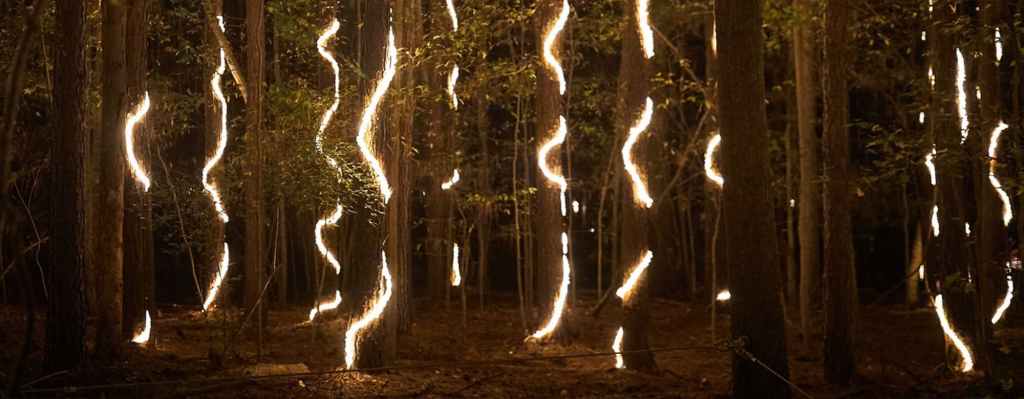
For example, Charlotte, NC-based artist Meredith Connelly began exhibiting illuminated artworks at the U.S. National Whitewater Center in 2019. Her 2020 “Moss” installation is a suspended cloud of 3,000 fiber optic strands that appears to float above the forest path.
The Paine Art Center and Gardens in Oshkosh, Wisconsin, began hosting “The Nature of Light” immersive light show in the Fall of 2022. The nocturnal festival features illuminated sculptural displays and environments throughout the four-acre site and historic mansion.
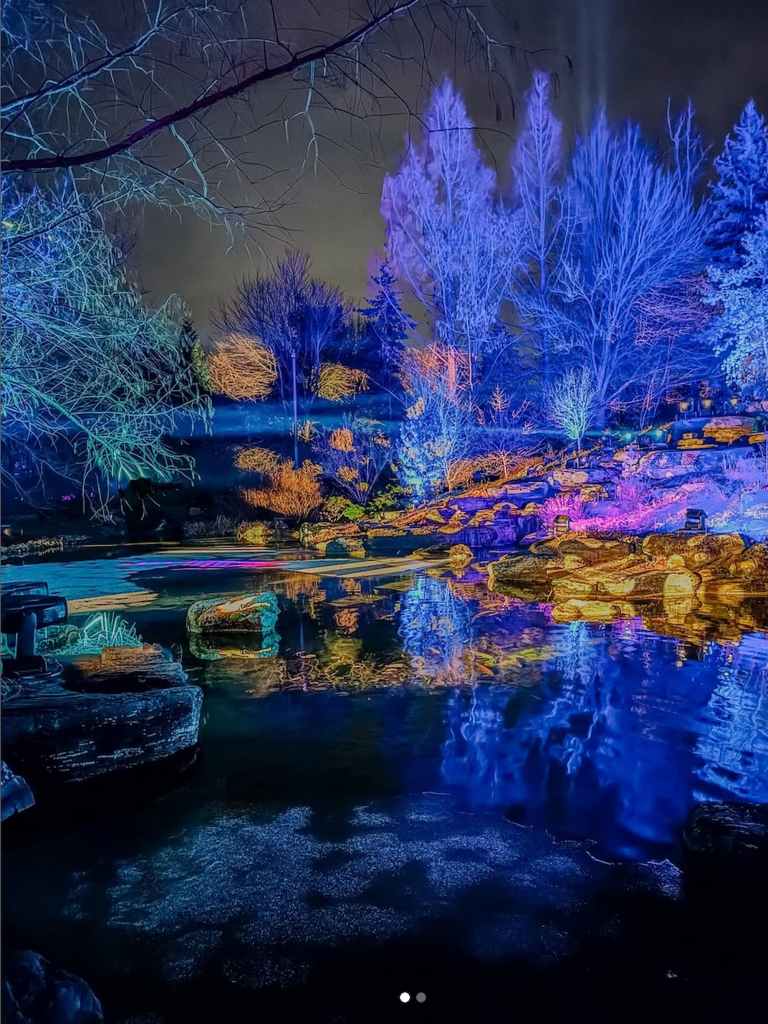
Last winter, the Frederik Meijer Gardens and Sculpture Park in Grand Rapids, Michigan, hosted “Enlighten,” described as “a stunning 1-mile pathway illuminated by innovative light displays, enchanting music, interactive experiences, and world-renowned sculpture.”
Outdoor light art is not only about aesthetics. New technologies also invite designers to test various functional applications as part of a movement that could be called “the quantified landscape.”
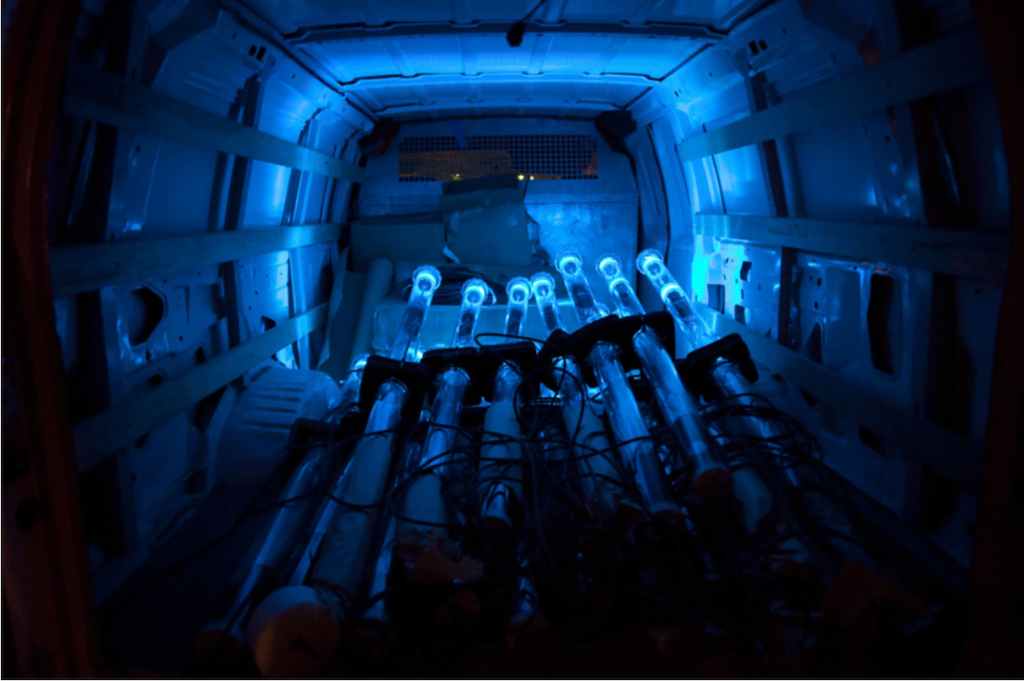
One example is The Living’s Amphibious Architecture, a riverine installation of water quality sensors connected to photovoltaic-powered colored LEDs. The micro-archipelago, launched at the junction of New York’s East and Bronx Rivers, is illuminated in different colors based on real-time changes in water conditions.

Studio Roosegaarde’s Grow is an immersive light project for agricultural applications. Based on photobiology science that demonstrates the effects of colored light on plant growth, the installation of flickering red and blue lights spanning a 20,000 m2 leek field is a “luminous dreamscape” with a utilitarian purpose. The studio has also experimented with illuminated orchids in the Glowing Garden project and Spark, a firework alternative composed of biodegradable light sparks.
As one approaches a clearing in the Nagai Botanical Garden, the alien pods grow larger, into inflated, luminous eggs about two to three times the height of an adult. Although semi-rigid, the eggs are sufficiently pliable to invite interaction. Visitors lose inhibitions and chase one another through the ever-changing egg maze with childlike glee.
Interaction and play are hallmarks of teamLab’s work. The artists’ installations promote physical and sensory engagement, team dynamics, and creativity. “Humans perceive the world with their bodies and think with their bodies,” explains the group, arguing that “spatial awareness, which is the ability to understand spatial relations between objects and store them in memory, is just as important as linguistic and mathematical abilities.”
As immersive design expands into the landscape, many benefits will likely result. Some installations will enhance sensory information and improve our awareness of ecological health. Other projects—such as the nocturnal garden in Osaka—will improve visitors’ spatial awareness and physical activity. In all cases, the artfully illuminated landscape sparks our curiosity and wonder, allowing us to be kids again.