
The undercroft beneath the sanctuary, where Latrobe meant to place a chapel, helps tell the story of his exacting vision and the ways in which it was thwarted. Latrobe resigned once because the builders disregarded his specifications and didn’t sink the foundation piers deeply enough. When Carroll persuaded him to return, he compensated with inverted brick arches, visible in the undercroft, to carry the massive dome’s load, much as spread footings might today.
Latrobe resigned a second time when, again, his design was ignored and wood joists were installed to support the church floor instead of a vaulted brick ceiling in the undercroft; that time, Carroll ordered the work redone with Latrobe’s vaults. Even so, the space became too shallow for a chapel. Waite’s team was able to test the depth of the piers and foundation walls with radar and underpin them to deepen the undercroft. After they removed the old, intrusive mechanical systems that filled the space and placed them outside the building in a new vault dug beneath the north yard, they were able to create the forsaken chapel.
The revelations of the most recent work have cast a certain irony on previous judgments of the building. In an essay accompanying the historic structure report, Charles Brownell, a professor of art history at Virginia Commonwealth University, cites the historian Henry-Russell Hitchcock’s opinion that “internally, at least, this is one of the finest ecclesiastical monuments of Romantic Classicism.”
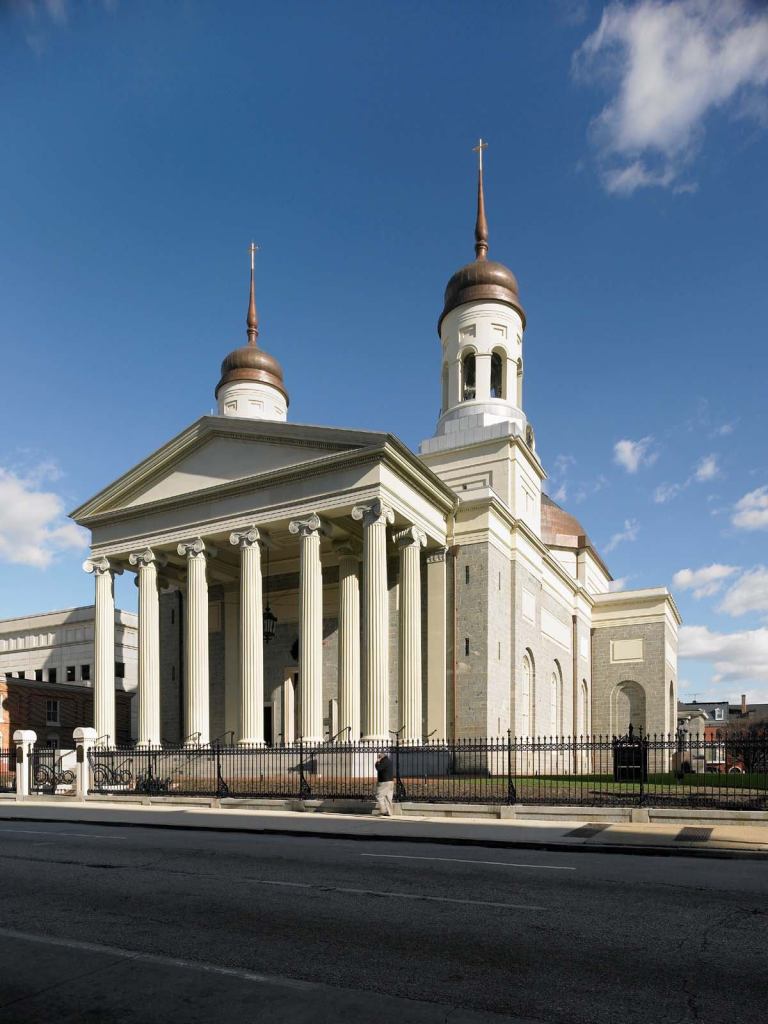
Hitchcock, however, took less pleasure from the exterior, believing that the Saracenic domes were “not of Latrobe’s design.” Yet it is likely that Hitchcock, whatever he found inside the church, was not even viewing Latrobe’s genuine article, whereas those onionlike domes with their slender finials—set perhaps to contrast and amplify the spherical power of the main dome—were entirely the architect’s own.
“For the first time, we know how Latrobe was putting together buildings, what materials he was using, and how inventive he was,” Waite says. “It’s not only his masterpiece, but his best-preserved building.”
Bradford McKee, a former senior editor at Architecture, is a freelance writer based in Washington, D.C.