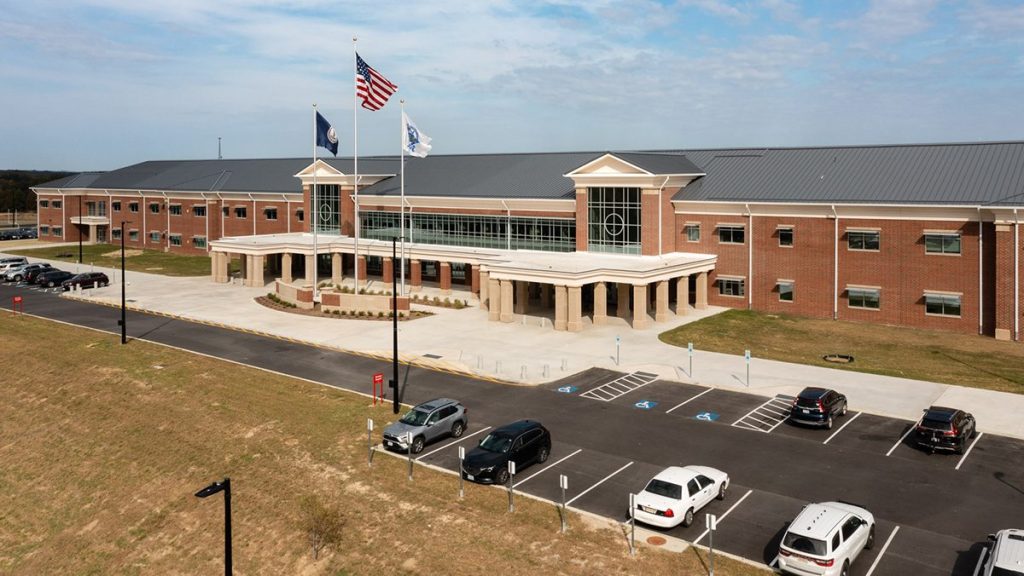
Each day, millions of students and educators enter facilities that may lack adequate defenses against contemporary challenges such as fires, severe weather events, or more importantly, security breaches. While discussions about school safety often focus on policies and emergency responses, the fundamental role of physical infrastructure is sometimes overlooked.
School design must prioritize the safety of students and staff above all else. For decades, concrete masonry units (CMU) have reliably fulfilled this crucial function. CMU construction provides ongoing protection through inherent fire resistance, durability, and resilience to storms, eliminating the need for frequent, costly upgrades.
“Our producer network constructs over 40 schools annually; educational facilities are central to the masonry industry,” says James Cain, president of the Southeast Concrete Masonry Association. “CMU provides sound insulation and offers protection against fire, storms, and high-velocity impact.” This proven reliability positions CMU as the preferred choice for environments where security, longevity and durability are paramount—including government buildings, healthcare facilities, and, increasingly, educational institutions.
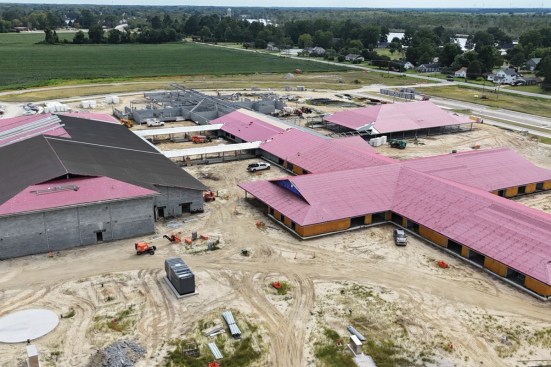
Perquimans County Intermediate School in Winfall, North Carolina
A recent white paper from the Southeast Concrete Masonry Association underscores several key advantages of CMU in school construction:
- Fire Containment: Fire safety requires that a wall not only halt the spread of fire from one area to another but also retain its structural integrity throughout the fire and fire-fighting operations. Concrete masonry is widely specified for fire walls and fire barriers because concrete masonry is noncombustible, provides durable fire resistance, and is economical to construct. Concrete block can be rated to withstand fire for up to four hours, depending on size (equivalent thickness) and aggregate type.
- Storm Resilience: Due to their substantial mass, buildings constructed with reinforced CMU demonstrate notable strength during natural disasters, including earthquakes, tornadoes, hurricanes, high winds, hail, and heavy rainfall. CMU structures designed to be storm shelters can endure winds reaching 250 mph and projectiles traveling at 100 mph. CMU structures remain the default refuge during severe weather drills, with many gymnasiums designed as fortified community shelters.
- Sound Transmission: CMU offers superior sound transmission class (STC) ratings, controlling noise both between rooms and within busy areas such as cafeterias or gymnasiums.
- Ballistic Resistance: Independent testing has shown that CMU walls withstand high-velocity impacts and ballistic threats. Given the unfortunate reality of school violence, architects and districts recognize their responsibility to select materials that ensure maximum safety.
Shelter in the Storm
Beyond security, CMU enables schools to serve as emergency shelters, accommodating the needs of entire communities. CMU constructions offer critical protection during severe weather, capable of resisting debris and wind speeds up to 250 mph when designed as a storm shelter.
“In numerous districts, CMU-built schools also function as emergency shelters for local residents.,” Cain says. “Educational facilities are the core of our communities and should be built to safeguard everyone who enters.”
Take the new Mecklenburg County Middle/High School Complex in Baskersville, Virginia. This two-story, 347,000-square-foot middle/high school facility was built with 750,000 CMU from Chandler Concrete, which owns block plants in Virginia. Cain adds, “It makes me extremely proud to see the hardworking men and women inside our member plants doing their part to make schools and communities safer every day. CMU can be designed to double as a storm shelter inside our schools for the entire community. CMU education among developers, architects, engineers, and districts is essential. Competing materials do not offer equivalent protection. Our children merit world-class products.”
Quiet, Durable, and Cost-Effective
CMU contributes to quieter learning environments by mitigating sound transfer, fostering focus, and academic success. Additionally, CMU’s low maintenance and extended lifespan promote cost efficiency.
Concrete block construction offers significant energy savings due to CMU’s high thermal mass, stabilizing interior temperatures throughout seasonal changes. As a result, HVAC systems operate more efficiently, lowering utility expenses and reducing the building’s operational carbon footprint.
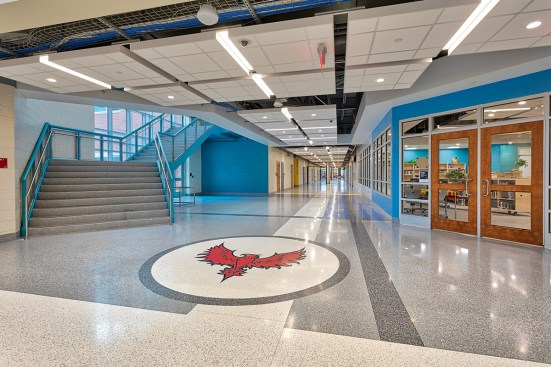
Mecklenburg County Middle/High School Complex in Baskersville, Virginia
Not Just Gray Block
Architects today have access to countless varieties of masonry units and alternative finishes such as thin veneers and stone-like surfaces. CMU enhances safety in classrooms, restrooms, and gyms with style.
The Block Design Collective (BDC), supported by the Concrete Masonry Checkoff, provides complimentary design assistance and technical guidance to architects, engineers, and builders seeking to optimize safety, durability, and efficiency in masonry projects. Further information is available at www.blockdesign.org.
Building for Future Generations
The forthcoming Perquimans County Intermediate School in Winfall, N.C., demonstrates ongoing innovation. Scheduled to open in May 2026, the $64.4 million, 158,000-square-foot facility will replace two existing schools and embody the district’s commitment to safety, excellence, and opportunity. “The new intermediate school will stand as more than a structure—it represents how the masonry industry is keeping students, educators, and communities in a safer place for tomorrow,” adds Cain.
WIMCO Corporation, together with Hite Associates, opted for masonry load-bearing construction based on economic considerations. Brett Hardy, owner of East West Products, notes, “The new facility will contain approximately 300,000 CMUs. We are proud to contribute to the safety of students and educators.” Currently, East West Products is providing CMU to three schools.
CMU Builds America’s Schools and Communities
The widespread use of concrete masonry in American schools reflects its reputation for strength, comfort, affordability, and sustainability. CMU construction provides robust protection from storms, fire, and stray bullets, while offering flexibility for modern design. Schools demand uncompromising quality, and concrete masonry consistently meets—and exceeds—these expectations, ensuring educational spaces will endure and thrive for future generations. For more information, visit beautyofblock.com.