
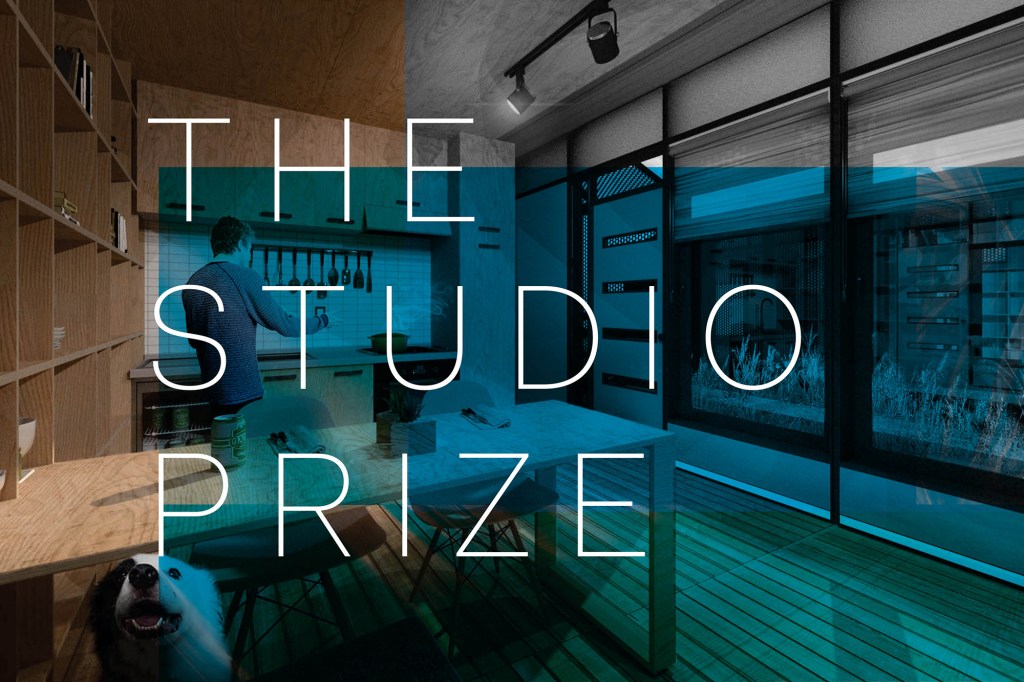
See all the winners of the 2019 Studio Prize.
Studio Brief | At the request of a state-level homelessness prevention organization, this studio researched the possibility of co-locating micro-housing—free-standing residences of between 150 and 400 square feet—to form “villages” that provide shelter and support for homeless veterans.
Investigation | In early 2018, the North Carolina Coalition to End Homelessness approached the NC State University architecture school with a problem, and a request: On any given night, more than 800 veterans are homeless across the state. Would the school be willing to investigate ideas for low-cost, high-quality housing that would offer easy access to community and health services?
Thomas Barrie, AIA, a professor who runs the school’s Affordable Housing and Sustainable Communities Initiative, took up the challenge. Bringing together 11 master’s-level students, he and his co-instructor, professor David Hill, AIA, created a semester-long studio to examine existing solutions for affordable and supportive veterans housing, and to assemble a “playbook,” which the client could then use to guide future planning and construction efforts statewide.
The studio began with the students dividing into two-person teams, each of which spent a month researching questions about the needs and habits of homeless veterans, commonly used materials, and so forth.
From there, each student developed their own design, drawing on the expertise of two visiting design professionals—Davin Hong, AIA, of Baltimore’s Living Design Lab, and Washington, D.C.–based Omar Hakeem, AIA, of bcWorkshop—both of whom have experience designing affordable micro-housing. Barrie also created an advisory committee composed of local homeless advocates, affordable housing experts, and designers who provided their own input as the students developed their projects.
“The studio reinforced for me the role that schools of architecture should play,” Barrie says. “Students should leave studios and programs like ours with a strong sense that architecture is a social art.”
Once the students left, Barrie and graduate assistant Alyssa Dohler compiled the student research and presentations into a 100-page book, which they delivered to the Coalition Against Homelessness in April 2019.
While the studio emphasized research over design, Barrie insists it is all part of the same whole. “Everything, even research, is design,” he says.
And the jury agreed: “It hits all the buttons it needed to hit,” said Carol Ross Barney. “It has interaction, it has social purpose.”
Student Projects |
Research and Engagement | Over the course of the semester, the 11 students conducted research into veteran homelessness and affordable supportive housing. Sponsored by the North Carolina Coalition to End Homelessness (NCCEH), the studio afforded students access to architects and designers who have worked on similar community designs, as well as to homeless activists. After conducting their research, the students worked individually and in teams to develop designs for micro-house village proposals, such as these by Ross Davidson and Katie O’Campo.

Ross Davidson

Katie O'Campo

Katie O'Campo

Katie O'Campo
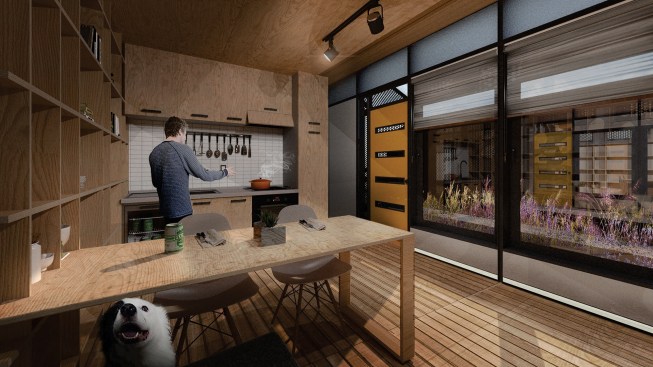
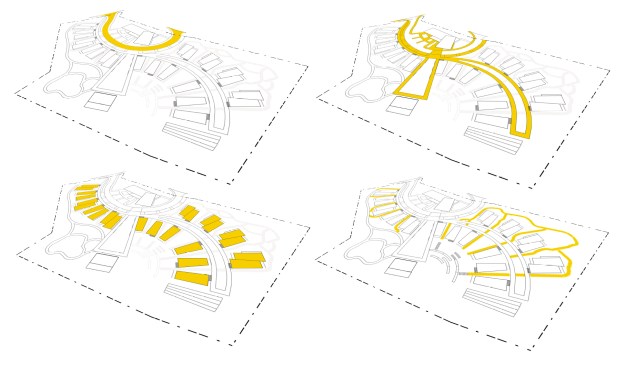
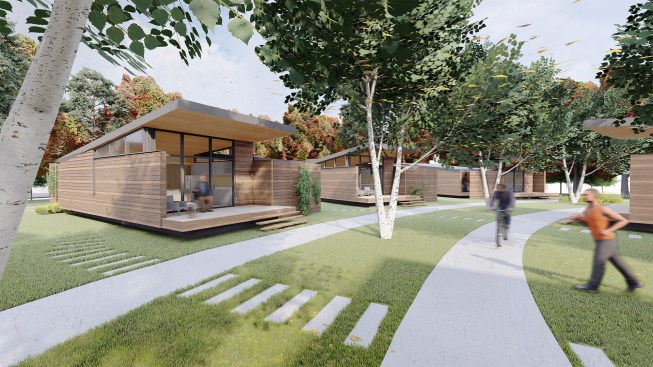
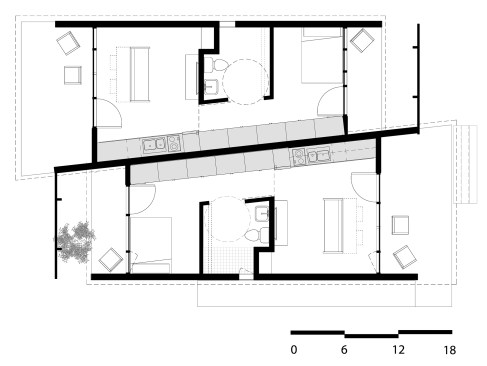
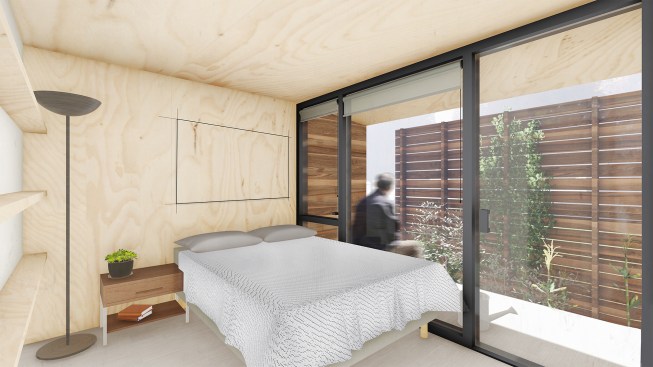
Micro-House Village Designs and Report | Each village plan had to incorporate housing units, a community house with social services, and outdoor programming such as sports fields and gardens, and the students generated a variety of documentation, such as individual unit floor plans that address unit adjacencies, renderings, and site plans. Examples of that documentation are shown here, by students Scott Needham, Austin Corriher, and Amelia Murphy. The proposals and research were then compiled by the professors and graduate research assistant Alyssa Dohler into a 100-page report designed by Master of Graphic Design student Katie Froebose that will be used for raising awareness and fundraising by the NCCEH.

Scott Needham

Scott Needham

Scott Needham

Austin Corrither
Austin Corrither

Amelia Murphy
Amelia Murphy
Amelia Murphy
Amelia Murphy
Amelia Murphy
Studio Credits
Course: Micro-Housing for Homeless and Disabled Veterans
School: NC State University, School of Architecture, College of Design
Level: Graduate and Senior Undergraduate
Duration: Fall 2018 semester
Instructors: Thomas Barrie, AIA (professor of architecture, academy of faculty engaged in extension); David Hill, AIA (professor of architecture, chair of the School of Architecture)
Project Sponsor: Terry Allebaugh (community impact coordinator, North Carolina Coalition to End Homelessness)
Project Research Assistant: Alyssa Dohler (M.Arch. student)
Report Designer: Katie Froebose (Master of Graphic Design student)
Visiting Experts: Davin Hong, AIA, Omar Hakeem, AIA
Advisory Committee: Andy Fox (associate professor of landscape architecture); David Harris (Wake County Human Services Housing Division); Mary Haskett (professor of psychology, CHASS); David Maurer, AIA (TightLines Designs); Lewis Sadler (Sadler Construction; Wake County Home Builders Association); Jeff Smith (NC Dept. of Health and Human Services); Abbie Szymanski (Partnership to End Homelessness)
Students: Austin Corriher, Ross Davidson, Alyssa Dohler, Kal Fadem, Assoc. AIA, Ryan Kilgannon, Elenor Methven, Justin McNair, Amelia Murphy, Scott Needham, Assoc. AIA, Katie O’Campo, Nicole Simeonsson, Assoc. AIA (work submitted)