
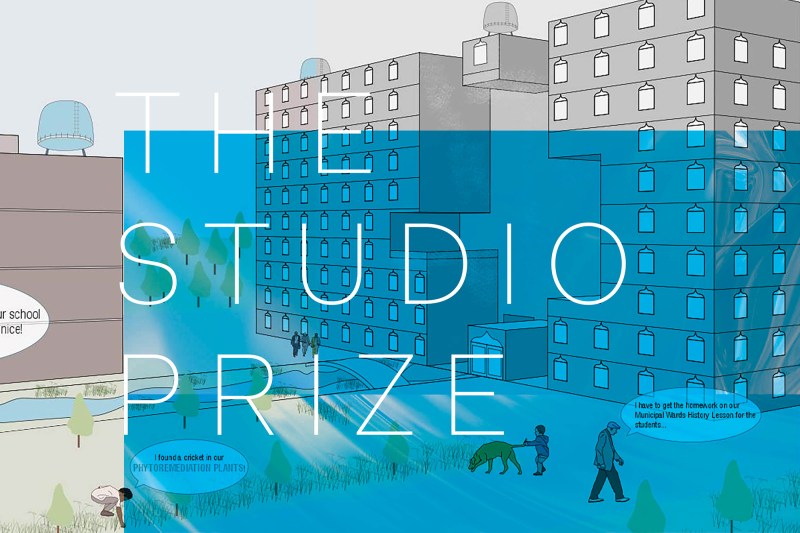
See all the winners of the 2019 Studio Prize.
Studio Brief | Using an international design competition as a prompt, this studio for first-year master of infrastructure planning students and advanced undergraduates created a master plan for redeveloping a postindustrial stretch of the Mumbai waterfront. The resulting proposal, “Hydrohoods of Tomorrow,” imagines a series of mixed-use districts planned around efficient and equitable uses of the city’s dwindling supply of fresh water.
Investigation | Mumbai is the largest city in India, at 18.4 million people, and it is expected to add another 20 million, or more, by 2050. Planning for that growth, in particular along the city’s waterfront, was the focus of the 2019 Schindler Global Award, an international student design competition that became the basis for a one-
semester studio at the New Jersey Institute of Technology. (Several students continued developing the scheme after the studio ended, and ultimately, it took fourth place in the competition.)
The studio focused on the city’s eastern waterfront, a once-bustling port area that fell into disuse after more-modern, container-based facilities opened elsewhere in Mumbai. Professor Georgeen Theodore, AIA, who led the studio, first had to train her 14 students to think at such a large scale, and to gather information on everything from Mumbai’s ecology to its government structures and politics. “That would be a big challenge for even the most seasoned professional,” Theodore says.
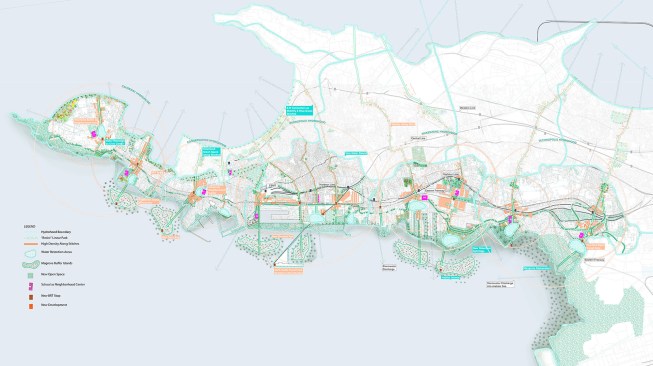
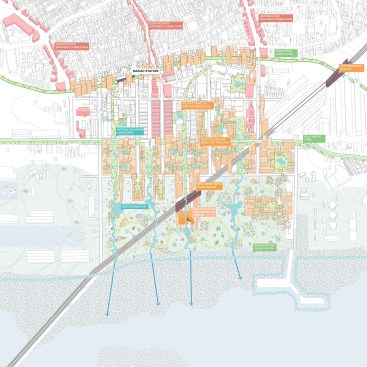
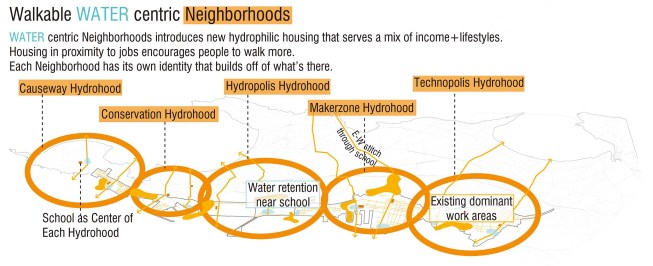
In the second half of the studio, the students worked together on a single master plan. They divided it into five “hydrohoods,” or mixed-use areas built around the collection, filtration, and reuse of water supplies at the neighborhood level. Parkland, interwoven among apartment blocks, provides open space for residents and rainwater catchment, while a shoreline mangrove forest provides a buffer against rising water levels.
“This is a visionary and systemic project that is not utopian,” said juror Thomas Fisher.
Part of what made the plan appealing was the work the students put into “selling” it to residents and developers. Since the hydrohood model might take decades to realize and would disrupt thousands of homes and businesses in the process, the students developed an advertising campaign to explain the project, as well as a narrative that relates the daily life of a hydrohood through the life of a young girl.
For Theodore, that exercise was about more than marketing—it forced students to think about their master plan at both the macro and the individual level. “I wanted them to see that the practice of architecture and urban design is interscalar,” she said.
Student Work |
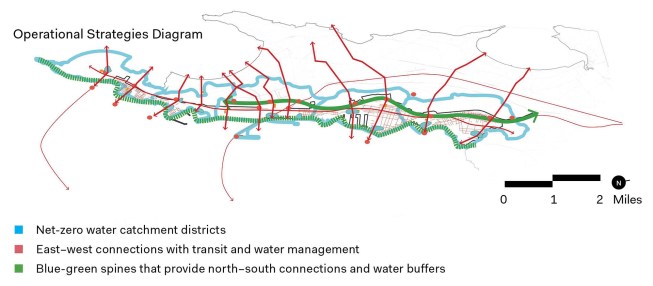
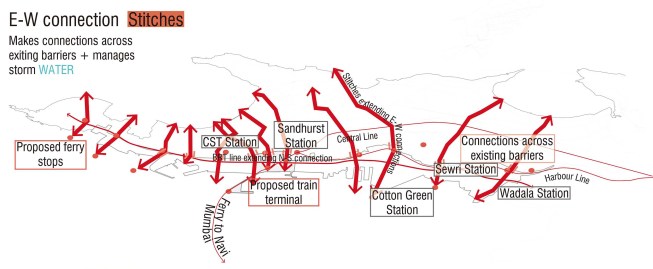
Designing the Hydrohood | The students’ proposal encompasses all of Mumbai’s eastern waterfront, and would develop several distinct hydrohoods, all connected by strategies for mass transit, water buffers, catchment areas, and stormwater management (above). Each hydrohood (an example of one is shown opposite) is designed as a walkable, water-centric neighborhood that creates a mixed-use landscape, more thoroughly integrating residential, commercial, and recreational typologies and connecting them all via a variety of transit options. The students developed schemes to rethink the grid to better address water catchment and management (below), with strategies as large scale as the citywide blueways and greenways and as small scale as water-retention areas on each parcel.
Courtesy New Jersey Institute of Technology, Hillier College of Architecture and Design
Courtesy New Jersey Institute of Technology, Hillier College of Architecture and Design
Courtesy New Jersey Institute of Technology, Hillier College of Architecture and Design
Courtesy New Jersey Institute of Technology, Hillier College of Architecture and Design

Courtesy New Jersey Institute of Technology, Hillier College of Architecture and Design

Courtesy New Jersey Institute of Technology, Hillier College of Architecture and Design
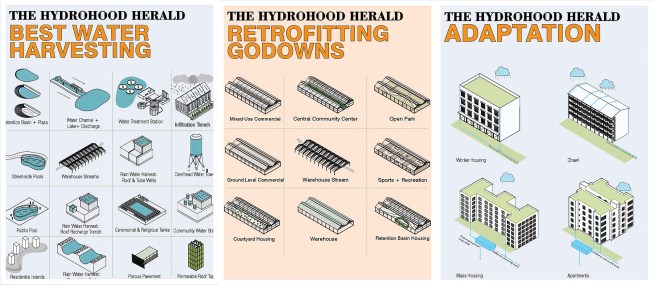
Socializing the Concept | Building out the students’ proposal for redeveloping Mumbai’s waterfront would take at least a generation and require buy-in from existing residents. To that end, the students created an advertising campaign of posters that can begin to socialize the concept of a hydrohood and the possibilities of retrofit and renovation to thereby change attitudes toward water use and collection.
Courtesy New Jersey Institute of Technology, Hillier College of Architecture and Design
Messaging | To further socialize the idea of hydrohoods beyond the advertising campaign, the students also developed “A Day in a Life of Paani, A Girl Growing up in the Hydrohood,” a comic strip that follows a young girl of the future who lives in one of the completely retrofitted neighborhoods. It shows what the new hydrohoods would look like, and introduces readers to the idea that hydrophilic housing, walkable neighborhoods, and widespread mass transit can exist in place of existing slums.

Courtesy New Jersey Institute of Technology, Hillier College of Architecture and Design

Courtesy New Jersey Institute of Technology, Hillier College of Architecture and Design

Courtesy New Jersey Institute of Technology, Hillier College of Architecture and Design
Studio Credits
Course: Moving Mumbai: Urban Frameworks for Mumbai’s Eastern Waterfront
School: New Jersey Institute of Technology, Hillier College of Architecture and Design
Level: Master of Infrastructure Planning (MIP), Year 1
Duration: Fall 2018 semester, plus independent study
Instructor: Georgeen Theodore, AIA (professor, program director of master of infrastructure planning)
Students: Rehma Asghar, Catherine Brito, Kassandra Castillo, Priti Dawadi, Matteo Ferraro, Joseph Giambri, Naymah Hashmi, Vishnu Shankar Krishnan, Christopher Long, Rebecca Morales, Melissa Nieves, Sean Rackowski, Chau Tran, Assoc. AIA, Bo Zhang (work submitted)