

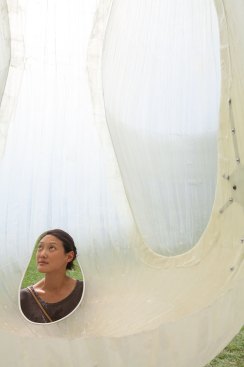
At the 2015 Design Biennial Boston, a cluster of curious, oblong vessels propped on a metal armature invited onlookers to pop their heads into an enclosure created by the intersecting volumes of their papier-mâché-like skins. The cluster of 8- to 10-foot-tall, 4-foot-diameter forms is titled Grove. Brookline, Mass.–based GLD Architecture designed the installation to give people the experience of simultaneously inhabiting an intimate enclosure and a public space.
Grove represents a significant advancement in architectural form-making. By combining composite-based structural analysis with inflatable vinyl forms, GLD has developed a workflow that embeds structural logic into design from the very start—and at a low cost.
Jane Messinger
Principal Joel Lamere says the pillow-like forms are designed materially, as opposed to identifying the appropriate construction materials after design is completed. The team used Grasshopper, the physics engine Kangaroo, and the structural analysis program Karamba to simulate how Grove’s forms would appear when inflated, which directly guided its fabrication. Patterns of vinyl sail material were cut and sewn into balloons that were inflated to act as the molds. These bulbous forms were then covered with layers of fiberglass strips and coated with resin. After an approximately 24-hour cure, the vinyl balloons were deflated and removed from the now-rigid fiberglass structures.
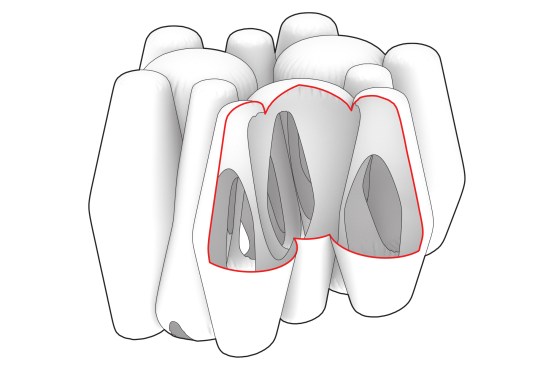
The digital simulation tools also informed the configuration of the 12 intersecting vessels, optimizing Grove’s overall stability. Just 2 millimeters thick, the curvaceous shells are incredibly sturdy. “It’s cladding and structure in a single surface,” Lamere says. GLD has used a similar molding process to create furniture.
The jury selected Grove as much for its intriguing design as for the ideas behind it. “The intelligence of this fabrication process results in a highly sophisticated, formal ensemble,” said juror Elizabeth Whittaker, AIA.
GLD Architecture
Cutaway view into Grove

Jane Messinger
See all the 2016 R+D Award winners here.
Client: Design Biennial Boston, Boston Society of Architects (BSA)
Design Firm and Fabricator: GLD Architecture, Brookline, Mass. · Joel Lamere, Cynthia Gunadi, Sophia Chesrow, Grigori Enikolopov, Zain Karsan, Dohyun Lee, Elizabeth Galvez (project team)
Drawings: GLD
Funding: Design Biennial Boston; GLD
Photography: Jane Messinger
Special Thanks: Rose F. Kennedy Greenway Conservancy, Boston Art Commission, Pinkcomma Gallery, BSA Space, Boston Mayor’s Office of New Urban Mechanics, David Costanza, Sixto Cordero, Caitlin Mueller, Steven O. Anderson, John Skibo, Matt Wagers, Chris Dewart, Christopher Gunadin